Oh…Poop!

Yes, poop happens. If there are birds there is poop. That is the straight poop… I mean scoop!

Royal Tern, Florida

Royal Tern, Florida

Some birds poop in mid-air which it is always wise to have your mouth closed when photographing birds directly over your head. A wide-brimmed hat is kind of handy too. I’m glad this Royal Tern banked when it did or I might have gotten bombed.

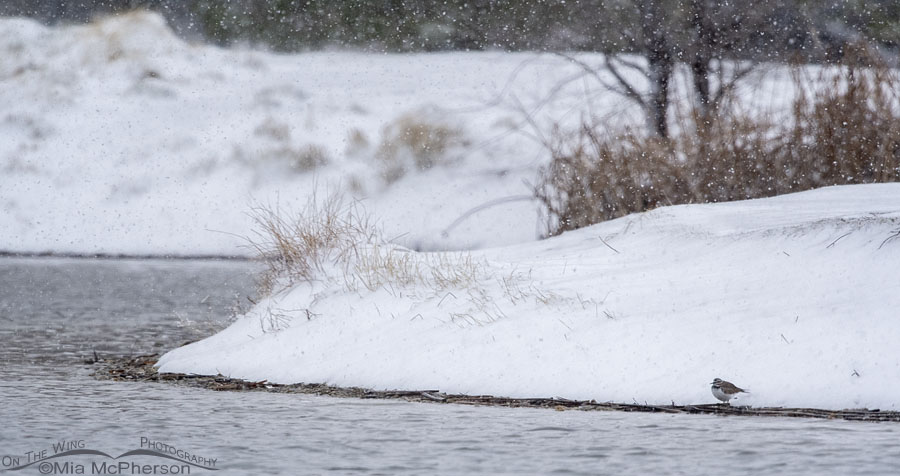
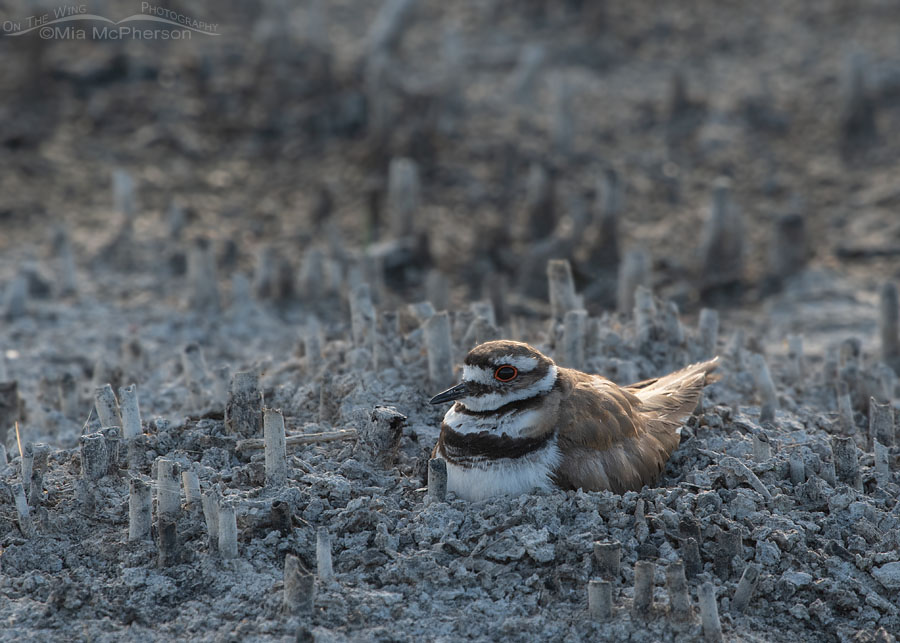
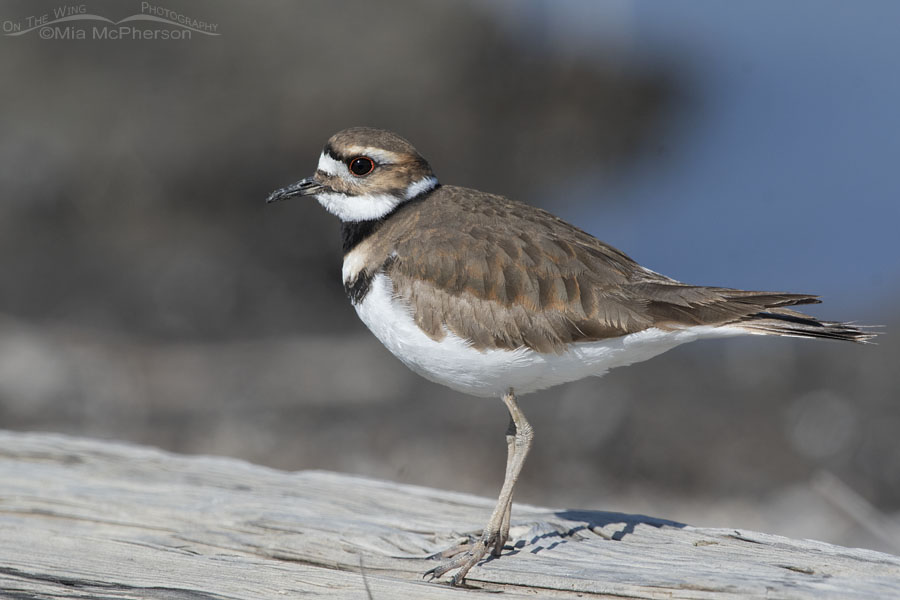
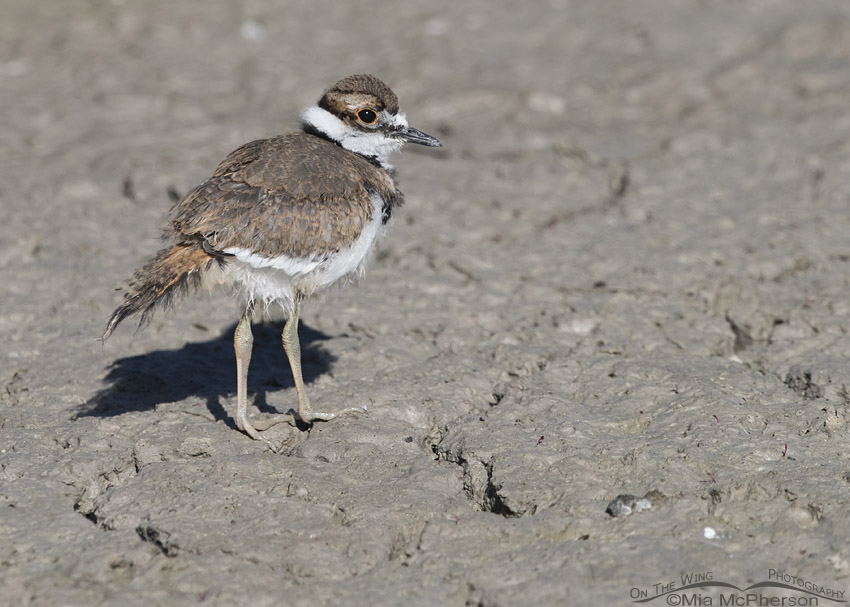
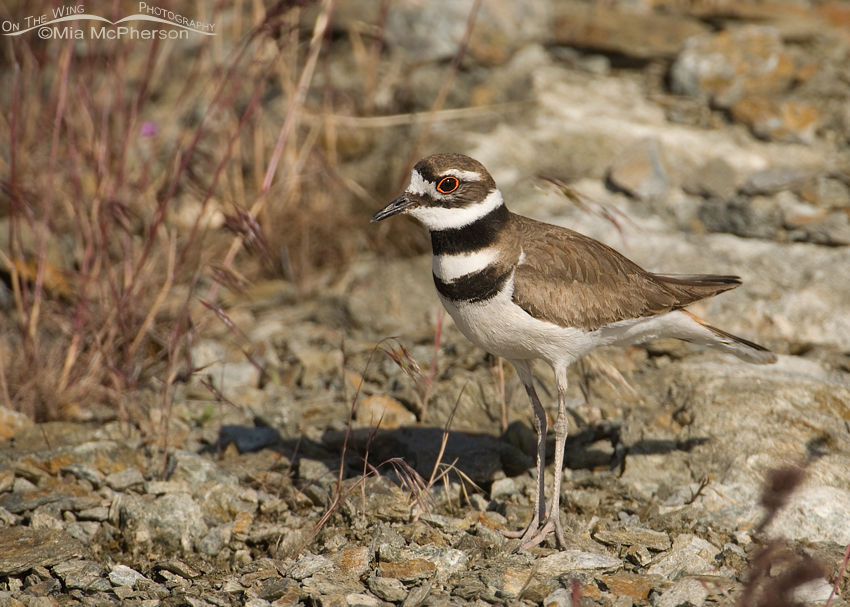
Killdeer, Utah

Killdeer, Utah

Some shorebirds will leave the water to poop, I’ve noticed that American Avocets always exit the water when they need to pooh. Some shorebirds poop so fast you don’t even notice it. Even with a shutter speed of 1/1600 I could not freeze the motion of this Killdeer’s poop, they must be the “fast as lightning” poopers.

Roseate Spoonbill, Florida

Roseate Spoonbill, Florida

I think that Roseate Spoonbills are Super Dooper Poopers, this bird looks like it grew an extra leg the stream of poop is so long!

Okay, enough talk about poop! (At least until the next Oh… Poop post)

Mia

Facebook Twitter Stumbleupon Digg Delicious Reddit Posterous Pinterest Email

Share

Killdeer – Wash, Fluff and Dry

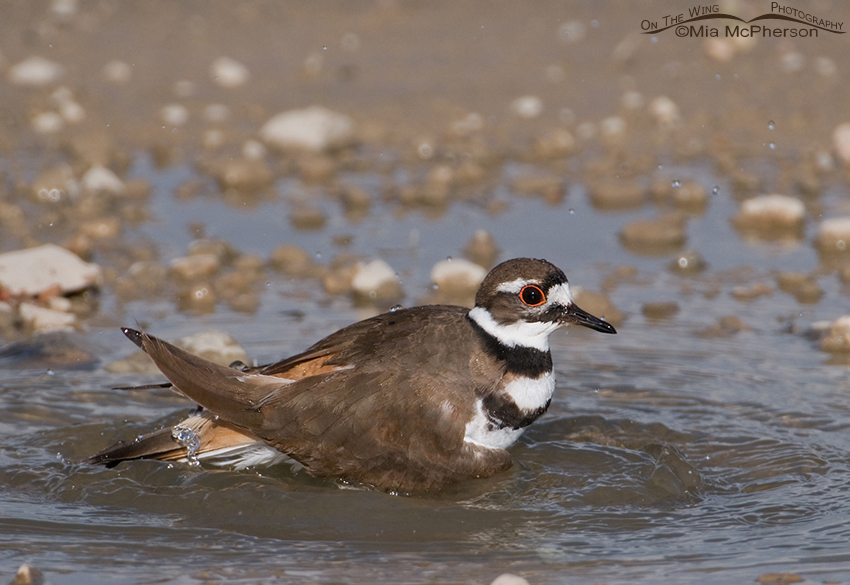
Last week I photographed a Killdeer (Charadrius vociferus) bathing at Farmington Bay Wildlife Management Area in Davis County, Utah. I was in a mobile blind (vehicle) and the shorebird was quite comfortable in my presence. I used my Nikon D300, resting on my Noodle, f6.3, ISO 400, Nikkor 200-400mm VR with 1.4x TC at 400mm, 0.0 EV and my shutter speed ranged from 1/1600 to 1/2000.
The images are posted in sequential order.

Killdeer bathing

Killdeer bathing

The Killdeer was bathing when we first pulled up and it stopped momentarily.

Killdeer bathing

Killdeer bathing

It soon began bathing again, vigorously. I like the flying water droplets and how the water is running off of the birds back.

Killdeer bathing

Killdeer bathing

The Killdeer would press its body into the water and then rise back up.

Killdeer bathing

Killdeer bathing

Then it would spread out its wings a bit.

Killdeer bathing

Killdeer bathing

Sometimes the Killdeer would dip its head into the water, twist it and fling water over its back. While I wish that some of the water wasn’t in front of the eye blocking the catchlight I am happy that the bird had its eye open in this frame. I love the action shown here.

Killdeer bathing

Killdeer bathing

The Killdeer also bobbed its body up and down without immersing its whole body.

Killdeer bathing

Killdeer bathing

I liked this image because I caught the bill open.

Killdeer bathing

Killdeer bathing

I like the great eye contact in this frame.

Killdeer bathing

Killdeer bathing

And the fluffed up feathers in this frame.

Killdeer bathing

Killdeer bathing

Even 1/1600 wasn’t fast enough to stop the motion blur of the feathers but it did freeze most of the water droplets.

Killdeer bathing

Killdeer bathing

Then the Killdeer stood up and called.

Killdeer bathing

Killdeer bathing

Turned its back and gave us an over the shoulder look…

Killdeer bathing

Killdeer bathing

And it began to preen.

Killdeer bathing

Killdeer bathing

I thought this was a funny pose.

Killdeer bathing

Killdeer bathing

And this one too!

Killdeer after the bath

Killdeer after the bath

The bird moved away from the water and gave itself a final fluff before it flew away.

Mia

More Killdeer images

Facebook Twitter Stumbleupon Digg Delicious Reddit Posterous Pinterest Email

Share

Mating Killdeer – Thanks to a Coyote

Last week I wrote about Long-billed Curlews having a Territorial Encounter but earlier that same morning I had another wonderful photographic encounter thanks to a scruffy looking, rain soaked Coyote waking up at the top of a ridge.
Scruffy Coyote just waking up

Scruffy Coyote just waking up - Nikon D300, f6.3, 1/2000, ISO 640, +0.3 EV, Nikkor 200-400mm VR with 1.4x TC at 400mm, natural light

After taking just a few images of the Coyote I caught some movement out of the corner of my eye and saw a Killdeer (Charadrius vociferus) perched on some rocks on the slope below where the Coyote had been.

Alert Killdeer

Alert Killdeer

I figured that the Killdeer wouldn’t be there long so I wanted to get a few photos of the bird as it perched on a boulder.

Killdeer on a rocky slope

Killdeer on a rocky slope

When the Killdeer moved to another location I was happy to have a different setting to photograph the bird in.

Killdeer going up the slope

Killdeer going up the slope

The Killdeer moved up the slope a little bit more.

Killdeer on scrape

Killdeer on scrape

It didn’t take long to realize the Killdeer was in the process of selecting a scrape because it was kicking things out of a small area.

Killdeer scraping

Killdeer scraping

The Killdeer lowered its breast to the ground  and scraped its feet, this behavior is part of the “Scrape Ceremony” performed by males and females.

Checking out the scrape

Checking out the scrape

The Killdeer left the scrape and seemed to be looking for something on the ground right next to it.

Killdeer going back to the scrape

Killdeer going back to the scrape

The Killdeer then went back to the scrape and lowered its chest to the ground again.

* The images above were taken using my D300 with the 1.4x TC attached at 400mm, all were taken at f6.3, o.0 EV compensation with shutter speeds from 1/2500 to 1/3200, ISO 640.

A Pair of Killdeer near the scrape

A Pair of Killdeer near the scrape

 Then I noticed movement just outside of my viewfinder and another bird moved down to where the first Killdeer was and I backed up my zoom to 357mm so that both birds fit easily into the frame with room to spare in case one of them spread their wings or lifted off.

Killdeer on a small rocky ledge

Killdeer on a small rocky ledge

The female Killdeer moved down towards a small pebble covered ledge.

*At this point I changed my aperture to f11, and the focal length to 400mm, my shutter speed dropped to 1/1000.

Male and female Killdeer

Male and female Killdeer

The male descended to the ledge.

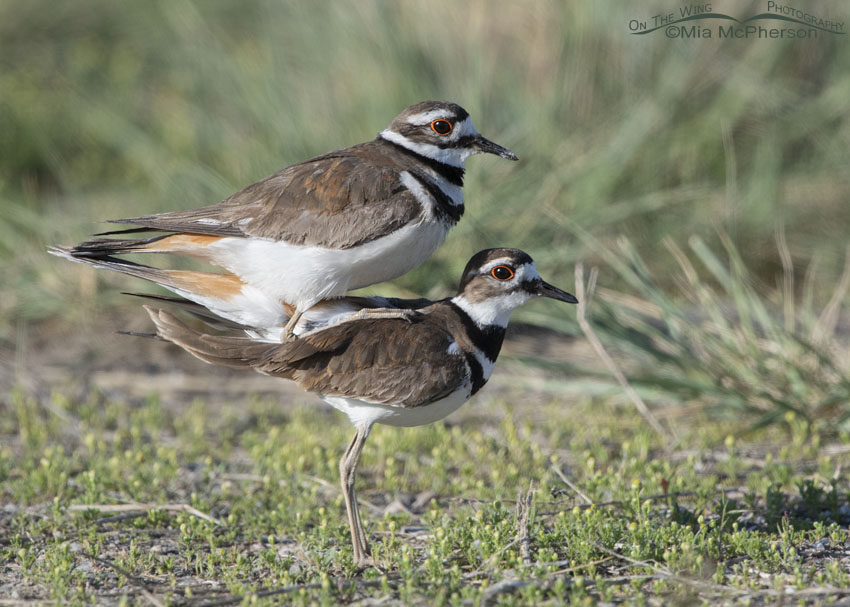
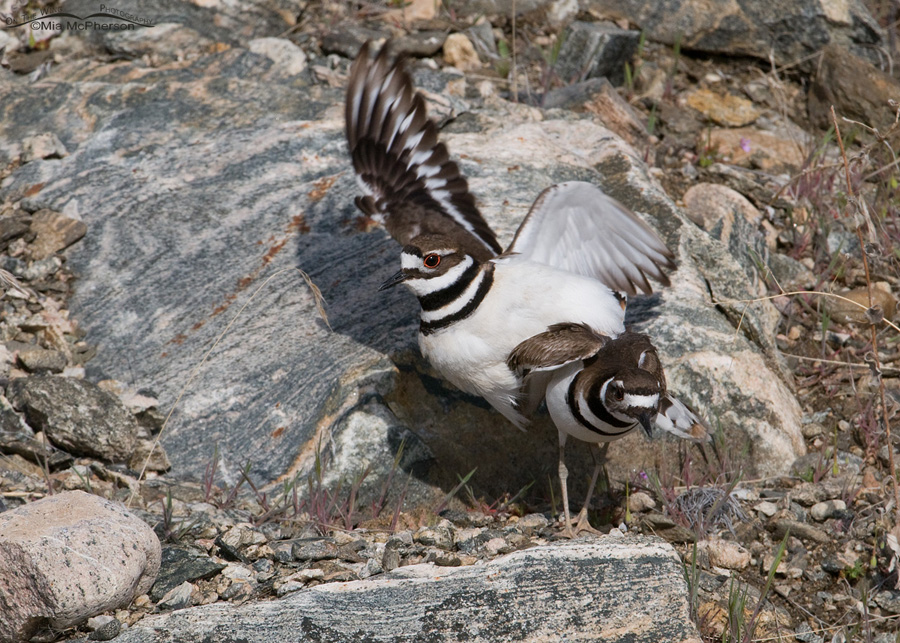
Male Killdeer mounting the female

Male Killdeer mounting the female

Then he mounted the female.

Killdeer mating

Killdeer mating

I wish the birds had been turned slightly towards the left side of the frame in the mating images to get more eye contact.

Male Killdeer about to dismount

Male Killdeer about to dismount

The male began to dismount.

Male Killdeer dismounting

Male Killdeer dismounting

Throughout this series I was very careful about not filling the buffer on my memory card, I didn’t want to miss any great action because the buffer was full.

Female Killdeer after mating

Female Killdeer after mating

When the birds had finished mating the male went up the slope and the female moved down it towards the road. I’ll keep an eye on this area to see if the Killdeer used this scrape to lay their eggs.

If it hadn’t been for the Coyote waking up after a rainy night on Antelope Island I may have missed seeing the Killdeer and creating this series of images.

Mia

Facebook Twitter Stumbleupon Digg Delicious Reddit Posterous Pinterest Email

Share

Wild and Wonderful – Antelope Island State Park – The Birds

This is the third post in my series about Wild and Wonderful Antelope Island State Park, I’ve saved the best (and longest) for last. The Birds! Okay, maybe they aren’t the best thing about Antelope Island State Park, but I am a bird photographer and they are what I am most passionate about!
Birds of Antelope Island:

Before I get to the avian life of the island I’d like to provide a link from UtahBirds.org that has a checklist of the birds of Antelope Island that is downloadable. If you need ID help for the birds found on the island UtahBirds.org has a great photo gallery of the various species put together by the wonderful Milt Moody that are contributed by local bird photographers that can assist in ID.

Upland Game Birds:

Feeding Chukar (Alectoris chukar)

Feeding Chukar (Alectoris chukar)
Nikon D200, f8, 1/1250, ISO 400, Nikkor 200-400mm VR with 1.4x TC at 400mm

Chukars are the most visible of the upland game birds that inhabit the island, they do not migrate so they can be seen all year round. Although they are not native to North America the Chukars on Antelope Island have adapted well to their adopted home. My first sighting of a Chukar in the wild was on Antelope Island and I am still as thrilled today to photograph them as I was on my first to the island.

Other upland game birds that can be seen on the island are Ring-necked Pheasants, California Quail and I’ve seen Sharp-tailed Grouse there as well. Thankfully the birds on Antelope Island are not hunted.

Gulls:

California Gull (Larus californicus) chasing brine flies

California Gull (Larus californicus) chasing brine flies
Nikon D200, f6.3, 1/1500, ISO 250, Nikkor 200-400mm VR with 1.4x Tc at 400mm

The Great Salt Lake and its surrounding marshes are a magnet for birds like gulls and terns. The Utah State Bird is the California Gull and it is often visible along the causeway to the island, the shoreline, in flight over the island and can also be found perched on the pavilions near the campgrounds and the Buffalo Grill.

I believe that although gulls are common they can be uncommonly beautiful photographed in the right light, in a great pose or interesting habitat.

Shorebirds:

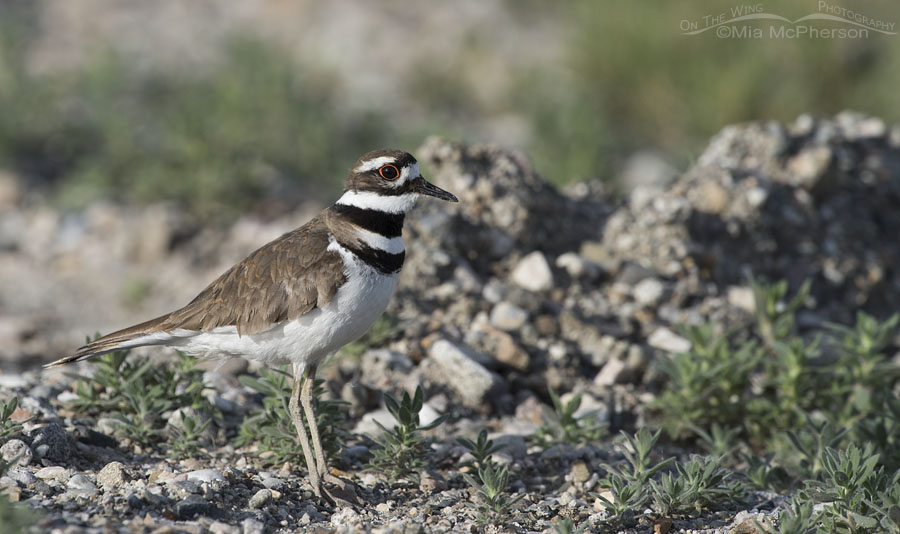
Killdeer on a rock
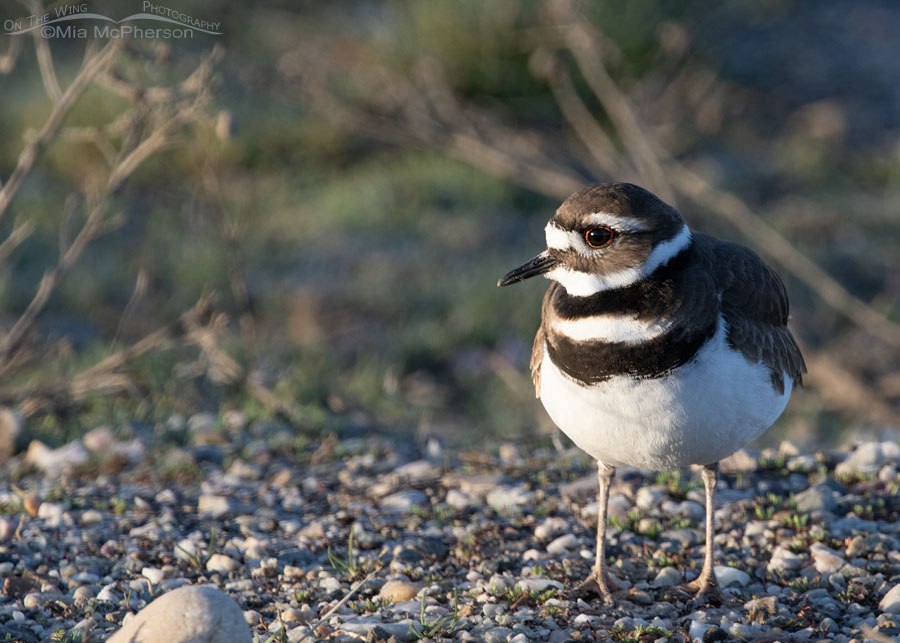
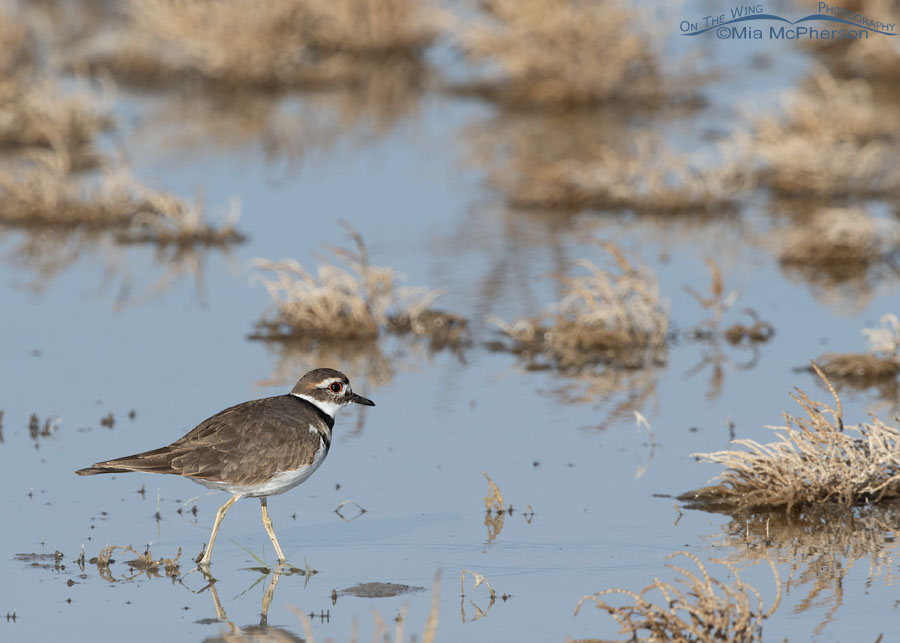
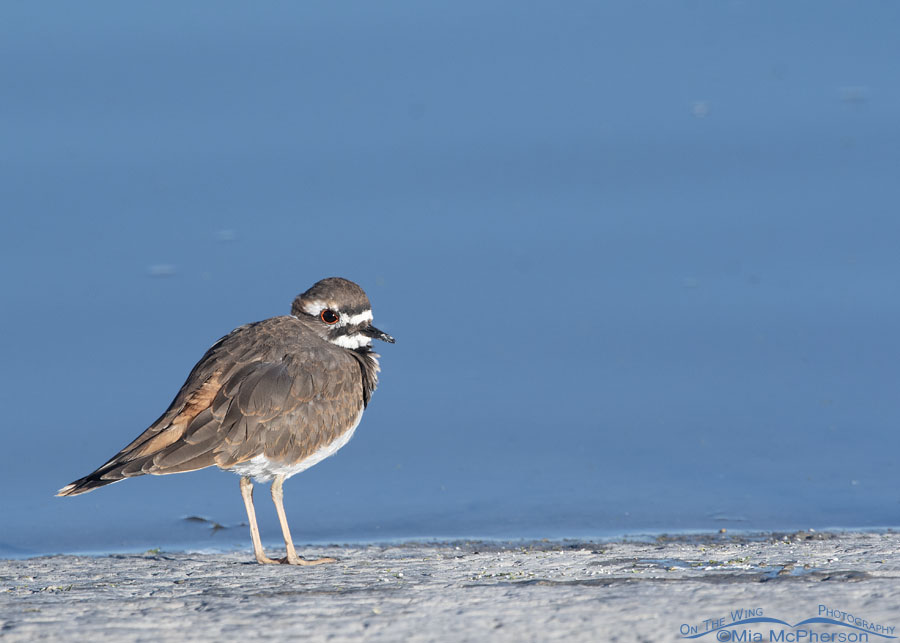
Killdeer (Charadrius vociferus) on a rock
Nikon D200, f6.3, 1/320, ISO 400, Nikkor 200-400mm VR with 1.4x TC at 400mm

There are many shorebirds that visit Antelope Island, the causeway to the island and the surrounding freshwater marshes, too many for me to post an image of each one so I will just post a few. I counted 35 on the checklist but some of those are rare vagrants, still that is a lot!

Some of the shorebirds are just passing through the Salt Lake Valley during their migration further north to their breeding ground, the Killdeer pictured above nests on the island along with several other species.

Willet (Tringa semipalmata) wing lift

Willet (Tringa semipalmata) wing lift
Nikon D200, f7.1, 1/750, ISO 400, 200-400mm VR with 1.4x TC at 400mm

Willets are another species of the shorebirds that nest on the island, prior to breeding season they can be seen quite often along the causeway but when they are nesting they can be seen in the grasses and on the rocks along the road. They let their presence be known by loud calling and wing displays. The bird above was displaying because another Willet was nearby and they don’t seem to care for intruders on their territory.

Male Long-billed Curlew (Numenius americanus)

Male Long-billed Curlew (Numenius americanus)
Nikon D200, f5.6, 1/640, ISO 400, Nikkor 200-400mm VR with 1.4x TC at 400mm

It won’t be very much longer before the Long-billed Curlews return to nest on Antelope Island and until I can hear their hauntingly beautiful calls. In Florida I never heard the calls of these graceful shorebirds, it is call that once you hear it, you’ll never forget it. I am very much looking forward to their return.

In the summer the calls of American Avocets and Black-necked Stilts can easily be heard along the causeway and their numbers are in the thousands (and thousands). There are just so many shorebirds present at times I can’t post a photo of them all but the checklist I linked to above shows all of the species.

Perching Birds:

Black-billed Magpie (Pica hudsonia) on nest

Black-billed Magpie (Pica hudsonia) on nest
Nikon D200, f6.3, 1/640, ISO 500, +1.0 EV, Nikkor 200-400mm VR at 380mm

There are also more perching birds on the island than I can list, I didn’t even try to count them so I’ll just post some images of the ones I see often like this Black-billed Magpie on top of its nest. Black-billed Magpies are great fun to observe and photograph at any time of the year. Some people call them noisy but as a bird lover their raucous calls are music to my ears.

Common Raven (Corvus corax) with nesting material

Common Raven (Corvus corax) with nesting material
Nikon D200, f6.3, 1/1500, ISO 400, +0.7 EV, Nikkor 200-400mm VR with 1.4x TC at 400mm

Common Ravens are in the Jay, Crow and Allies family along with the Black-billed Magpies and they are among the smartest birds in the world. They can bee seen flying all over Antelope Island, on the ground, perched on bushes or harassing other birds and animals. Just yesterday alone I saw them harassing Northern Harriers, a lone Coyote on a hill and a Rough-legged Hawk. Fiesty and fun!

Male Brewer's Blackbird (Euphagus cyanocephalus) displaying on sagebrush

Male Brewer’s Blackbird (Euphagus cyanocephalus) displaying on sagebrush
Nikon D200, f7.1, 1/500, ISO 400, Nikkor 200-400mm VR with 1.4x Tc at 400mm

There are several different species of Blackbirds present on the island which include Brewer’s Blackbirds, the bird above is displaying for a female who was just outside of this frame. I love the beautiful iridescence that can been seen in their plumage when the light is at the right angle.

Western Meadowlark (Sturnella neglecta) singing in early spring

Western Meadowlark (Sturnella neglecta) singing in early spring (low light)
Nikon D200, f6.3, 1/160, ISO 400, +1.0 Nikkor 200-400mm VR with 1.4x TC at 400mm

I don’t believe I have ever made a visit to Antelope Island without hearing or seeing Western Meadowlarks. Ever. During breeding season they seem unable to stop singing, you can tell they are trying to not sing but it just bursts forth anyway.  And when they are feeding nestlings it is not uncommon to see them with 25 or more bugs in their bills. I don’t know how they don’t drop them all.

Male Horned Lark (Eremophila alpestris)
Nikon D200, f6.3, 1/2000, ISO 400, Nikkor 200-400mm VR with 1.4x TC at 400mm

Horned Larks are also year round residents on the island, they delight me with their soft calls while perched on rocks and in flight. I love their subtle coloration, the little bit of yellow on their faces and those tiny little horns. They can be seen out in the open, feeding in the grasses, perched on signs and singing from the top of boulders that dot the island. I can’t resist taking photos of them.

Sage Thrasher (Oreoscoptes montanus) juvenile

Sage Thrasher (Oreoscoptes montanus) juvenile
Nikon D200, f9, 1/500, ISO 400, Nikkor 200-400mm VR with 1.4x TC at 400mm

Sage Thrashers are part-time residents of Antelope Island that breed and nest during the summer. Some years they show up in large numbers while other years there just aren’t as many. I love to see them flitting from one sage brush to another or perched on the boulders like the juvenile shown above. I miss them during the winter but I know I’ll get to see them again soon.

Perched Loggerhead Shrike (Lanius ludovicianus)

Perched Loggerhead Shrike (Lanius ludovicianus) in low light
Nikon D200, f6.3, 1/1000, ISO 400, +0.7 EV, Nikkor 200-400mm VR with 1.4x TC at 400mm

I am always tickled to see Loggerhead Shrikes on the island and normally I hear them just before I see them. They are classified as “songbirds” and they really do sing but to me they look and act like small raptors. They are fierce, aggressive and very interesting birds. During the winter their cousins; the Northern Shrikes can also been seen on the island, this winter I have seen a few but too far away to get decent images of them.

There are sparrows, doves, warbler, wrens, vireos, tanagers and many more perching birds that live on or visit Antelope Island, it is such a bird magnet!

Pelicans:

American White Pelicans (Pelecanus erythrorhynchos) in flight

American White Pelicans (Pelecanus erythrorhynchos) in flight
Nikon D200, f7.1, 1/1000, ISO 250, Nikkor 200-400mm VR with 1.4x TC at 400mm

American White Pelicans breed in the Great Salt Lake area and it isn’t uncommon to see large flocks of them soaring in the thermals on clear days. These are huge birds with wingspans of up to 108 inches, nearly 30 inches longer than their relative the Brown Pelican. They are graceful and beautiful in flight.

Their cousins; the Double-crested Cormorants, are also seen in flight over the island from about March until late fall.

Ducks and Grebes:

Green-winged Teal (Anas crecca) with Northern Shovelers (Anas clypeata) in the surf of the Great Salt Lake

Green-winged Teal (Anas crecca) with Northern Shovelers (Anas clypeata) in the surf of the Great Salt Lake
Nikon D300, f6.3, 1/2000, ISO 640, Nikkor 200-400mm VR with 1.4x TC at 400mm

Swans, geese and many species of ducks can be found in the waters of the Great Salt Lake and nearby freshwater marshes, I counted 29 of them on the bird checklist for Antelope Island.  Autumn and winter is awesome for seeing ducks along the causeway which sometimes number well over thousands within plain view.

For my Florida friends:  yes, we actually get surf on the Great Salt Lake when the winds are strong and our ducks seem to enjoy surfing!

Other water birds that can be sen on the lake are five species of Grebes, American Coots and occasionally Common Loons.

Hawks, Eagles and Falcons: 

Northern Harrier (Circus cyaneus) male in flight

Northern Harrier (Circus cyaneus) male in flight
Nikon D300, f9, 1/1000, ISO 640, +1.3 EV, Nikkor 200-400mm VR with 1.4x TC at 400mm, not baited

Antelope Island State Park is home year round for Golden Eagles and Bald Eagles are a common sight during the winter with fly overs and Bald Eagles sitting on the ice of the Great Salt Lake. Northern Harriers are year round residents that cruise along the causeway to the island, near the shorelines and over other areas of the island itself. Northern Harriers prefer voles as their diet and there must be plenty of those around to support the numbers of harriers that I have seen.

Osprey are seen flying over the island during migration, they don’t fish in the Great Salt Lake because it is too saline for fish to live in but they do fish in the surrounding freshwater marshes and ponds.

Rough-legged Hawk (Buteo lagopus) in flight

Rough-legged Hawk (Buteo lagopus) in flight
Nikon D300, f6.3, 1/2500, ISO 640, +0.3 EV, Nikkor 200-400mm VR with 1.4x TC at 285mm, not baited

Rough-legged Hawks have been plentiful on the island this winter and I have been overjoyed with that happening. I have been able to observe them hunting, hovering, eating, perching, having aerial fights with each other, swooping towards their prey and in flight. I have learned much more about this species habits because they have been so abundant.

Other hawks that are found on the island include Sharp-shinned, Cooper’s, Red-tailed and Swainson’s Hawks.

American Kestrel (Falco sparverius) male

American Kestrel (Falco sparverius) male
Nikon D200, f7.1, 1/350, ISO 400, +1.0 EV, Nikkor 200-400mm VR with 1.4x TC at 400mm, not baited

Then there are the Falcons of Antelope Island. This beautiful little American Kestrel male was perched on a snow covered shrub while keeping an eye on me. They are the smallest falcon in North America but I don’t think they know that, I’ve seen them dive bombing much larger birds than themselves. Feisty and small, that is what my mother used to say about me.

Peregrine Falcon (Falco peregrinus) on prey in low light

Peregrine Falcon (Falco peregrinus) on prey in low light
Nikon D300, f7.1, 1/200, ISO 640, -0.3 EV, Nikkor 200-400mm VR with 1.4x TC at 400mm, not baited

Peregrine Falcons are permanent residents of the Antelope Island area, during warmer months they often feed on a variety of shorebirds and during the winter they eat ducks like this Northern Shoveler. Inflight they are very challenging to photograph because they fly so fast. This falcon wasn’t bothered by my presence as it ate but it did keep an eye on me at times.

Juvenile Prairie Falcon (Falco mexicanus) in early morning light

Juvenile Prairie Falcon (Falco mexicanus) in early morning light
Nikon D300, f6.3, 1/2000, ISO 640, +0.3 EV, Nikkor 200-400mm at 400mm, not baited

Prairie Falcons are another year round resident of the area and I have had a great time this winter photographing them. Until this winter they were a nemesis bird for me, always too far away to get good photographs of, but they are a nemesis no more.

Merlins are seen during the winter on the island and the causeway, I’m still working on getting some images of them from the Antelope Island area.

Owls:

Adult Barn Owl (Tyto alba) in flight

Adult Barn Owl (Tyto alba) in flight
Nikon D200, f6.3, 1/640, ISO 400, Nikkor 200-400mm VR with 1.4x tc at 400mm, not baited

Barn Owls nest on the island and nearby locations, when the adults are feeding chicks they can be seen in flight during daylight. When we have a hard winter (and this year we are not) they can be seen hunting all day long. This Barn Owl was hunting near the beginning of the causeway to the island which is marshy and it has the mud on its feet from pouncing on prey.

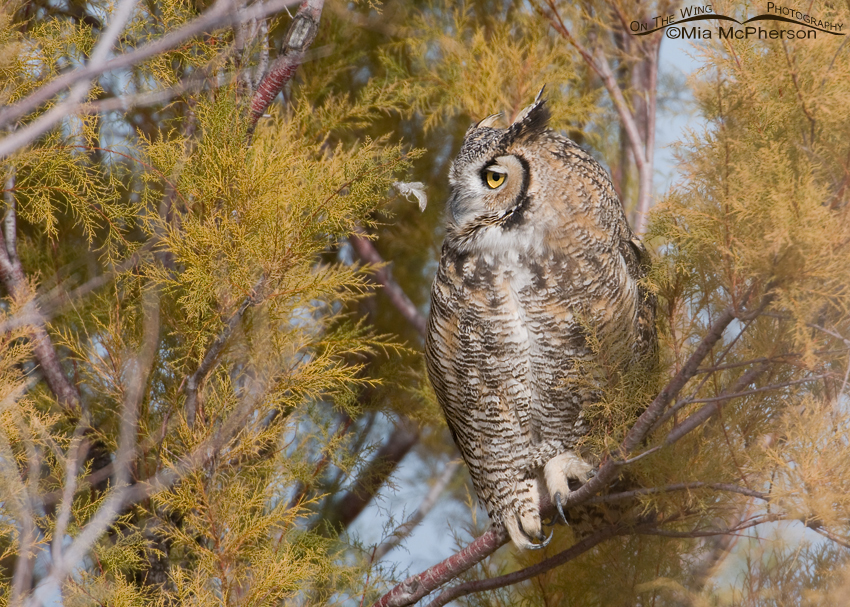
Great Horned Owl (Bubo virginianus) adult

Great Horned Owl (Bubo virginianus) adult
Nikon D300, f6.3, 1/1000, ISO 400, Nikkor 200-400mm VR with 1.4x TC at 400mm, not baited

Great Horned Owls can be seen and photographed in several locations on the island and are permanent residents. Since I was a child I have always been fascinated by Great Horned Owls so I am always thrilled to have an opportunity to photograph them.

Juvenile Burrowing Owl (Athene cunicularia) flapping its wings

Juvenile Burrowing Owl (Athene cunicularia) flapping its wings
Nikon D200, f6.3, 1/1600, ISO 400, Nikkor 200-400mm VR with 1.4x TC at 400mm

I simply adore Burrowing Owls, they are little, cute, funny and stunningly beautiful. They are a pleasure to photograph and because they are often very animated it can be hilarious too. I have had to hold my breath to squelch my laughter at times just so my camera and lens wouldn’t shake.

Other Owls that are seen on Antelope Island are Short-eared and Long-eared Owls. Northern Saw-whet Owls have also been seen and this winter there was a Snowy Owl reported along the causeway which turned out to be “A One day Wonder”, I would have loved to have a few images of that visitor from the Great White North. Maybe another year.

There are other birds of Antelope Island whose images aren’t here, there are simply too many for a blog post. Perhaps I should create a book.

Thanks for looking at the series of images and my thoughts from Wild and Wonderful ~ Antelope Island State Park!

Mia


* If you are in the Great Salt Lake Area from May 17th through the 21st (2012) you may want to consider visiting the Great Salt Lake Bird Festival which includes events on Antelope Island State Park.  For more information please click on the graphic below.

Great Salt Lake Bird Festival

Facebook Twitter Stumbleupon Digg Delicious Reddit Posterous Pinterest Email

Share

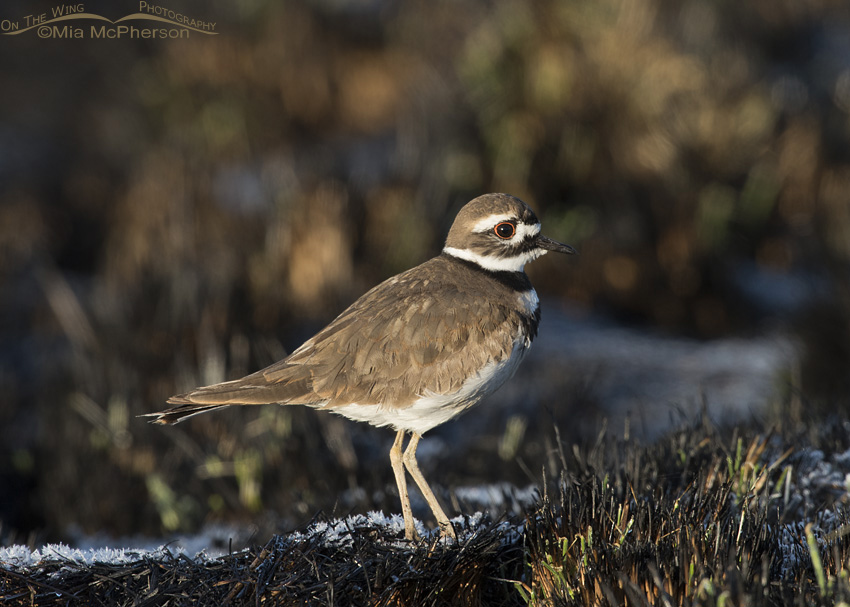
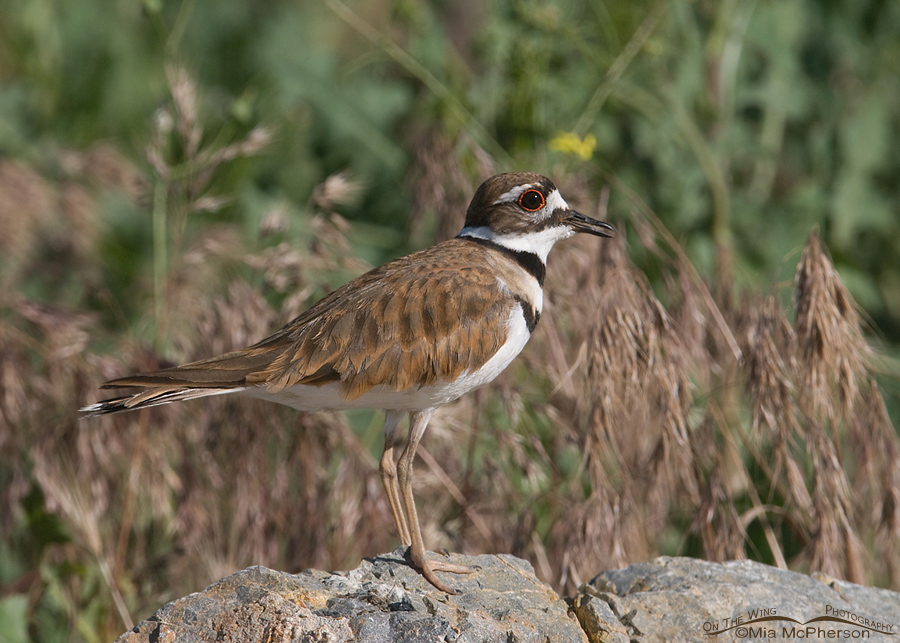
Killdeer Calling in Habitat

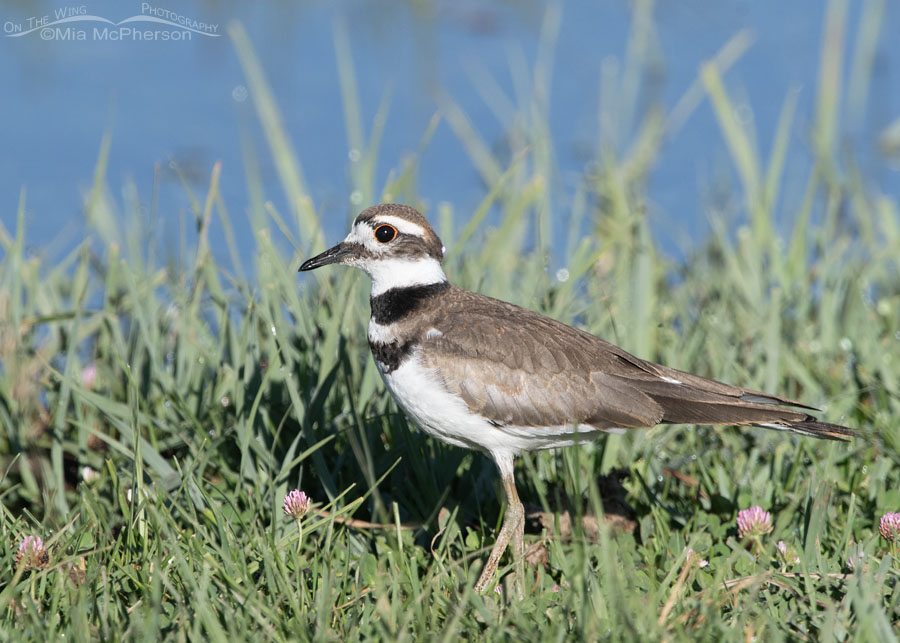
Adult Killdeer calling

Adult Killdeer (Charadrius vociferus) Calling
Farmington Bay WMA, Davis County, Utah
Nikon D200, f9, 1/800, ISO 400, -0.3 EV, Nikkor 200-400mm VR with 1.4x TC at 280mm, natural light

As a “Nature” photographer one of my goals is to create  images that show the bird or animal’s natural habitat within the frame which is why the photograph above is very appealing to me.

I enjoy the green hues of the of the vegetation combined with the drying seed heads of the grasses behind the Killdeer and the one little yellow area of out of focus flowers because they all give me an idea about the location where the picture was taken.

I used f9 for my aperture because the Killdeer was fairly close and I wanted enough depth of field to get the entire bird sharp. I was fortunate that the grasses and other vegetation were several feet behind the bird or they would have been more in focus and might have competed visually with the Killdeer.

I dialed in some negative exposure compensation because the whites in the light I had could have easily been blown out,  using just-0.3 EV controlled the whites well.

I suspect that the bird was calling because of an approaching motorcycle, just before the motorcycle got to the area the Killdeer took off.

Mia

More Killdeer images

Facebook Twitter Stumbleupon Digg Delicious Reddit Posterous Pinterest Email

Share