
I was photographing one evening in Florida while laying in the mudflat of a tidal lagoon, there were Dunlins, Black-bellied Plovers and Greater Yellowlegs in front of me where the evening light was great.
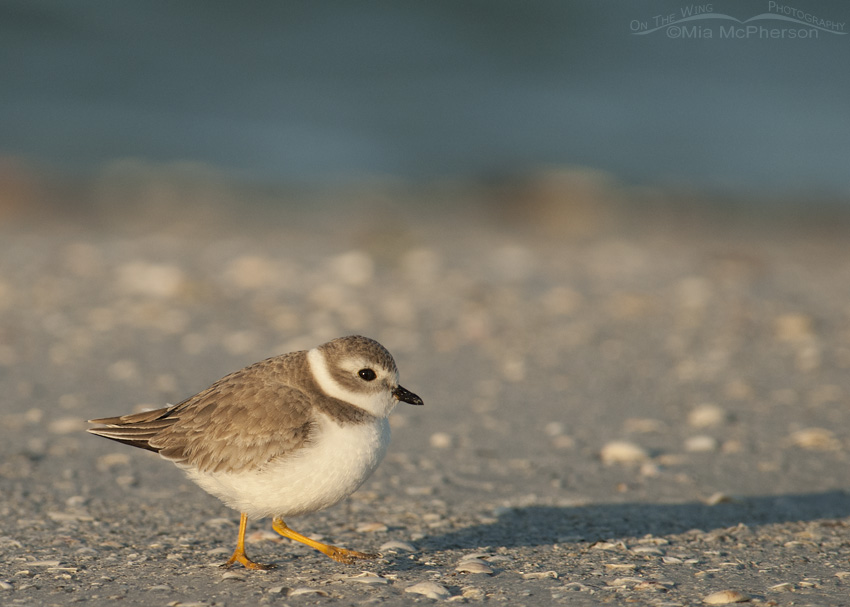
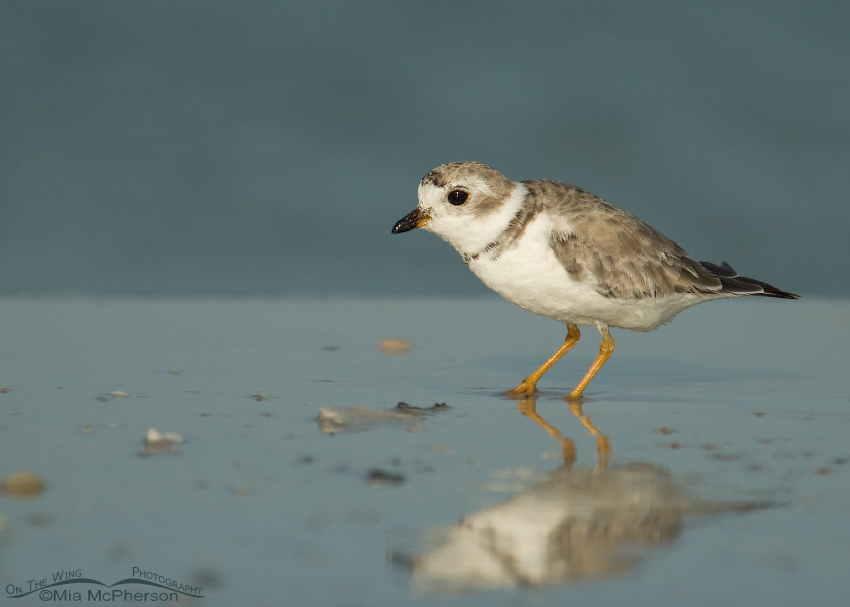
Sidelit Piping Plover – Nikon D200, handheld, f7.1, 1/640, ISO 160, Nikkor 80-400mm VR at 400mm, natural light
Out of the corner of my eye I caught a bit of movement and turned my head towards what I could see was a Piping Plover (Charadrius melodus) looking for prey in the mudflats. The light was not what most photographers would call “great“, the plover was below a dune and the angle of the sun in the west caused the bird to be sidelit.
Some photographers would pass on the shot because of the “tough”, “harsh” or “contrasty” light, but I simply couldn’t pass up the opportunity.
Even though the sun wasn’t behind my shoulder and the light wasn’t golden this image has a great mood to it. I know I could have used flash to brighten up the bird and the setting but if I had it certainly would not be this moody, besides; I very rarely use flash.
This Piping Plover image reminds me to try to photograph birds in other than perfect light. Sidelit and backlit images can be spectacular so I don’t like passing up taking the chance that I might just get a great shot despite what some photographers think of as bad light.
When photographing shorebirds I like to get down to their level which usually means I am getting dirty. I will lay on the sand, mud, grass or get as low as I can in the water to get a low angle perspective. It can bring the viewer into the bird’s world but as a bird photographer I enjoy sharing that space with them too because it gives me a sense of intimacy with my subject.
These images were taken at Fort De Soto County Park in Pinellas County, Florida.
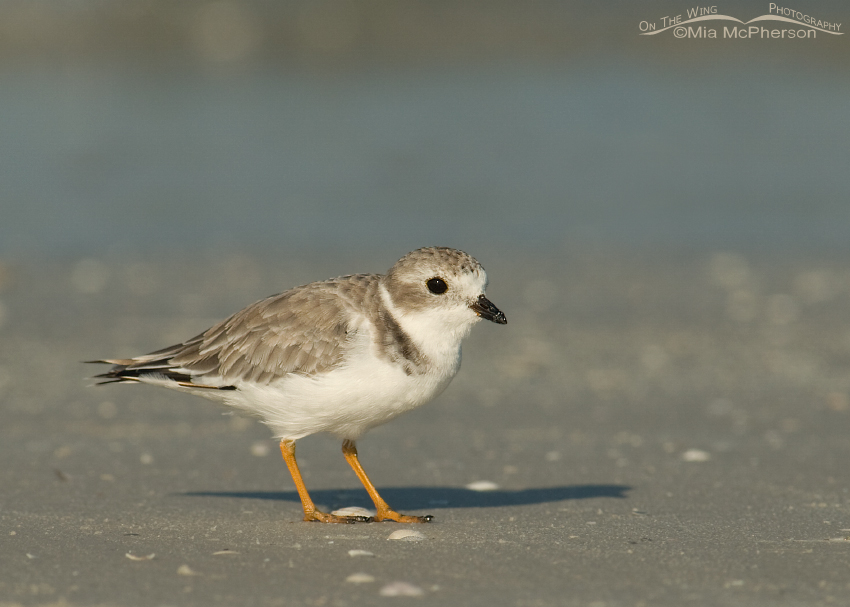
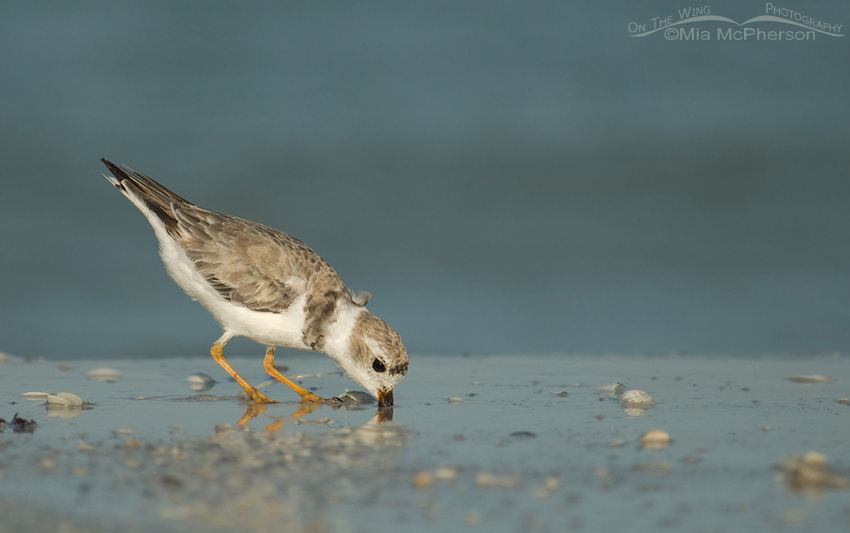
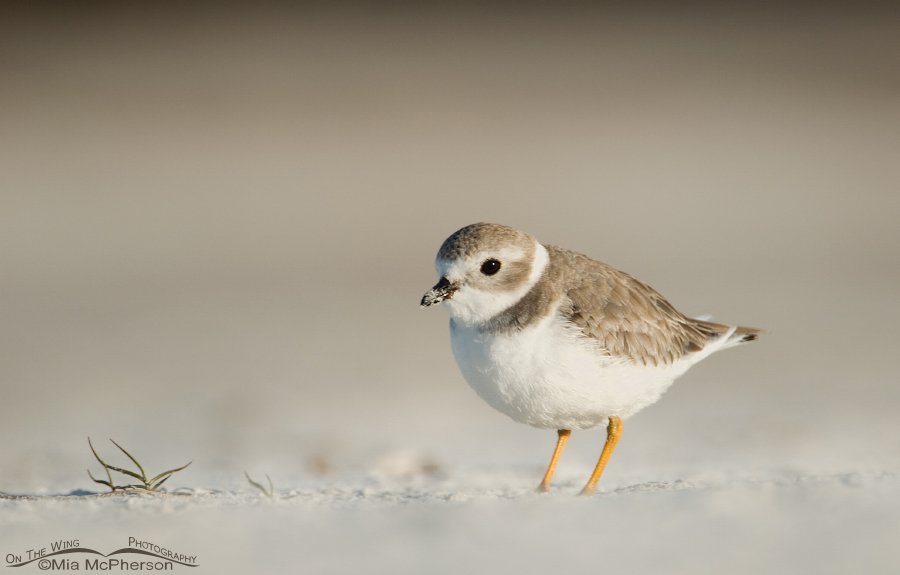
Feeding Piping Plover (Charadrius melodus) – Nikon D200, handheld, f5.6, 1/2000, ISO 320, Nikkor 80-400mm VR at 400mm, natural light
Piping Plovers are small, pale shorebirds, they are about 7 1/4 inches in length with a wingspan of 19 inches. They can live up to 11 years. Their status is vulnerable throughout much of their range. There are two subspecies, one that is found along the Atlantic and Gulf coastlines and the other is an inland species.
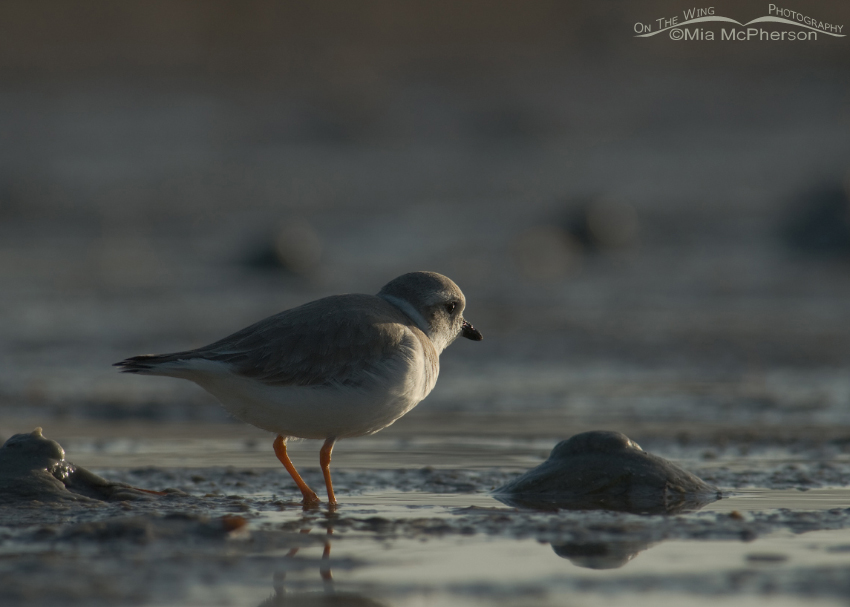
Piping Plover (Charadrius melodus) on the shore of the Gulf – Nikon D200, handheld, f5.6, 1/2000, ISO 320, Nikkor 80-400mm VR at 400mm, natural light
Piping Plovers nest in shallow scrapes in sand, gravel, salt flats or dunes which leaves their nests vulnerable to predators and in danger of being accidentally stepped on. The chicks are precocial and begin to run around not long after being born. They look like little tan cotton balls on stick legs. The feed on small mollusks, insects and marine worms in typical plover fashion, run, pause and pluck.
When I photographed this Piping Plover I was flat on my belly where the shallow waves of water pushed onto the sand. I have found that if I lay still enough the birds will approach me while I am “down & dirty”.
When I am out in the field I take a large amount of photos and there are times I don’t get around to processing them until much later, these are two such images taken at Fort DeSoto, Florida in 2008.
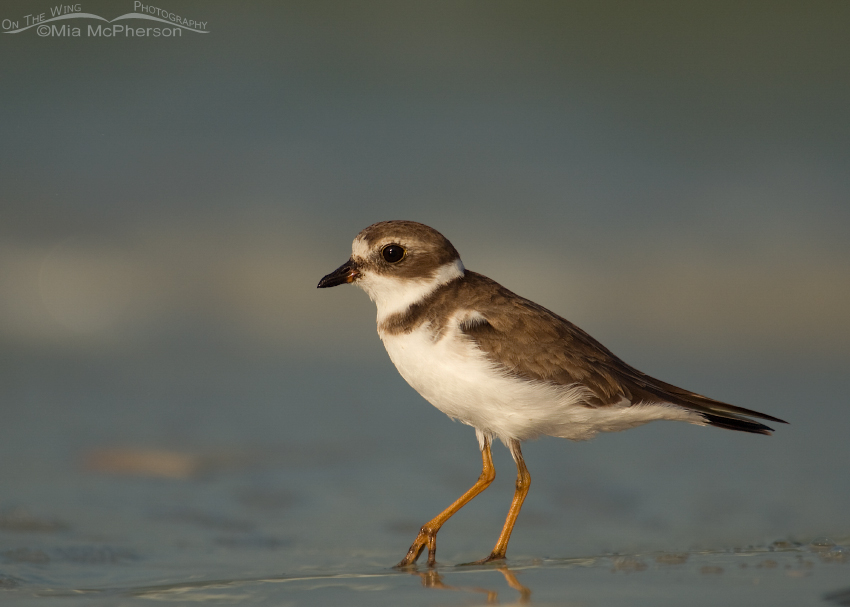
Semipalmated Plover in the sand ~ Fort De Soto County Park, Florida Nikon D200, handheld, f5.6, 1/800, ISO 250, Nikkor 200-400mm VR with 1.4x TC at 400mm, natural light
I wish I could get caught up on my post processing and editing but I won’t hold my breath about that. These two files have been languishing in their folders for over 3 years.
While I lived in Florida I very rarely took my 200-400mm VR lens to the beaches with me, I very clearly remember laying down on the sand to get eye level with these birds all the while worrying about what the sand could do to moving parts of my lens. I placed both elbows on the sand and used my left hand to brace the lens from underneath while I used my right to operate the camera, I think getting up was the most difficult part because I didn’t want to put my hands in the sand.
My friend & fellow photographer Al Wallace who had walked up and taken a few pictures of yours truly (without me being aware) probably had a good laugh watching me get up from the gritty sugar sand. That’s ok, I can laugh at myself and the weird positions I get in to get images of my subjects.
That is a floor buffing pad in front of me, I’ll never know how that ended up on the beach.
*Be careful; you never know when your sneaky but wonderful photographer friends are photographing you while are so focused on your subject that you are totally unaware of what they are doing! And yes, I look pretty goofy in this photo.
Piping Plover on a sandy beach ~ Fort De Soto County Park, Florida
Nikon d200, handheld, f5.6, 1/750, ISO 250, Nikkor 200-400mm VR with 1.4x TC at 400mm, natural light
By getting down to eye level with our feathered subjects the viewers often feel like they are part of the bird’s world, I know I do when I view images taken from low angles. I was almost too low for these pictures.
Sand, water, ice or snow can light up the bottom of your subjects because of the light being reflected upwards, Fort De Soto’s sugar sand is great at that.
Throughout the year you can see and photograph many different species of Plovers on Fort DeSoto’s beaches, tidal lagoons and spartina marshes. Of the plover species that are seen in North America there are seven species that can been seen during their migration or winter grounds, six of those species are seen with regularity and one that is seen infrequently.
American Golden Plover – seen infrequently during migration
Black-bellied Plover
Killdeer- year round resident of Florida, seen mostly inland but does show up at Fort DeSoto’s beaches infrequently
Piping Plover
Semipalmated Plover
Snowy Plover -can be a year round resident and does breed in Florida
Wilson’s Plover – year round resident
Black-bellied Plover in nonbreeding plumage D200, handheld, f6.3, 1/1000, ISO 160, 80-400mm VR at 340mm, natural light
Black-bellied Plovers are the largest and most common of the North American plovers. It feeds in the mudflats, the shallow waters of the lagoons and along the Gulf shoreline of Fort DeSoto.
Black-bellied Plover in breeding plumage D200, handheld, 1/1000, ISO 200, 70-300mm VR at 300mm, natural light
At Fort DeSoto the Black-bellied Plovers are often seen in nonbreeding plumage as well as in breeding plumage. The image above shows the black belly that this species is known and named for. In breeding and nonbreeding plumage Black-bellied Plovers show a black underwing part close to the body that distinguishes them from the other Pluvialis plovers.
Killdeer in grasses D200, handheld, f6.3, 1/1000, ISO 320, 80-400mm VR at 400mm, natural light Taken near Ruskin, Florida across Tampa Bay
Killdeer are considered “Upland Plovers” and can be seen far from water in fields, lake and river edges, golf course, air fields, pastures, the sides of roads, parking lots and more. At Fort DeSoto I have seen them on near the mudflats of the lagoons and I have seen them in the grassy areas between the parking lot at North Beach and the sand of the beaches. It is larger than the Wilson’s and Semipalmated Plover that look similar and has two breastbands instead of one. The only photos I have of Killdeer at Fort DeSoto the birds were small in the frame and I decided to post this one instead for identification purposes.
Puffed up Piping Plover D200, handheld, f5.6, 1/750, ISO 250, 200-400mm VR with 1.4x TC at 400mm, natural light
Piping Plovers are small and pale, paler than the Semipalmated and Wilson’s Plovers though not quite as pale as Snowy Plovers. It can easily be distinguished from the Snowy Plover by their yellow to orange legs, Snowy Plovers have gray to pinkish legs. The differences in the bills of the two species are also a help with ID, Piping Plovers have an orange, black tipped bill and Snowy Plovers have a black bill.
Semipalmated Plover in early morning light D200, handheld, f5.6, 12000, ISO 250, 80-400mm VR at 400mm, natural light
Semipalmated Plovers are seen along the lagoons, mudflats and the Gulf shoreline. On chilly days they seem to enjoy resting in the sand with their feathers all fluffed up. Thier food can be taken right at the surface but they also dig down a few millimeters to find their prey.
Snowy Plover resting on the wrack line D200, handheld, f6.3, 1/1000, ISO 250, 80-400mm VR at 400mm, natural light
Snowy Plovers are the smallest and palest of the plovers seen on Fort DeSoto. In some parts of Florida they are year round residents that breed on open beaches and dunes. This species blends in extremely well with the sand at Fort DeSoto and can run very quickly. Habitat destruction has resulted in declining populations of this charming and diminutive plover.
Adult Wilson’s Plover D200, handheld, f6.3, 1/800, ISO 250, 80-400mm VR at 400mm, natural light
Wilson’s Plovers are the largest of the Charadrius species of plovers. They have a heavy belly and usually exhibit a very upright posture. Wilson’s Plover have a thick black bill that is heavier appearing than the other Charadrius plovers. When they are adults they have brownish upperparts.
Juvenile Wilson’s Plover with crab D200, handheld, f7.1, 1/640, ISO 200, 80-400mm VR at 400mm, natural light
When Wilson’s Plovers are young their plumage can appear much paler than the adults as seen in the image above.
Unfortunately I never had the opportunity to photograph American Golden Plovers at Fort DeSoto and thus I do not have an image to provide for them. Maybe on my next trip I’ll have that chance. I hope so.
As a bird photographer it can some times be disheartening when you have great light, a wonderful setting and a beautiful specimen of a bird in front of your lens when you see the “jewelry” (bands) that some birds will be wearing. However; those bands can supply information about that individual bird that may help its species survive. Whenever I see and can photograph a banded bird I do my part and send the information on the re-sighting in. At the end of the post I will provide some links for resightings.
Banded Red Knot D200, HH, f6.3, 1/1500, ISO 400, 80-400mm VR at 400mm, natural light
Red Knots(Calidris canutus) have been a species of special interest for me since I first saw one while living in Florida. I would see banded Red Knots on the beaches of the Gulf of Mexico and because of the bands I began to do research about the species and soon found myself reporting all the banded Red Knots I saw and photographed there hoping that my small contribution of information to researchers might help these beautiful shorebirds.
Red Knots are a long distance migratory species. They winter in Chile and Argentina then fly 9,000 miles to the Canadian Arctic Circle to breed. On the way north Red Knots feed upon the eggs of the Horseshoe Crabs, fattening up for the long journey and to acquire fat reserves in case food is not plentiful on the breeding grounds. They need those fat reserves to raise their young and so they can begin to make the long journey back to South America.
Horseshoe crabs have been harvested for their blood which can make a medical dye, for their shells which are used for fertilizer and they are also used for bait in eel pots. The medical dyes can be synthetically produced as can the fertilizer.
Due to dramatic declines in Red Knot populations there are ongoing research studies for this species. Re-sighting information may help Red Knots to survive. I once photographed and reported a banded Red Knot and later found out that the bird was over 12 years old, a remarkable find.
The red knot in the image above was banded on Anna Maria Island in Florida on 2/28/09, my resighting was on 3/20/09 about an hour north of where it had been originally banded.
Banded Roseate Spoonbill D200, f6.3, 1/800, ISO 200, 80-400mm VR at 400mm, natural light
This Roseate Spoonbill(Platalea ajaja)was photographed at a wetlands near where I lived in Florida. The bird was banded on Pigeon Key just north of Marathon Florida which is on the way to Key West. My resighting was about 250 miles north and west of where the bird was banded as a chick on 12/23/05. It was an interesting resighting according to the local Audubon Chapter, I reported the bird to them because I had read where they were specifically interested in banded Spoonbill resightings at the time.
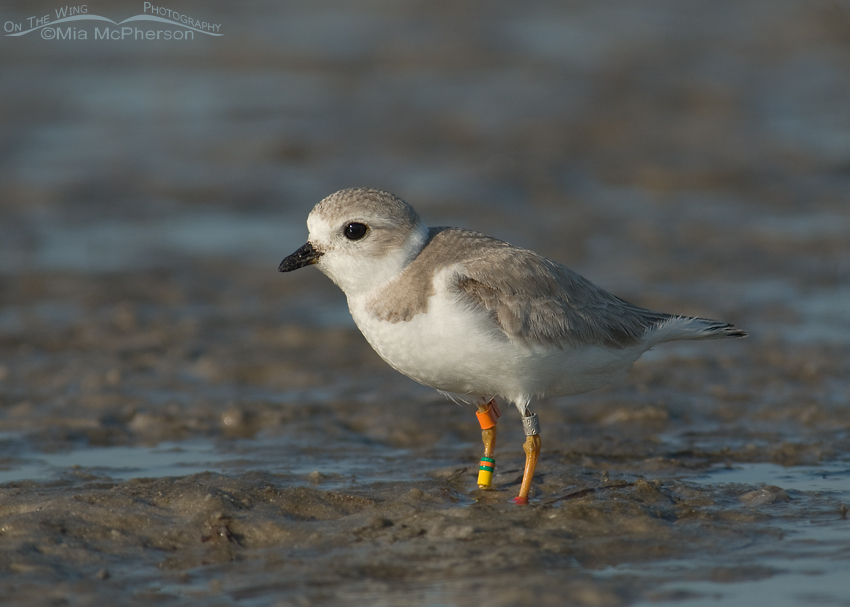
Banded Piping Plover D200, f6.3, 1/1000, ISO 200, 80-400mm VR at 400mm, natural light
I reported my resighting of the Piping Plover(Charadrius melodus) in the image above but seem to have lost the information on this bird that was sent back to me during my move from Florida to Utah. It is not uncommon to see banded Piping Plovers along the coast of Florida. There are several research projects going on up North to help understand this imperiled species better.
Yes, I used to complain about the “jewelry” I would see when I photographed birds but now I am more than willing to do my part and send in my resightings for these research studies.