
Birds and Bison

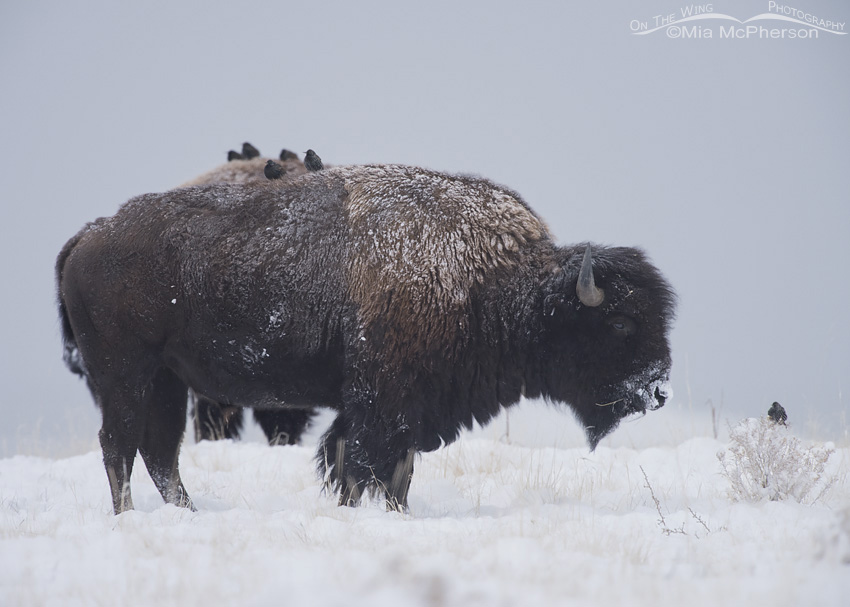
Certain species of birds ride on the backs of Bison and feed on the insects they find in the Bison’s fur; European Starlings are among those birds.

European Starling landing on a Bison's back

European Starling landing on a Bison’s back – Nikon D200, handheld, f8, 1/1000, ISO 400, -1.0 EV, Nikkor 18-200mm VR at 130mm, natural light

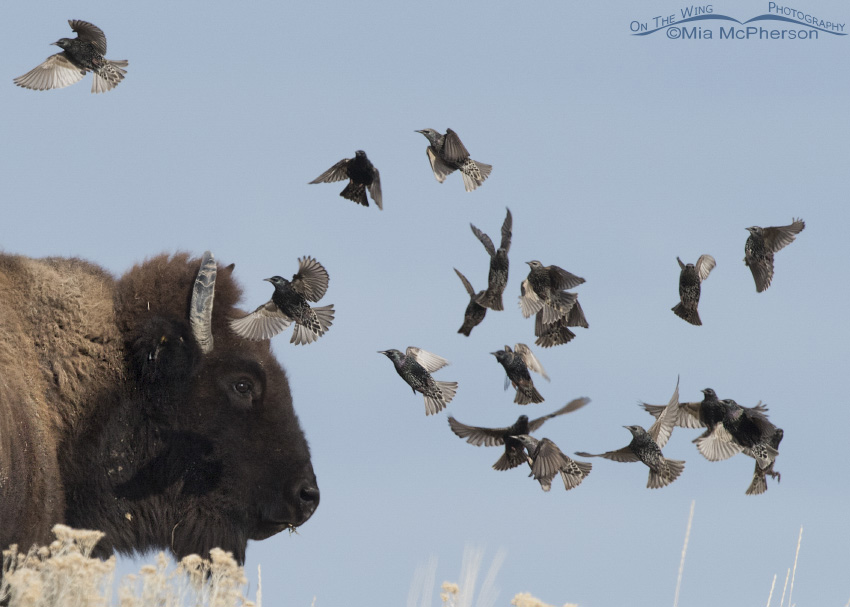
This image not only shows a European Starling about to land on the back of the feeding Bison, it also shows another bird flying past the Bison’s leg. The Bison was too close for me to use my Nikkor 200-400mm VR lens so I quickly grabbed my backup D200 with my 18-200mm VR attached.

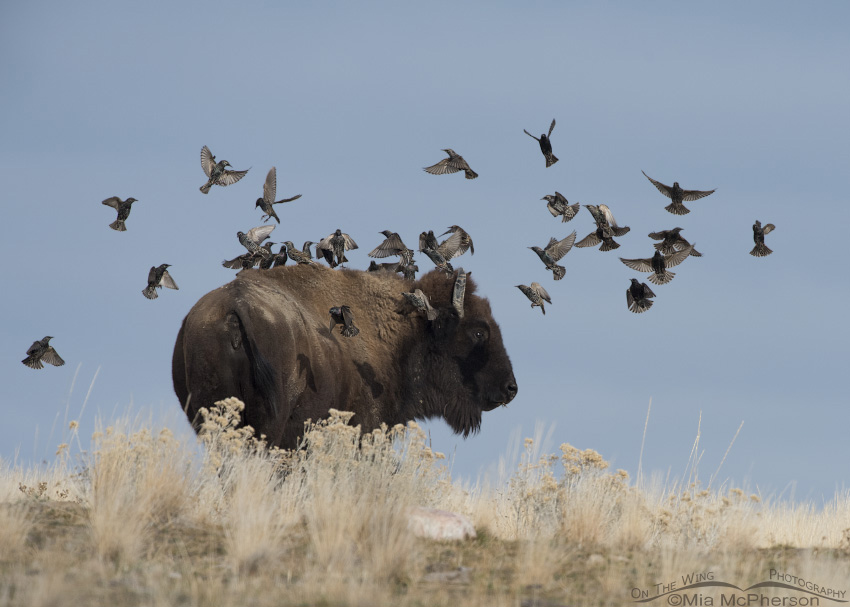
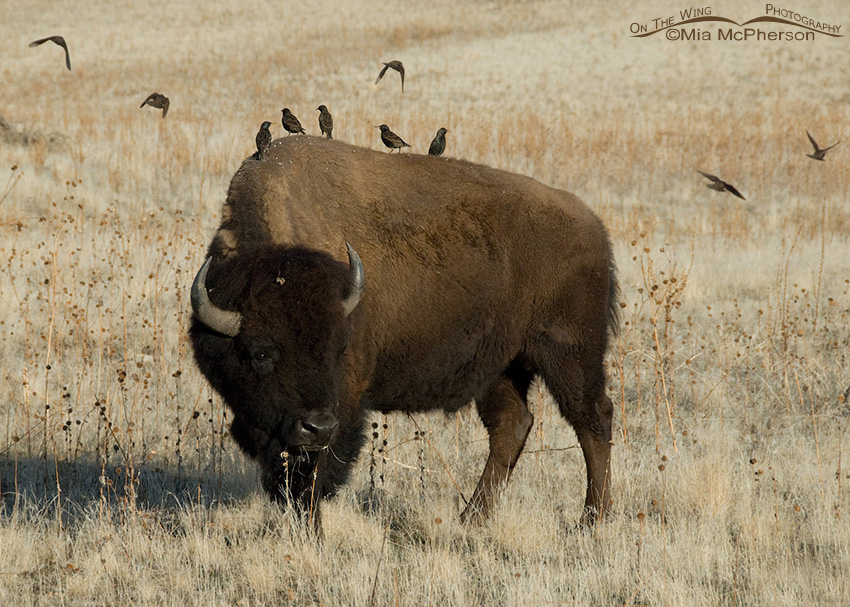
Flock of European Starlings with a Bison

Flock of European Starlings with a Bison – Nikon D200, handheld, f8, 1/1250, ISO 400, -1.0 EV, Nikkor 18-200mm VR at 120mm, natural light

It isn’t unusual to see European Starlings or Brown-headed Cowbirds riding on the backs of Bison while on Antelope Island State Park, at times there might be 20+ birds on a single Bison’s back. Usually I see that from a distance so yesterday I was glad that the Bison and birds were closer to me than normal.

European Starlings with a Bison and its tongue stuck out

European Starlings with a Bison and its tongue stuck out – Nikon D200, handheld, f8, 1/1250, ISO 400, -1.0 EV, Nikkor 18-200mm VR at 120mm, natural light

The Bison do not seem to mind the hitch hikers on their backs,  I am not sure they even notice the birds. The winter coat of this Bison is beginning to matt up on its back and shoulders, soon that fur will be shed and used by many of the birds on the island to line their nests. Loggerhead Shrikes seem to use the fur often as nesting material.

The top of a Bison’s tongue is a grayish color as shown in the photo above.

Bison licking its nose with European Starlings on its back

Bison licking its nose with European Starlings on its back – Nikon D200, handheld, f8, 1/1000, ISO 400, -1.0 EV, Nikkor 18-200mm VR at 130mm, natural light

The underside of a Bison’s tongue is dark brown on the edges and a light bubble gum pink in the center as shown here.

This Bison and the others nearby were easily approachable while staying within the confines of a vehicle and I prefer it that way. I can stay safe.

The other day I saw a photographer out walking through a grassy area of the park to get closer to some grazing Bison. He was strolling through an area where he should not have been, that side of the park has signs that state clearly to ”Stay on the Trails“ and he was putting himself at risk trying to get closer to these wild, unpredictable animals. Before I left the area though I saw one of the Park Rangers slow down next to his vehicle as the guy slowly made his way back to it. I bet he was educated very quickly about the dangers of what he had been doing and got told to stay on the trails.

Mia

More Bison images

Facebook Twitter

Ride, ride, ride…Hitching a ride

As a bird and nature photographer there are always images that I dream of getting, sometimes it is of a certain species or a specific setting. Some of those images I have been fortunate enough to create, others; not yet.

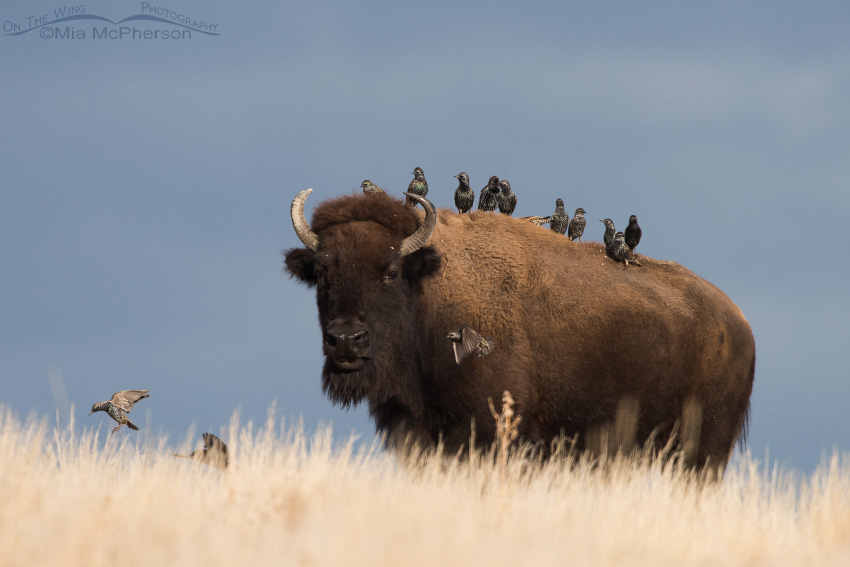
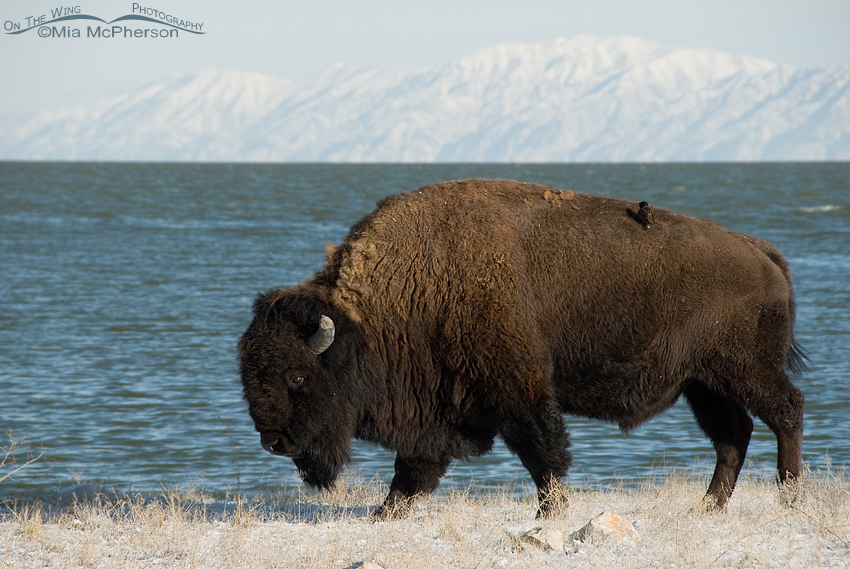
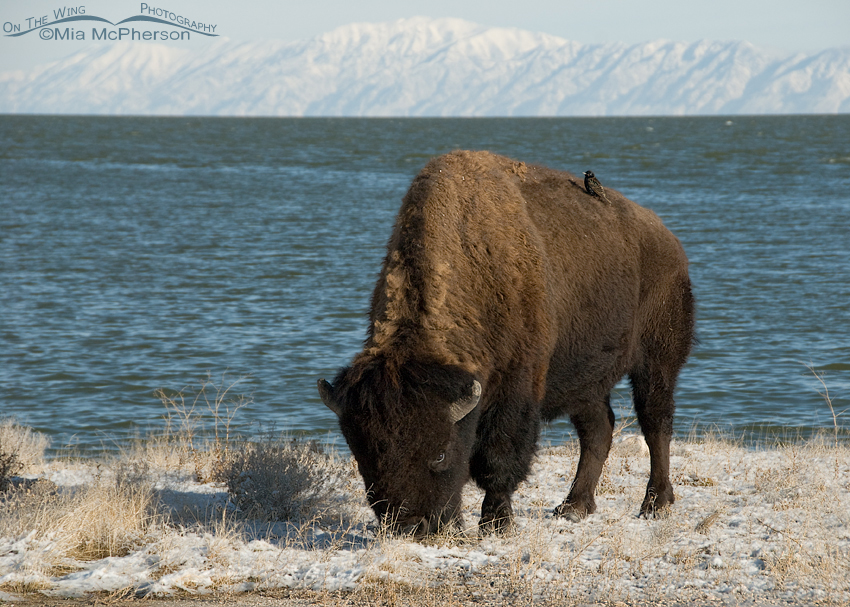
European Starling hitching a ride on a Bison
European Starling (Sturnus vulgaris) hitching a ride on a Bison
Nikon d200, f8, 1/1000, ISO 400, -0.7 EV, Nikkor 18-200mm VR at 170mm, natural light

Since moving to Utah in the summer of 2009 I have wanted to get some images of a Bison standing with the Great Salt Lake in the background. I had gotten them grazing on the hillsides, rolling around in a wallow, with calves, near the rocks and laying down but I hadn’t gotten the images I wanted with the lake clearly visible in the background.

Patience does pay off because two days ago I was able to get a series of images of this Bison with the Great Salt Lake clearly in view plus I had the added bonuses of having the snow topped Wasatch Mountain Range in the distance and a European Starling hitching a ride.

So, on to my next “dream” shot, I wonder when it will happen.

Mia

* It isn’t uncommon to see Brown-headed Cowbirds or European Starlings perched on the backs of Bison.

Facebook Twitter

Bye bye Blackbirds?

Adult Red-winged Blackbird male singing

Adult Red-winged Blackbird (Agelius phoeniceus) male singing
Pinellas County, Florida
Nikon D200, handheld, f6.3, 1/640, ISO 250, Nikkor 80-400mm VR at 400mm, natural light

In December of 2010 and January of 2011 the national media outlets reported several mass die offs of birds in the United States. On December 31, 2010 over 5000 blackbirds died and fell on the town of Beebee, Arkansas. On January 4, 2011 near Labarre, Louisiana 500 blackbirds and starlings were reported dead.  It was reported that the mass die off in Arkansas was caused by illegal fireworks going off which startled the blackbirds into flying at night, smashing into objects because of their poor night vision.

Recently the USDA accepted responsibility for a smaller die off in South Dakota which brought to light a little known program called “Bye bye Blackbird” which uses DRC-1339, a poison that is also called an avicide. I didn’t see this program brought to national attention in the evening news.

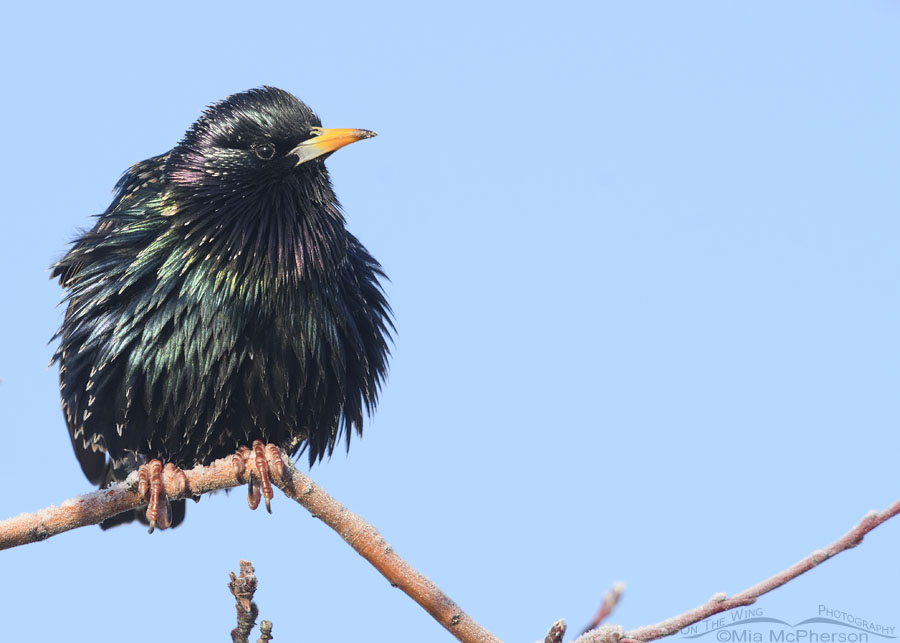
Adult European Starling

Adult European Starling (Sturnus vulgaris)
Salt Lake County, Utah
Nikon D200, f5.6, 1/1000, ISO 400, +0.3 EV, Nikkor 200-400mm with 1.4x TC at 260mm, natural light

Target species of the “Bye bye Blackbird” USDA program are blackbirds, starlings, grackles, cowbirds, and pigeons.

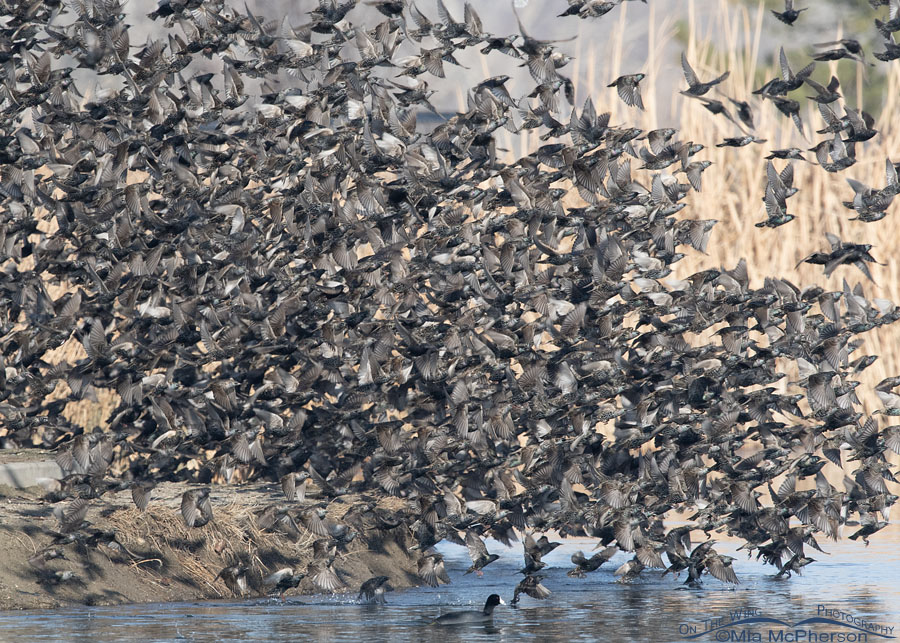
A bit about European Starlings: Few people in North America like European Starlings, my thoughts on that are not to blame the bird but to place the blame where it belongs with the people who introduced this species in 1890 – 1891 in New York’s Central Park.

It only took 60 years for European starlings to make their way from the Atlantic coast all the way to the Pacific and a mere 100 birds has now been estimated at over 200 million. They do compete with native species for food and nesting cavities.

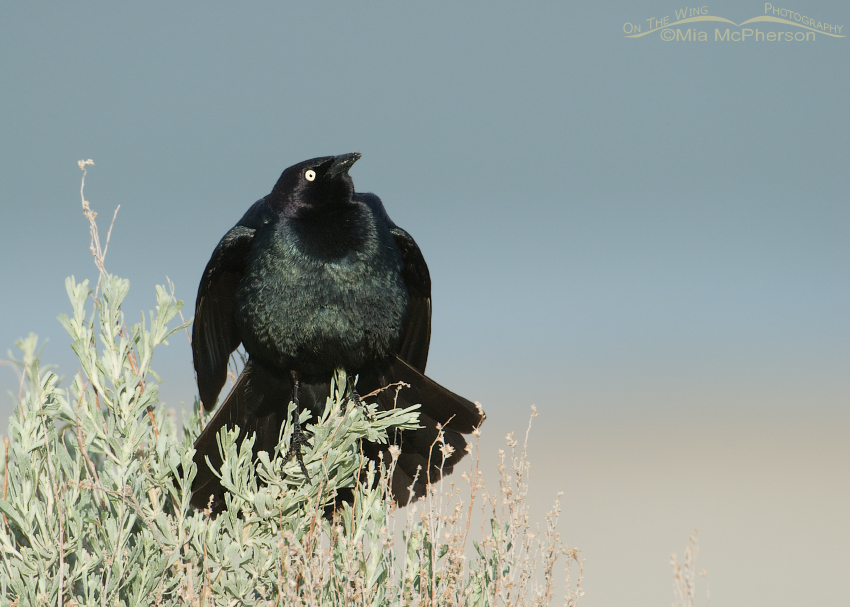
Brewer's Blackbird male singing

Brewer’s Blackbird (Euphagus cyanocephalus) male singing
Antelope Island State Park, Davis County, Utah
Nikon D200, f7.1, 1/350, ISO 400, -0.3 EV, Nikkor 200-400mm VR with 1.4x TC at 400mm, natural light

Of the blackbird target species there are Red-winged Blackbirds, Yellow-headed Blackbirds, Brewer’s Blackbirds, the less common Tricolored Blackbird,  and the rare Rusty Blackbird. The depredation order is currently under review because of the impact it may have on the declining population of the Rusty Blackbird.

Brown-headed Cowbird male

Brown-headed Cowbird (Molothrus ater) male
Antelope Island State Park, Davis County, Utah
Nikon D200, f6.3, 1/640, ISO 250, +0.3 EV, Nikkor 200-400mm VR with 1.4x TC at 400mm, natural light

Cowbirds are also targeted by the Bye bye Blackbird program, there are 3 species which can be affected,  Brown-headed Cowbirds, Shiny Cowbirds and Bronzed Cowbirds. Brown-headed Cowbirds can be found throughout most of North America while the Shiny and Bronzed Cowbirds are more localized to certain geographical areas.

Great-tailed Grackle male

Great-tailed Grackle (Quiscalus mexicanus) male
Farmington Bay WMA,
Davis County, Utah
Nikon D200, f7.1, 1/640, ISO 400, Nikkor 200-400mm VR with 1.4x TC at 400mm, natural light

There are three grackle species that are also targeted by the “Bye bye Blackbird” program, Common Grackles, Boat-tailed Grackles and Great-tailed Grackles. Common Grackles cover the largest geographical area, Great-tailed Grackles are found throughout the southwestern United States while Boat-tailed Grackles seem to prefer being along the east coast.

Adult male Yellow-headed Blackbird male singing

Adult male Yellow-headed Blackbird (Xanthocephalus xanthocephalus) male singing
Farmington Bay WMA, Davis County, Utah

 Nikon D200, f7.1, 1/800, ISO 400, +0.7 EV, Nikkor 200-400mm VR with 1.4x TC at 400mm, natural light

Why was the USDA “Bye bye Blackbird“ program started and when did it begin? It began in the 1960′s and became a part of the USDA later. The program was started to aid farmers, dairy farmers and ranchers in the reduction and removal of  avian “pests”. Dairy farmers say that a large flock of starlings or blackbirds can eat 200 pounds of feed a day and that their feces can spoil the feed.

Through the US Fish and Wildlife Service there is a “depredation order” which allows anyone kill blackbirds, starlings or grackles who claims they pose health risks or economic damage. Some areas of the country require permits but farmers are often able to hire private contractors who don’t need to report their bird culls to any authority.

USDA agents killed more than 4 million starlings, blackbirds, grackles and cowbirds in 2009.

“Every winter, there’s massive and purposeful kills of these blackbirds,” says Greg Butcher, the bird conservation director at the National Audubon Society. “These guys are professionals, and they don’t want to advertise their work. They like to work fast, efficiently, and out of sight.”

I have to wonder:

* Why aren’t the farmers required to cover the feed they say is being lost daily or annually?
* Would the birds even be there if the feed was covered?
* Would the birds be defacating on the feed if the feed were covered?
* Why should this program to exterminate these species be paid for by the government?
* What are the effects on non-target species who eat seeds?
* What are the effects on raptors who may ingest the poisoned birds?
* What are the long-term effects of DRC-1339 on humans and the environment?
* How many other birds are dying because of DRC-1339 that we don’t know or hear about?

The USDA says that DRC-1339 does not affect livestock, pets or humans but they didn’t think that DDT would cause the well documented problems for birds that it did. How many times has the USDA or FDA said that a poison or medication wouldn’t be harmful only later to have to recant those statements because it was harmful?  How many government studies have been proven wrong?

From promedmail.org: Known exceptions are owls and felines, with LD’s of about 5 mg/kg placing them in the sensitive category.

Last I checked felines included a well known family pet, the cat. And owls are protected.

DRC-1339 causes severe renal failure and congestion to the bird’s major organs, does that sound humane? I don’t think so.

What is next?

* If a Golden or Bald Eagle takes, kills and ingests a lamb or a calf will they be on the Bye bye Blackbird hit list too? They would be causing economic damage.
* Who is watching the private contractors to make sure they are “dosing” the target species safely if they don’t have to report to authorities?
* Why are the private contractors not required to report the number of birds (or species for that matter) to government authorities?

I’d hate to think that our great-grandchildren won’t ever know the sound of a Red-winged Blackbird singing on a spring morning. There needs to be more transparency & accountability about the “Bye bye Blackbird” program.

I’m really bothered by the USDA Bye bye Blackbird program, are you?

Mia

Juvenile male Red-winged Blackbird singing

Juvenile male Red-winged Blackbird (Agelius phoeniceus) singing
Pinellas County, Florida
Nikon D200, f6.3, 1/800, ISO 200, Nikkor 80-400mm at 400mm, natural light

http://www.truth-out.org/bye-bye-blackbird-usda-acknowledges-a-hand-one-mass-bird-death67028
http://www.sustainabilityforum.com/news/bye-bye-blackbird-usda-mass-bird-deaths
http://www.promedmail.org/pls/apex/f?p=2400:1001:2123109730310003::NO::F2400_P1001_BACK_PAGE,F2400_P1001_PUB_MAIL_ID:1000,86850

Facebook Twitter

Four Eyes

Black-billed Magpie building a nest

Black-billed Magpie (Pica hudsonia) building a nest
D200, f6.3, 1/1600, ISO 400, 200-400mm VR at 400mm, +0.3 EV, natural light

When I started to become serious about bird photography while living in Florida I did it alone. I would walk the trails, search for birds and look for new locations to find them. I think at that point in my life I needed the solitude and I probably needed the time alone to learn about my camera, the strengths and limitations of my gear and so I could become more knowledgeable about the behaviors, habitats, food preferences and more about the birds I wished to photograph.

There is something very peaceful and relaxing about wandering alone down a lonely beach before the sun starts to light up the sky, sitting on a sand dune waiting for the sunrise or strolling through the Spanish Moss covered Slash Pines just before the sun starts to set.  

Listening carefully for the sounds of the birds, the tap-tap of a woodpecker drumming on a tree, the “drink your teeee” of an Eastern Towhee or the call of a Bald Eagle overhead. You tune in with your ears and you can locate many bird species simply by their sound.

One of the most important tools we use though for locating the birds are our eyes.  We see a flutter, the flip of a tail, stretch of a wing or a bird flying through our field of vision and then get the camera ready.

 I can detect a spotted sandpiper in amongst other small peeps because I know that they bob their bottoms up and down. Or know that a bird I see in the distance is a harrier because of the white rump and the buoyant way they fly. I’ve grown to know the hornet’s nest shape of a Great Horned Owl sitting in a pine and more.

It wasn’t until a few years after I got serious about photographing birds that I started to shoot them with other photographers. At first I wasn’t sure about it, but over time I saw the great benefits.

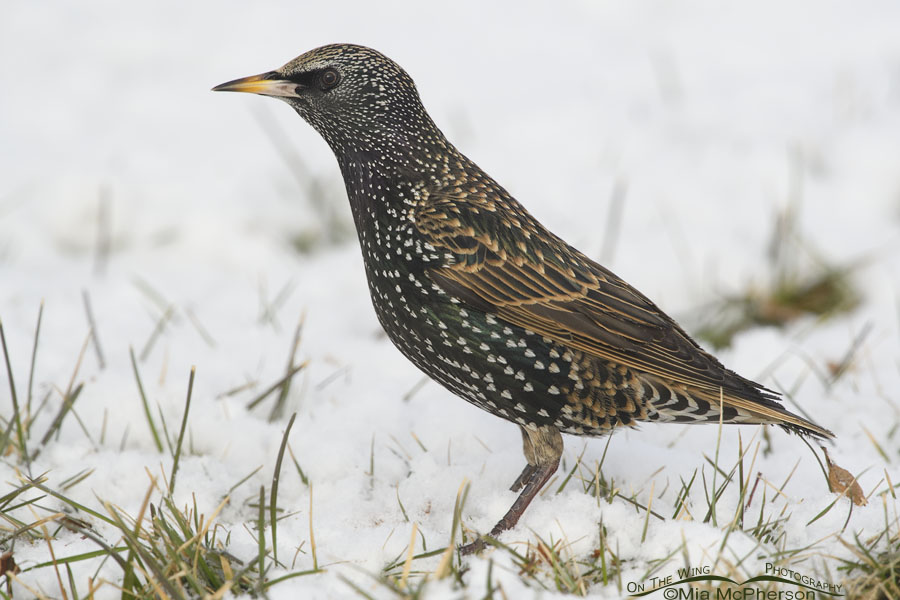
European Starling in winter plumage

European Starling (Sturnus vulgaris)
D200, f7.1, 1/1000, ISO 320, 200-400mm VR with 1.4x TC at 400mm, EV +0.3, natural light

Four eyes instead of just two.

When you have two photographers scanning the horizon for birds you almost double the chances of seeing them in many cases.  

Also, if the other person knows the bird’s behavior well they can detect when a bird might lift their wings, lift off or perform an interesting action and give a warning.

One photographer might have better vision and be able to spot birds that the other person may not have seen.  

If one of the photographers is driving while using the vehicle as a mobile blind they will need to focus on driving while the other person focuses on locating birds.

I know on a few occasions I have been able to spot birds whose activity clued me in that the birds were actively building a nest*(see below) or on the nest  that a person who was driving would not most likely see.

A few things to consider if you are thinking of photographing birds with a partner are as follows:

Realize that other people may have more or less patience for sitting still and waiting for birds.

Or that they may want to take more images than you feel are necessary for a species you are not particularly interested in.

Consider the focal length the other photographer normally uses. If one person uses a 300mm lens with a 1.4x and the other is using a 500mm with a 1.4x, the person with the shorter focal length will need to get closer to the birds if they are on foot to get a frame filling image or have to take a much larger crop to get the bird larger in the frame in post processing which is known to cause loss of detail. If the birds move in closer the photographer with the longer focal length may be too close to allow for space around the bird or it could cause them to clip important parts of the body of the subject.  It may be best to photograph with a person using the same focal length that you do.

Loggerhead Shrike with nesting material

Loggerhead Shrike (Lanius ludovicianus) with nesting material
D200, f7.1, 1/2000, ISO 400, 200-400mm VR with 1.4x TC at 400mm, natural light

Photographing birds with another photographer can be a very rewarding and fun experience and while you are waiting for birds to show up you’ll have the time to compare techniques and share information about the bird species that you are hoping to see.

And if the other photographer is great company you will find the time a pleasure.

Mia

* Ethics on photographing nesting birds:

  • Do not approach too closely
  • If the birds show any sign of distress, back away
  • Don’t trim leaves, twigs or branches to get a clearer shot, you may inadvertently attract predators or cause the eggs/chicks to over heat
  • Follow local, state and federal guidelines concerning nesting birds
  • Don’t harass the birds to get an action shot
Facebook Twitter