By Mia McPherson, on January 24th, 2011% 
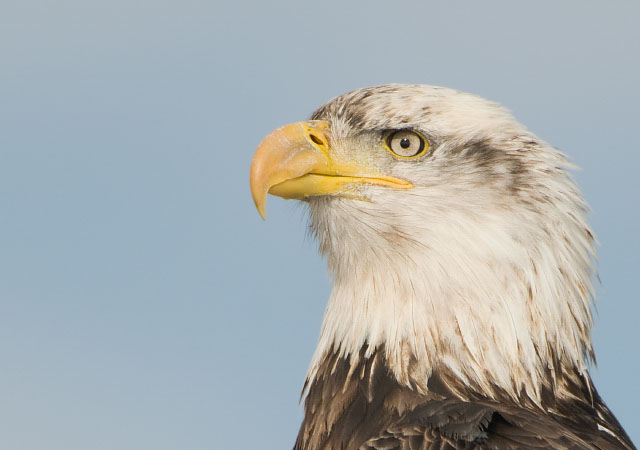
Four year old Bald Eagle Portrait
Farmington Bay WMA, Davis County, Utah
D200, f6.3, 1/640, ISO 200, 200-400mm VR with 1.4x TC at 400mm, natural light, not baited, a wild bird
I’ve enjoyed photography for a long time but for quite awhile I didn’t understand the value or importance of honest self critique. If the image was sharp enough I was pleased. If I was able to get the entire subject in the frame I was happy. If I had good light I was thrilled.

During that period of my growth as a photographer I started looking for a place to post my images to be critiqued by others hoping that it would improve my skills and image quality. I’ve only actively posted on two of those nature critique forums, the first one went belly down after about 6 months so I searched for another one. I’ve been posting my images at the second forum I found since 2005 for critique, comments and evaluations. I also peruse several other nature photography sites.
I have learned a great deal from the members who take the time to honestly evaluate, critique and offer suggestions for future improvement of not just my images but other members too. I have gained skills and knowledge by reciprocating and giving thoughtful critiques for the other members too. By critiquing other people’s work I found myself able to be emotionally distanced from the image, something that can be a challenge to do with our own.
There are real benefits to having multiple people critiquing my images, some may go more indepth and another person may offer a suggestion that hasn’t been mentioned. It helps with finding the best camera settings, composition and learning to work with the habitat present and the light.
What being a participant on a nature photography critique forum has taught me is invaluable, it is the ability to look at my own images objectively and to critique them honestly. The keywords are objectively and honestly.
Some days I take hundreds of images because with birds I want to be shooting when they are doing something interesting either on the land, water or in the air. I often take my images in bursts hoping to get several in focus, sharp files. When I am away on camping trips the number of images can go up drastically because although I can load the images onto my laptop, I don’t like using its screen to make critical decisions about sharpness. However, that means when I upload the files to my hard drive I have a ton of culling to do. It is time consuming to cull that many images, keeping the best so I can delete the rest.
I look at every image I delete and ask myself “What could I have done to make this image better?”.
- Sometimes I’ll see that my shutter speed was too low for the action or conditions. I’ll know that I could have increased my ISO or used less depth of field.
- Or notice that I used the wrong aperture and didn’t get the whole bird sharp or the tail wasn’t quite in focus. I will learn what aperture to use in the future for a similar shot.
- I might not have been paying close enough attention to the background and see that I have something distracting in it that may have been avoided by moving right, left or positioning the camera higher or lower.
- The same can be said of the foreground, there can also be distracting elements there. Grass stems, branches, rocks and more crossing any part of the bird has the potential to be distracting
- I may not have used the correct EV compensation and blown out the whites or blocked up the darks. My whites could look muddy and I’ll know I needed more positive EV compensation.
- I may not have composed the image to its best advantage. That makes me think about how I frame future images.
- Was the light good? Too bright, not bright enough?
Those are just a few of the thoughts that run through my mind while culling. I store all of that information in my mind for use while out in the field again.
Honest self critique is a valuable tool that I consistently use. I can look at images and know they belong in my delete bin. I can also see when I’ve nailed a shot, exposure or pose. I have learned to become my own harshest critic.
Mia

A flock of resting American Avocets
Antelope Island State Park, Utah
D200, handheld, f7.1, 1/350, ISO 200, 80-400mm VR at 400mm, natural light
By Mia McPherson, on October 7th, 2010% 
Tricolored Heron (Egretta tricolor) with head tilt
Pinellas County, Florida
D200, handheld, laying flat on the sand, f6.3, 1/1500, ISO 250, 80-400mm VR at 330mm, natural light
On the web there are many image critique forums, I am only active on one of the nature photography critique forums, though I have participated on a few since 2003. I believe that by receiving and giving critiques I can strengthen my skills in composition, technique and learn a great deal about the birds I love to photograph.
I have seen some avian images posted on other forums that I found interesting and appealing but several people who critiqued the photos have talked about having the head angle 2 degrees this way or three degrees another. I’ve pondered those critiques and personally there are times when I think different head angles; even those that do not show the “perfect head turn” can be very compelling images.
I thought I would post a few of my photos on the avian critique forum where I am a member where the head angle isn’t perfect but where I find that I like the images despite the lack of direct eye contact. The feed back I received was very positive, so I don’t believe I am alone with my thoughts about head angles.
In the image above the Tricolored Heron (Egretta tricolor) turned its head towards the sky to eyeball an Osprey overhead and I feel that the head being turned upwards adds interest to the image. It can make the viewer wonder what the heron is looking at. You can see the eye but the bird is just going about its life and it was comfortable in my presence.

American Coot (Fulica americana)
Salt Lake County, Utah
D200, on Gitzo CF tripod, Black Widow head, F7.1, 1/500, ISO 250, 200-400mm VR with 1.4x TC at 400mm, natural light
In this American Coot (Fulica americana) image the head angle might not be considered ideal, there is no direct eye contact or catchlight in the eye but I still feel that this is a compelling and interesting image because of the head angle and the bird’s pose and demeanor. I have more images of this coot where the head angle would be considered “better” but they do not have the same effect on me that this one does. In this image it is the head angle that draws me in and keeps my attention.

Snowy Egret (Egretta thula) gazing over stormy water
Pinellas County, Florida
D200, handheld, laying in the sand, f5.6, 1/500, ISO 500, 80-400mm VR at 400mm, natural light
In this photo the primary Snowy Egret (Egretta thula) is looking away, yet you can still see the eye. I believe the reason this image works for me is that it appears that the Snowy Egret is looking at the stormy water thus I don’t mind the head angle. For me this photo is as much about the setting as it is about the birds. I like the out of focus egret in the background, I feel it adds a tension that might not be there if that egret were absent.
The critiques I received on all three of the images were overwhelmingly positive which I feel supports my thoughts that even without what some may consider “the perfect head angle” that we can create interesting and compelling avian images.
Mia
By Mia McPherson, on September 20th, 2010% I spent last week in southern Montana at Red Rock Lakes NWR, it is a gorgeous location and you never know what bird or animal will show up in your viewfinder. Weather conditions there can change from dense fog to the golden light of early morning rather quickly or from strong midday light to the darkness created by thick, foreboding storm clouds.
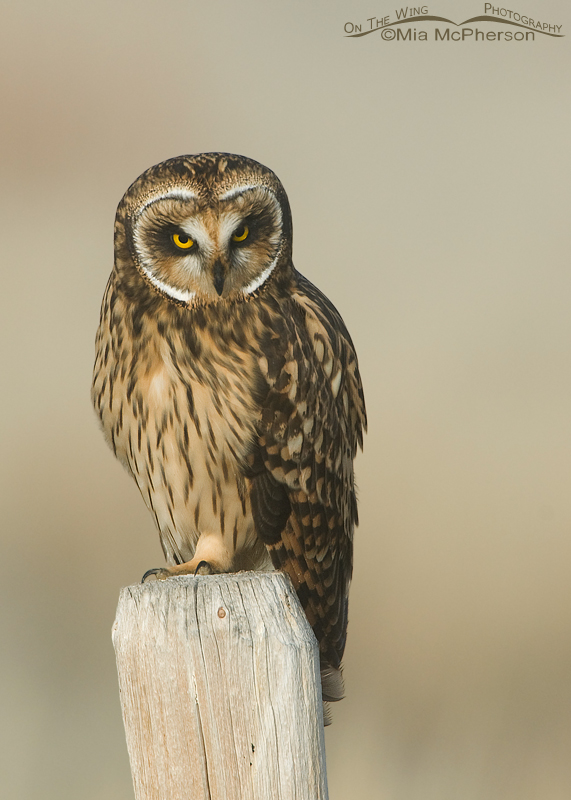
I was excited while I was on the refuge when a female Short-eared Owl (Asio flammeus) flew up from the gravel road and landed on a fencepost in a heavy, swirling fog. Not only was I seeing the beautiful owl, I was going to have the opportunity to take images of it in low light and fog. A challenge I was more than willing to meet.

Short-eared Owl in a fog at Red Rock Lakes, NWR, Montana
D200, f7.1, 1/640, ISO 400, 200-400mm VR with 1.4x TC at 350mm, natural light, not baited
Oddly though there seem to be people who don’t like foggy or low light shots. I posted one of my foggy Short-eared Owl photos on a Nature Photography site where I am a member just before a friend of mine posted a Swainson’s Hawk (Buteo swainsoni) taken in the same area taken in clear afternoon light two days later. One of the other members there unfavorably compared my foggy owl image to my friend’s hawk photo. While I can respect that other people’s tastes differ from mine and actually expect it, I know I wouldn’t nor couldn’t honestly compare the two images of two different species, in two settings under extremely different lighting conditions.
The hawk image below is the same bird, on the same post taken the same day as my friend’s hawk image just at a different moment.

Juvenile Swainson’s Hawk along the road to Red Rock Lakes, NWR, Montana
D200, F7.1, 1/1000, ISO 250, 200-400mm VR at 1.4x TC at 400mm, natural light, not baited
Comparing apples to oranges.
Yes, apples and oranges are both fruit but their tastes are quite different, their texture isn’t at all alike nor is the fragrant aroma of the fruits. Personally I love them both and on any given day one might appeal to my tastes more.
I would not compare a Picasso to Monet, a Rubens to a Warhol or a Salvador Dali to a Cézanne. Their artistic techniques, personal styles and even their very brushstrokes are remarkably individualized. Though I can and do appreciate the unique flavors of their styles and techniques when I view their art.
I adore a good hamburger on a sesame bun, a burger suits my tastes just fine, but lettuce, tomato and mayonnaise only, skip the pickle and cheese please. I am also delighted with a serving of a perfect Châteaubriand drizzled with Béarnaise Sauce. It is certainly richer than a simple burger yet they are still both beef. Strawberry Shortcake or Pavlova, they have strawberries in common though their taste and texture are not the same.
It’s all a matter of taste.
I knew at a young age that because of the many geographic locations where I lived and explored combined with my unrestrained delight in not only seeing nature but feeling a strong attachment to it would inspire me to see the world; and now my photography, with my eyes wide open, delighting in the large and seemingly minute differences I am privileged to see each day in nature.
As an avian photographer I have worked to develop my own personal style, something that a great many excellent photographers do. I’m certainly not hesitant to take a leap and try something new with my photography, to appreciate another photographer’s personal style or post an unusual image to have other photographers whose work I appreciate and respect share their thoughtful, honest critiques.
Additionally I relish the possibility of photographing birds in different poses, settings, weather conditions and light and approach each day that I am out photographing with eager anticipation of what wonderful creatures I might see. Life will be far too short for me to become a photographer who has grown as stagnant as a pond with no outlet and far to little fresh water flowing in.
Maybe my tastes about the light in my images and the weather conditions are more varied than most or perhaps more refined. I’m perfectly fine with that and with my photographic work.
Mia
|
Photographing a Tricolored Heron from a tidal lagoon

Focusing on Wildlife Contributor

|