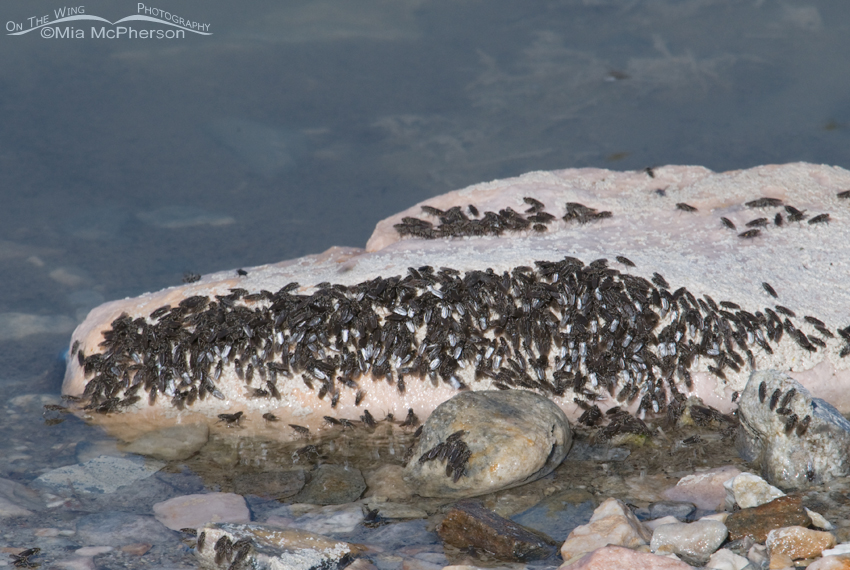

Yesterday while near the marina on Antelope Island State Park I spotted my first of the year Brine Flies warming up on some of the rocks in the water. You might wonder “why” am I so excited about flies?
It is because I know how many birds feast on the little buggers! If the brine flies are out it won’t be long before the shorebirds that eat them arrive. Last week there was ice on this water, how quickly things change. The image above was taken yesterday.
California Gull in a thick mass of Brine Flies
This image was taken last year when the brine flies were thick, all of those little dark dots in the air, on the rocks and in front of the California Gull are Brine Flies. With billions of them in just a small area it is easy to see why the birds that devour them like the area of the Great Salt Lake. The California Gulls are already here and they appear to be eating the flies along the causeway.
Franklin’s Gull with Brine Flies
It won’t be long before the first of the Franklin’s Gulls arrive too and for a short time the Bonaparte’s Gulls will feast on the flies too before heading further north. All those dark flecks on the water? Brine Flies.
California Gull with Brine Flies in flight
I do get excited about seeing the first Brine Flies because I know that their presence brings on the birds and the feeding frenzies that follow!
*Sorry for the double post this morning, I thought the other post on Capitol Reef National Park had already been published a long time ago, but it had been marked “private”. Oh well, it IS a great place.
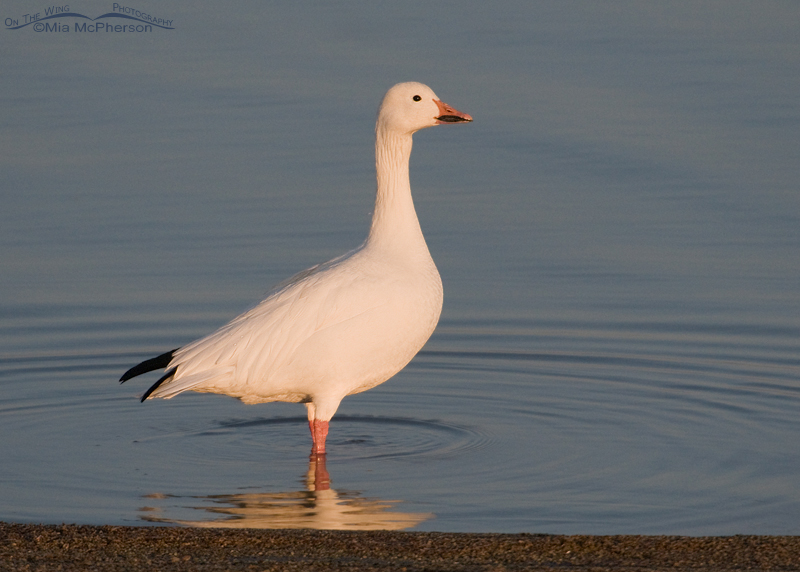
Adult Snow Goose in the Great Salt Lake
Spring is arriving and there have been reports of Snow Geese in the area. I edited some Snow Geese images I took in November of last year to post today.
I love the way it looks as if this goose is grinning.
Juvenile Snow Goose on the shore of the Great Salt Lake
The immature Snow Goose hung close to the adult. These two geese were seen along the causeway to Antelope Island for a few days last fall.
Adult Snow Goose walking the shoreline of the Great Salt Lake
They walked the shoreline of the Great Salt Lake. The early morning light seemed to make this adult glow.
Young Snow Goose walking the shoreline of the Great Salt Lake
The juvenile Snow Goose was starting to get the pure white feathers of adult plumage on its back. I wonder if by this spring it looks just like the adults.
I’m hoping to go on a “Goose Chase” this morning, the sky is supposed to be clear so there should be good light and I would be delighted to see some snow, Snow Geese that is! I’ve had about enough of the other snow for now.
Awhile back someone told me (in a comment on this blog) that Mergansers don’t change their plumage seasonally, which is incorrect as all three species of mergansers that live in North America do. The image above shows a Red-breasted Merganser drake in breeding plumage, I took this image at a pond very close to where I live in Salt Lake County, Utah.
Note the very dark head, striking black and white patterns on the back of the merganser and evidence of the red breast this species gets part of its name from. Don’t you just love the shaggy, punk rock do these birds have?
Male Red-breasted Mergansers in eclipse plumage
All three of the birds in the image above are male Red-breasted Mergansers in eclipse plumage and look remarkably different than the male in breeding plumage shown above. Or maybe these mergansers are just females that got a really bad deal on smoky eye shadows at Walgreens.
Seriously they are males in eclipse plumage photographed at Fort De Soto’s north beach in Florida.
It pays to have great Bird Guides, I have plenty on a shelf right above my computer monitor and keep one in the pickup, I also have two bird guide apps on my smart phone so I can use them anywhere I am without the weight of a book. Not only can the guides help with a bird’s identification they can also help us distinguish the various plumage phases of birds or if they change seasonally.
At any rate, I’d say that these images of Red-breasted Merganser drakes show there is a seasonal change in their plumage.
*Because of Google’s changes it Image Search and how they have begun to hotlink to my larger images I will no longer post large versions of my files on my blog.
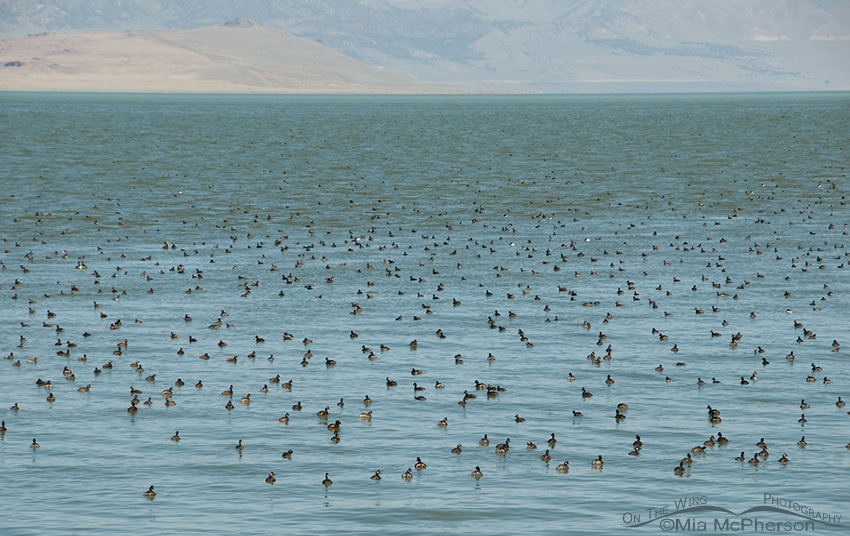
During spring and fall migration there can be so many Eared Grebes (Podiceps nigricollis) on the Great Salt Lake that they are impossible to count.
Eared Grebes on the Great Salt Lake – Nikon D200, handheld, f9, 1/1000, ISO 400, Nikkor 18-200mm VR at 130mm, natural light
The diet of Eared Grebes include brine shrimp and alkali flies that are found in hyper saline environments such as Mono Lake in California and the Great Salt Lake in Utah. For most of the year Eared Grebes and Wilson’s Phalaropes are the two bird species that spend the most time in highly saline environments.
It is amazing to stop on the causeway to Antelope Island State Park and see thousands upon thousands of Eared Grebes. Yesterday day most of the grebes were north of the causeway and even with my high-powered lens I couldn’t see where the birds stopped.
Eared Grebe in breeding plumage – Nikon D300, f6.3, 1/2500, ISO 640, +0.3 EV, Nikkor 200-400mm VR with 1.4x TC at 400mm, natural light
I think that Eared Grebes are gorgeous in breeding plumage with their primarily dark body and neck combined with the dark head in contrast to the wispy yellow plumes and cherry red eye. I like that crest too!
My portfolio is seriously lacking in Eared Grebe images, something I should remedy.
Not far from where I live there is a small pond where I photographed this American White Pelican (Pelecanus erythrorhynchos) just after it had lifted off from the water two springs ago.
I woke this morning to find the ground blanketed in fresh snow. Later this week the forecasters say it will be in the 70′s, crazy spring weather.
American White Pelican in flight – Nikon D200, tripod mounted, f6.3, 1/1000, ISO 320, +1.0 EV, Nikkor 200-400mm VR with 1.4x TC at 215mm, natural light
I don’t have to go far from home to photograph birds because of that pond being nearby but it can be a challenge trying to frame a shot where the hand of man isn’t obvious when the birds are in flight. There are power lines, power poles, tall lights from a baseball field and quite often airplanes in the sky.
What can not be seen in this image is a huge power pole just outside the left side of the frame. I cropped this image to remove it.