Common Raven in the snow – An exposure problem

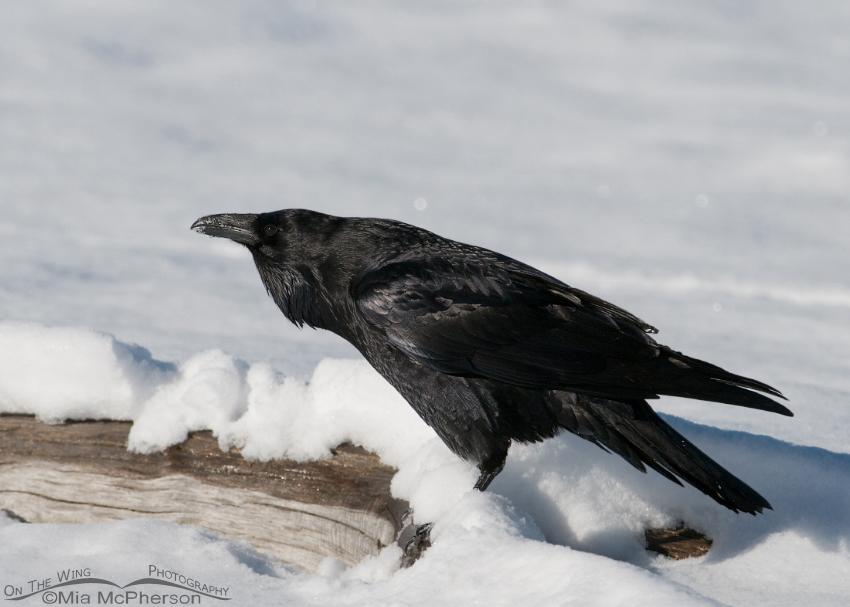
Common Raven in the snow - Original

Calling Common Raven in snow original - Nikon D300, f6.3, 1/4000, ISO 400, 0.0 EV, Nikkor 200-400mm VR with 1.4x TC at 285mm, natural light, not baited or called in

Photographing dark birds such as this Common Raven is a challenge and knowing how to expose properly as well as getting the right angle of light is critical in producing a quality image. I have posted before about the importance of honest self critique and that will discussed in this post too. The exposure of this very dark bird is even more difficult because of the high contrast between the dark raven and the bright white snow.

The Common Raven image above is not properly exposed, in fact it stinks. The blacks are blocked up and very little feather detail is evident even though the bird is sharp. This image belongs in my delete bin but it can be used as an example of honest self critique. The expanded view area above the bird shows the area outlined in red at 200% and except for the upper left hand corner of the expanded view I barely see any detail.

I brought this image into Photoshop, cropped it slightly then masked the bird and sharpened it, no other adjustments were made.

poorlyThis Photoshop histogram shows how poorly exposed this image is, the tall column of blacks on the edge of the left side shows how badly the blacks are blocked up. The histograms in our cameras can show us poor exposures in the field and by using the histogram exposure compensations adjustments can be made.

By using my skills of self critique I can say there were two things that could have made this image a keeper, 1) a better exposure and 2) a better light angle on the birds itself.

Could this image be saved in post processing?

Common Raven in the snow - lightened

Calling Common Raven in snow lightened – Nikon D300, f6.3, 1/4000, ISO 400, 0.0 EV, Nikkor 200-400mm VR with 1.4x TC at 285mm, natural light, not baited or called in

This is the same image processed differently. I brought the file into Photoshop and increased the exposure by +.15, used the fill light slider and bumped it up to +25, I also used the tone curve slider for the blacks & shadows and raised them by +40 to raise the exposure of the darks within the image. I masked the bird and sharpened it using the same procedure as the top image.

after-ps-adjustments

This is the Photoshop histogram after post processing in Photoshop, the blacks are no longer blocked up towards the left edge of the histogram. Looking at the expanded view at 200% does show feather detail and areas of the Raven don’t look like a black featureless subject.

The problem? By increasing the exposure of this Raven in post processing I have introduced “noise” and it is right on the edge of “color noise”. I find this amount of noise unacceptable in my images. In both the expanded view and normal view I can see and detect that noise as blocky areas that just do not appear natural and that ruins this image for me and because of honest self critique this file is delete bin bound. The quality of this image is not acceptable to me even after post processing.

Well-meaning friends, relatives and non-photographers might think that this is a good image and say “Wow” or “great image” but after spending years honing my skills and time spent critiquing myself, I know it isn’t “great”.

I use Noise Reduction software sparingly, I very rarely ever apply it to my subject because it can cause the subject to look unnatural and unrealistic. Used excessively Noise Reduction software can give the feathers a melted appearance and it also ruins the fine details I like to see in my images. Granted, I am not very skilled at noise reduction and I feel that by getting my exposure correct in the field there is very little need for me to use it or become proficient at it.

 Calling Common Raven in snow

Calling Common Raven in snow – Nikon D300, f6.3, 1/2500, ISO 400, +0.3 EV, Nikkor 200-400mm VR with 1.4x TC at 285mm, natural light, not baited or called in

After looking at my cameras histogram I made a slight adjustment to my exposure compensation (EV) of +0.3 which brought out more detail in the black plumage and while this exposure isn’t perfect I am pleased with it. This image was taken just four frames after the top image. The Raven had moved slightly and that improved the angle of light falling on the bird too. I could have increased the exposure another step but in doing so I would have risked blowing out the whites of the snow.  If I had blown out the snow I could have reduced the exposure in post processing but to be honest I would rather keep all my post processing adjustments to a minimum.

Ideally I would have liked to have started photographing the Common Raven about 10 feet back towards the west for a better light angle but sometimes other traffic can get in the way of doing that after the first stop. Just another of the frustrations bird photographers can face.

I know I am critical of my own images but every time I do an honest self critique I learn about improving my photography and that is a good thing.

Mia

Facebook Twitter

Common Raven – Friday Photos

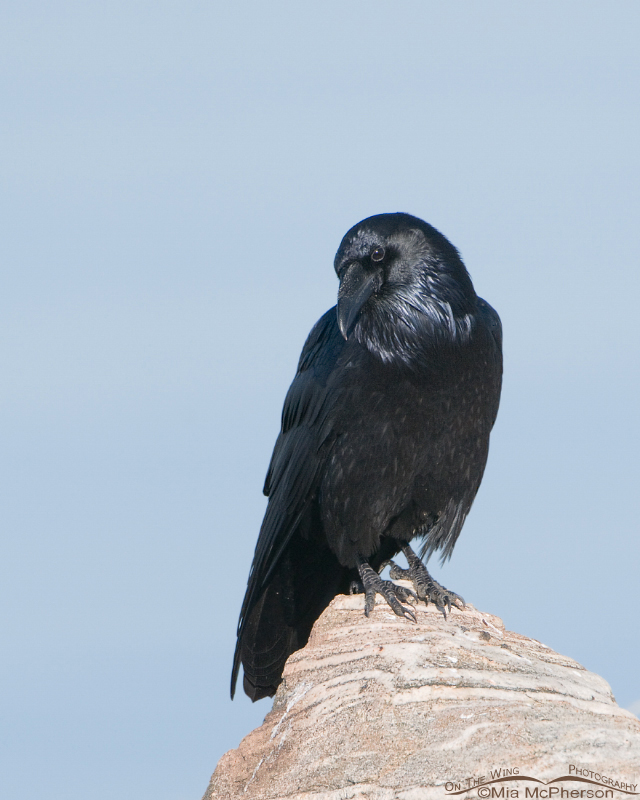
Common Raven on the causeway to Antelope Island
Nikon D300, f7.1, 1/1250, ISO 640, +0.7 EV, Nikkor 200-400mm VR with 1.4x TC at 400mm, natural light, not baited

Ravens hold a special place in my heart because they are smart (actually brilliant for birds), collectors of things shiny and/or odd, they let you know about their presence with hoarse croaking sounds and they are very amusing to observe and photograph.

Edgar Allan Poe considered them creepy, Native American’s regard them as tricksters and have marvelous stories about the birds.  Me; I like them a lot.

They are a challenge to photograph and expose properly because of their dark feathers and features. Earlier this week I spotted a Common Raven perched on a rock on the north side of the Antelope Island causeway, it turned out to be a very cooperative subject by staying perched on the rock for a period of about 15 minutes which allowed me to use different EV compensation settings and apertures.

The issues with exposing this bird correctly  were the lightness of the rock it was perched on and the light blue of the Great Salt Lake in the background. I needed to raise my EV compensation by +.07 to expose the blacks of the bird so details could be seen in the plumage but that left some areas of the rock a bit bright. I’ve found it easier to reduce exposure in light areas while post processing rather than trying to make dark tones lighter as that can introduce unnecessary noise in the dark areas. When I processed this file I brought the dark tones up slightly in ACR (Adobe Camera Raw), after that in Adobe Photoshop I selectively masked the perch and then brought the exposure down on just the rock.

What I liked most about this image in particular was the head angle and how the light showed the shiny iridescence of the Raven’s plumage.  I also like the nice clean background.

Earlier in this post I mentioned that Common Ravens are “collectors of things shiny and/or odd” and I wanted to provide an example of that. A few days before I photographed the Common Raven above I was out on Antelope Island and there were about 8 birds floating around in the wind near the shoreline of the Great Salt Lake over a sagebrush covered hill. I had been trying to photograph the ravens in flight when I noticed that one of the birds appeared to be carrying something in its feet. I knew the light angle was not the best but I took some shots anyway so that I could see what it was the raven had in its feet. When I got home and reviewed those images on my screen I was amused and puzzled at the same time. I had guessed from the pinkish color of the object that it might have been a very young vole, I was wrong! Way wrong.

Common Raven with Paddleball ball
Common Raven with a Paddleball ball?

I believe that the object the Common Raven was a ball from the children’s game “Paddleball”, it wasn’t a vole at all. I remember playing with Paddleball when I was a child. The puzzling thing; for me anyway, was where did the Common Raven find a Paddleball ball on Antelope Island or how it found it at all in the abundant grasses and sagebrush.

Pretty amazing “collector”!

Mia

Facebook Twitter

American Kestrel Male

American Kestrel (Falco sparverius) on a snowy perch

American Kestrel (Falco sparverius) on a snowy perch
Antelope Island State Park, Davis County, Utah
Nikon D200, f6.3, 1/640, ISO 400, +1.0, Nikkor 200-400mm with 1.4x TC at 400mm, natural light, not baited

The American Kestrel is our smallest falcon in North America but what they lack in size I feel they make up for in attitude.

This bird was perched on dried vegetation on Antelope Island State Park this past winter, there had been a light snow overnight and some of the snow was still sticking to the branches of the sagebrush. Because of the blue sky in the background I had to raise my EV to +1.0 so that the bird would not appear too dark. I’d rather get the exposure right in the camera than to try to raise the dark tones in post processing because that can introduce unnecessary noise.

Mia

More American Kestrel images

Facebook Twitter