Short-eared Owl in a fog – Nikon D300, f6.3, 1/1000, ISO 500, +1.0 EV, Nikkor 200-400mm VR with 1.4x TC at 400mm, natural light, not baited, called in or set up
Isn’t this Short-eared Owl lovely with her big yellow eyes? It had been a while since I had seen a Short-eared Owl and I was quite surprised when I spotted her on top of some snow-covered Rabbitbrush late last month along the causeway to Antelope Island State Park. It was a very foggy morning and the ground was covered in snow, the snow helped to brighten the scene some but I still had to increase my exposure compensation to +1.0 in order to expose her well in camera.
This image may be a bit high key for some people’s tastes but for me this image is a window showing a small portion of this owl’s world.
Coyote running across a snow drift – Nikon D300, f6.3, 1/1600, ISO 640, +1.0 EV, Nikkor 200-400mm VR with 1.4x TC at 400mm, natural light, not baited or called in
In my post yesterday I shared a Coyote photo in the snow and wanted to share a few more of the Coyotes I saw on Antelope Island State Park on Monday. It is a challenge to photograph in low light and snow, exposure compensation is key so that the subject isn’t too dark and the snow isn’t too bright. I opted to go light on the subjects in these images and brought down the exposure of the snow in post processing.
I mentioned that I spotted two Coyotes, one pale larger one I believe to be a male and a darker, smaller one I believe to be a female. The female never came up close like the pale Coyote did, the picture above shows the pale Coyote running through the snow as it came closer.
Coyote sniffing for voles – Nikon D300, f6.3, 1/1600, ISO 640, +1.0 EV, Nikkor 200-400mm VR with 1.4x TC at 328mm, natural light, not baited or called in
The pale Coyote was hunting, it would often stop and press its muzzle into the snow to sniff out voles. Just after the image above was created the Coyote stuck its nose into the snow drift. It was aware of our presence but didn’t seem bothered by us as it came so close I wasn’t able to focus on it at times.
Snowy Coyote portrait – Nikon D300, f6.3, 1/1250, ISO 640, +1.0 EV, Nikkor 200-400mm VR with 1.4x TC at 357mm, natural light, not baited or called in
I was able to zoom in and get some portraits of the pale Coyote with snow covering its muzzle and face.
Coyote and snow drifts pano – Nikon D300, f6.3, 1/1600, ISO 640, +1.0 EV, Nikkor 200-400mm VR with 1.4x TC at 400mm, natural light, not baited or called in
The Coyote that I believe to be the female because of its smaller size was more cautious than the paler Coyote and hung back, in front of her the pale Coyote’s tracks are just barely visible. She never came in close to us.
Coyote sitting on a road – Nikon D300, f6.3, 1/1600, ISO 640, +1.0 EV, Nikkor 200-400mm VR with 1.4x TC at 400mm, natural light, not baited or called in
The pale Coyote sat on the road and appeared to be waiting for the darker one to catch up but after a few minutes it was clear to us that she wasn’t going to and we passed the pale Coyote on the road. Later on after making a loop to the south of the island we saw them together again on a hill-side.
I know some people may not care for these images because they are high key but I find them; and the Coyotes, very appealing.
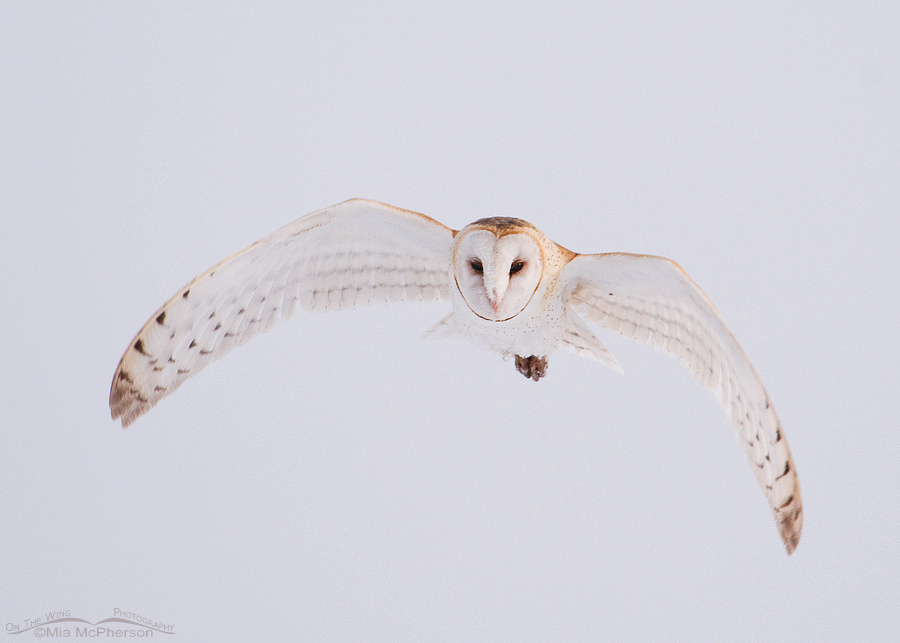
Fog can add a moody feel to images and yesterday there was plenty of fog at Farmington Bay Waterfowl Management Area. There were a few Barn Owls hunting for food and I captured images of this one as it flew towards me. The fog created the white background and there was just enough light to get a catch light in the eye.

Barn Owl flying in fog
With the whites in the owl and the fog I fell fortunate that the owl’s form stands out subtly from the background.
Barn Owl in flight on a foggy morning
I love the almost heart-shaped facial disc that Barn Owls have. These images are shown in the order that I created them, after taking the image above the owl turned east and I lost sharp focus.
Barn Owl searching for its prey in the snow
I mentioned in my recent post “Barn Owls and Harsh Winters” that the owls here are struggling because of the bitter cold we have been experiencing and how the heavy snow on the ground makes it hard for the owls to locate prey and I wanted to share this image of the Barn Owl after it dove into the snow to locate prey. I wish the owl would have been facing us because I can’t be sure the owl did locate the prey through what looks to be 8-9 inches of snow that is still laying on the ground. When I blow this image way up I think I see traces of blood on the bill so maybe it did get the prey.
The owl was in the snow for over 5 minutes then it lifted off to rest on the side of a small hill, through my lens I could see this owl shivering, the temp was around 7 degrees Fahrenheit. Over the next few days temperatures are going to be warming here and even though some snow is predicted to fall I am hoping the warmer temps will melt some of the snow and make it easier for the Barn Owls to locate their food. I hope so because the Barn Owls are struggling to survive now.
Mia
*All images taken with a Nikon D300, f6.3, ISO 640, shutter speed of 1/1000 to 1/1250, +1.0 EV, Nikkor 200-400mm VR with 1.4x TC at 400mm, natural light, not baited
Merlin (Falco columbarius) perched ~ Davis County, Utah Nikon D300, f6.3, 1/800, ISO 800, +1.0 EV, Nikkor 200-400mm VR with 1.4x TC at 400mm, natural light, not baited
Merlins are winter visitors in the Salt Lake Valley so I have just a few more weeks to attempt photographing them. Merlins are used to be called “pigeon hawks” because their shape and flight patterns are similar to pigeons. Merlins feed on small mammals, birds as large as doves and apparently they include bats in their diets.
Like other falcons Merlins are strong fliers, can turn very quickly and they can grab their prey in mid air.
I didn’t have the best of light when I photographed the Merlin in the photo above plus the fresh snow on the mountain slope behind the bird produced a high key effect but I liked the Merlin’s pose, the eye contact and the way the branches moved through the frame.
It seems that people either love high key images or they hate them. Personally; I believe that when a high key image is done well that they can be very appealing and have a place in my portfolio. Yesterday I went out on low light with falling snow to photograph birds on a pond near where I live and came back with a few high key images I really like, one of which I have posted below.
High key Mallard (Anas platyrhynchos) on snow ~ Salt Lake County, Utah December 13, 2011 Nikon D300, f6.3, 1/640, ISO 1000, +0.3 EV, Nikkor 200-400mm VR with 1.4x TC at 300mm, natural light
This Mallard had just come out of the water and was walking on snow-covered ice so in this case the foreground and background are entirely snowy white and by using exposure compensation of +0.3 I was able to expose the Mallard so that it would not need to be lightened in post processing introducing unwanted or unnecessary noise plus it showed nice details in her plumage. There is sufficient detail by the duck’s feet to show that it was walking on snow.
High key first year Bald Eagle ~ Davis County, Utah February 21, 2011 Nikon D200, f6.3, 1/250, ISO 320, +0.3 EV, Nikkor 200-400mm VR with 1.4x TC at 300mm, natural light, not baited
High key images do not always have white backgrounds, at times they are very light colors or a combination of colors like in this image of a first year Bald Eagle, the upper portion is sky and the lighter area below is snow on the ground. Because of the light and the exposure compensation I used I was able to retain the bird’s color and fine details in the plumage.
High Key Rough-legged Hawk lift off ~ Davis County, Utah December 12, 2011 Nikon D300, f5.6, 1/1600, ISO 800, +1.0 EV, Nikkor 200-400mm VR with 1.4x TC at 335mm, natural light, not baited
Gray or milky skies often lend themselves to the creation of high key images, when I photographed the Rough-legged Hawk above the skies were grey but in the distant background the out of focus mountains are still visible.
Personally I like all three images and will continue to look for the opportunity to create more high key images. They are different than my “normal” images but creating them also tests and increases my photographic skills and I enjoy that.
Mia
Rough-legged Hawk preening
Visit my photo galleries by clicking the image above
Photographing a Tricolored Heron from a tidal lagoon