Ospreys of Flaming Gorge

Male Osprey in flightMale Osprey in flight – Nikon D300, f6.3, 1/640, ISO 800, +1.0 EV, Nikkor 200-400mm VR with 1.4x TC at 400mm, natural light, not baited

Our trip to Flaming Gorge National Recreation Area in northeastern Utah was great despite my having been ill the last night we were there. We camped in two different locations this time and both had grand views of the Flaming Gorge Reservoir.

Last year at about this same time these Osprey were busy building their nest while this year they were already sitting on eggs.  The male pictured above was flying past the nest with part of a fish in its talons. We sat for nearly an hour watching the male eat this fish on a distant power pole before he flew past. Have I ever mentioned that one needs tons of patience to be a bird photographer?

Female Osprey in golden lightFemale Osprey in golden light - Nikon D300, f5.6, 1/1000, ISO 800, Nikkor 200-400mm VR with 1.4x TC at 357mm, natural light, not baited

The light in the morning can be gorgeous at Flaming Gorge, it was when I photographed the female regaining her balance on top of a power pole near the nest. We didn’t see much of this golden light though this trip. The Uinta Mountains can create their own weather and they certainly did the days we were there with clouds building up in the afternoons, some rain and thunderstorms too.

Female Osprey in low lightFemale Osprey in low light - Nikon D300, f5.6, 1/160, ISO 1250, -0.7 EV, Nikkor 200-400mm VR with 1.4x TC at 400mm, natural light, not baited

The last morning the light was low with clouds that were blocking the sun and spitting some rain down on us. I bumped my ISO up to 1250 and hoped to get a few useable images of the Osprey before we left. Even at ISO 1250 I wasn’t getting the shutter speed I would have liked and all the flight images I took had plenty of motion blur, I think I was quite lucky to get the female’s face in focus as she came in for a landing in this frame.

The beauty of Flaming GorgeThe beauty of Flaming Gorge - Nikon D300, f8, 1/500, ISO 400, +0.3 EV, Nikkor 18-200mm VR at 95mm, natural light

Who couldn’t love this view? I know each time I see it I am in awe of the beauty of the Flaming Gorge National Recreation Area, and this view is just a tiny part of the stunning vistas seen in the area.

I’ll be posting more Osprey images from this journey later along with scenery from other parts of the Recreation Area and Ashley National Forest.

Facebook Twitter

Photographing Red-tailed Hawk juvies on the wing

Red-tailed juvenile landing on a rock outcropping

Red-tailed juvenile landing on a rock outcropping – Nikon D300, f6.3, 1/2000, ISO 640, Nikkor 200-400mm VR with 1.4x TC at 300mm, natural light, not baited

These are a just few images that I have edited taken since August of Red-tailed Hawk juveniles on Antelope Island State Park.

The juvenile Red-tailed above was just coming in to land on a rocky out cropping, the white wash is a sign that this rock is used as a perch often and not just by the Red-tailed Hawks. I’ve seen American Kestrels, Chukars, Rock Wrens, Western Meadowlarks and more on those rocks.

Red-tailed Hawk juvenile and its shadow

Red-tailed Hawk juvenile and its shadow – Nikon D300, f6.3, 1/1250, ISO 640, +0.3 EV, Nikkor 200-400mm VR with 1.4x TC at 400mm, natural light, not baited

Even though the young  hawk is small in the frame in this image I like it because of the bird’s shadow falling on the rock below it.

Red-tailed juvie flying past

Red-tailed juvie flying past – Nikon D300, f6.3, 1/1600, ISO 500, +0.3 EV, Nikkor 200-400mm VR with 1.4x TC at 400mm, natural light, not baited

This immature Red-tailed Hawk was looking at the rock it would soon perch on as it flew past me.

We have lift off

We have lift off – Nikon D300, f6.3, 1/2000, ISO 640, -0.3 EV, Nikkor 200-400mm VR with 1.4x TC at 400mm, natural light, not baited

This Red-tailed juvenile was just lifting off from the dark rocks when I created this image, the talons on the bird’s right foot were still touching the perch it was leaving. This frame shows how long the legs of these Red-tailed Hawks actually are.

Mia

More Red-tailed Hawk images

Facebook Twitter

Juvenile Red-tailed Hawk

Red-tailed juvenile lifting off

Red-tailed juvenile lifting off – Nikon D300, f6.3, 1/2500, ISO 640, +0.3 EV, Nikkor 200-400mm VR with 1.4x TC at 400mm, natural light, not baited

One of the nice things about cruddy weather is that I get the chance to edit some of the images that are languishing in my files that I have taken but not gotten around to processing. Here are a few of a juvenile Red-tailed Hawk photographed in August on Antelope Island State Park.

I caught the juvenile Red-tailed with its feet still on the perch and its wings lifting.

Red-tailed Hawk right after lifting off

Red-tailed Hawk right after lifting off – Nikon D300, f6.3, 1/2500, ISO 640, +0.3 EV, Nikkor 200-400mm VR with 1.4x TC at 400mm, natural light, not baited

This is the next frame, the young hawk has left the perch and its wings are in a fully raised position.

Red-tailed Hawk juvenile flying by

Red-tailed Hawk juvenile flying by – Nikon D300, f6.3, 1/2000, ISO 640, +0.3 EV, Nikkor 200-400mm VR with 1.4x TC at 357mm, natural light, not baited

I’d like this image a whole lot better if the hawk had been a little higher so the out of focus rock and foreground vegetation weren’t in front of the left wing and tail of the Red-tailed.

Red-tailed Hawk landing

Red-tailed Hawk landing – Nikon D300, f6.3, 1/2500, ISO 640, +0.3 EV, Nikkor 200-400mm VR with 1.4x TC at 328mm, natural light, not baited

This is a “kick my own butt” shot because it is such a dynamic landing pose and I messed up by clipping the top of the wings. If only I had pulled my zoom back a bit or raised my lens a little. My bottom was sore for days.

Red-tailed Hawk gliding past

Red-tailed Hawk gliding past – Nikon D300, f6.3, 1/2000, ISO 640, Nikkor 200-400mm VR with 1.4x TC at 400mm, natural light, not baited

I think I was able to take about 20 images of the juvenile as it slowly glided by towards prey on the ground.

Perched juvenile Red-tailed Hawk

Perched juvenile Red-tailed Hawk – Nikon D300, f6.3, 1/2000, ISO 640, Nikkor 200-400mm VR with 1.4x TC at 400mm, natural light

I like how regal the young Red-tailed looks in this frame.

Mia

Facebook Twitter

More Raptor Rapture – Red-tailed Hawk Juvenile

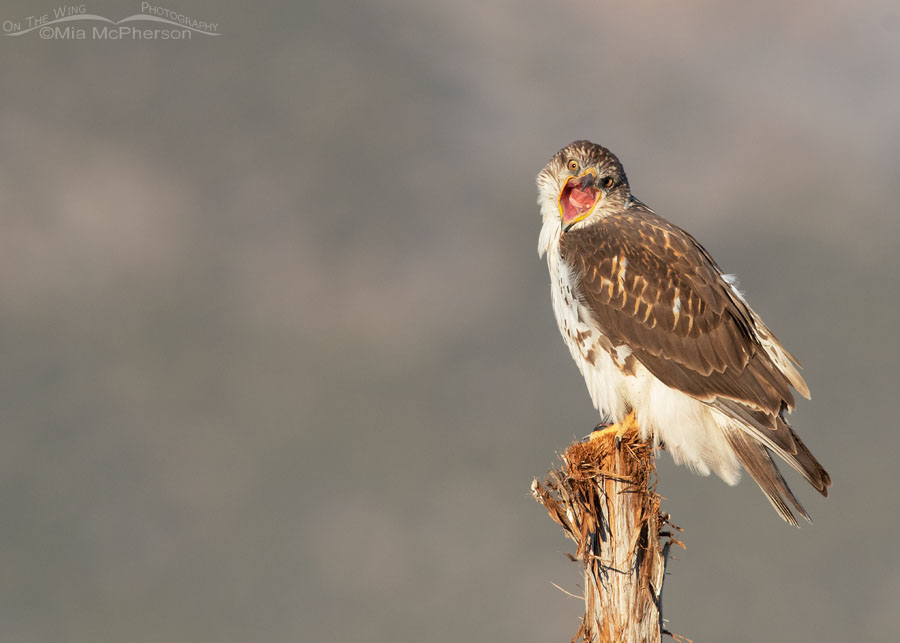
These juvenile Red-tailed Hawk (Buteo jamaicensis) images were taken on two consecutive days last week. I’m always excited to have a bird in my view finder and when I can photograph hawks for two days in a row… I feel raptor rapture.

About to land

About to land – Nikon D300, f6.3, 1/1600, ISO 640, +0.3 EV, Nikkor 200-400mm VR with 1.4x TC at 350mm, natural light, not baited

Red-tailed Hawk juveniles do not have the namesake “red-tail”; they will develop that as they mature, but they have the same beauty and power that the adults do.

Juvenile Red-tailed Hawk coming in for a landing

Juvenile Red-tailed Hawk coming in for a landing – Nikon D300, f6.3, 1/1250, ISO 640, +0.3 EV, Nikkor 200-400mm VR with 1.4x TC at 328mm, natural light, not baited

Fortunately for me on the two days I photographed this hawk it was intent on hunting and paid no mind to my presence as I focused on it from inside a mobile blind (pickup). It would perch for a bit while it scanned for prey and then swoop down into the grasses to search for it.

Perched juvenile Red-tailed Hawk

Perched juvenile Red-tailed Hawk – Nikon D300, f6.3, 1/1600, ISO 640, +0.3 EV, Nikkor 200-400mm VR with 1.4x TC at 400mm, natural light, not baited

It is said that Red-tailed Hawks can spot a rodent from 100 feet in the air which to me is amazing because quite often there will be grasses or other vegetation that could partially obstruct the view of the prey. That is probably why a person with keen eyesight could earn the nickname “Hawk Eye”.

The moment of lift off

The moment of lift off – Nikon D300, f6.3, 1/2000, ISO 640, -0.3 EV, Nikkor 200-400mm VR with 1.4x TC at 400mm, natural light, not baited

By carefully observing this young Red-tailed Hawk’s behavior, body movements and by paying attention to its eyes I was able to anticipate when it would lift off. Learning how to do that is important for those action shots.

Focused look of determination on a juvenile Red-tailed Hawk

Focused look of determination on a juvenile Red-tailed Hawk – Nikon D300, f6.3, 1/2000, ISO 640, -0.3 EV, Nikkor 200-400mm VR with 1.4x TC at 400mm, natural light, not baited

Focus” is a word I often think of when I am watching raptors hunt because it appears to me that they are entirely focused on their prey; after all, their lives depend on their hunting skills. This immature bird seems to miss more than it actually captures but it will develop better skills as it ages.

Juvenile Red-tailed looking at a new perch

Juvenile Red-tailed looking at a new perch – Nikon D300, f6.3, 1/2500, ISO 640, -0.3 EV, Nikkor 200-400mm VR with 1.4x TC at 321mm, natural light, not baited

I watched as this keen-eyed youngster located, captured and ate a small snake. I don’t have any images of it swallowing the snake because it was too far away and my view was obstructed by tall grasses and Moth Mullein stems. That was a disappointment, I would have loved to have had those images in my portfolio.

Red-tailed juvenile flying past a dark rock face

Red-tailed juvenile flying past a dark rock face – Nikon D300, f6.3, 1/3200, ISO 640, -0.3 EV, Nikkor 200-400mm VR with 1.4x TC at 321mm, natural light, not baited

Look at those talons, the sharp hooked bill and the feathers that are built just right for carrying this handsome young Red-tailed Hawk through the air to capture and devour its prey. This is perfection.

Back view of the young Red-tailed Hawk and its shadow

Back view of the young Red-tailed Hawk and its shadow – Nikon D300, f6.3, 1/2000, ISO 640, -0.3 EV, Nikkor 200-400mm VR with 1.4x TC at 400mm, natural light, not baited

Normally I don’t keep images without eye contact from my subject but in this image I was fascinated by the landing pose, the great view of the spread wings, fanned tail, the intricate plumage patterns and the shadow below the hawk.

I am hoping that this juvenile hawk and it’s darker and more elusive sibling will continue to stick around the area where I located them so that I may have; as my friend Shyloh puts it, more “face melting” opportunities with these incredible birds. Yeah, they make my face melt from smiling so much.

I’m looking forward to more Raptor Rapture!

Mia

More Red-tailed Hawk images

Facebook Twitter

Juvenile Red-tailed Hawk in landing pose

Juvie Red-tailed Hawk coming in for a landing

Juvie Red-tailed Hawk coming in for a landing – Nikon D300, f6.3, 1/1250, ISO 640, +0.3 EV, Nikkor 200-400mm VR with 1.4x TC at 328mm, natural light, not baited

I had fun yesterday photographing this juvenile Red-tailed Hawk (Buteo jamaicensis) as it perched on rocks and hunted for prey. This image shows the Red-tailed coming in for a landing.

More images of this young hawk to come soon. Got to go, I’m going to see if I can relocate it this morning!

Mia

More Red-tailed Hawk images

Facebook Twitter