Wilson’s Plover in habitat

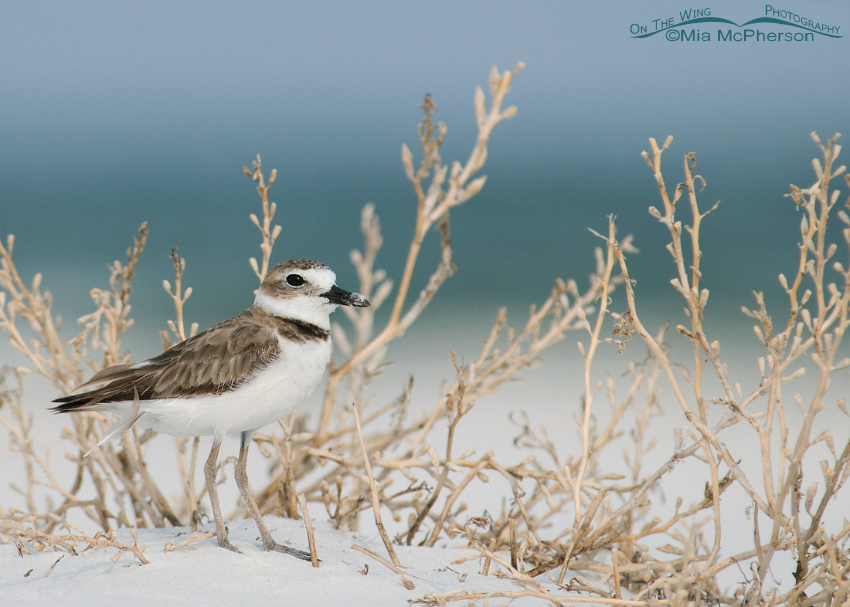
Wilson's Plover in dried Sea Purslane

Wilson’s Plover in dried Sea Purslane – Nikon D200, handheld, f6.3, 1/640, ISO 250, +0.3 EV, Nikkor 80-400mm VR at 400mm, natural light

One of the shorebirds that I saw often along the coast of Florida year round was the Wilson’s Plover. Wilson’s Plover are the largest of the belted plovers and are found primarily along the coastlines of the Gulf of Mexico and the Atlantic ocean up to about the Chesapeake Bay, they can also be found on the Pacific coast of the Baja Peninsula of Mexico. Their long, thick black bill is distinctive and a great key for identification.

Just watching the two chicks running around in the dunes like small windup toys made me realize what a hard job it is for the adult plover to protect their young. I very much enjoyed the setting I photographed this plover in and loved the loose feather near the bird’s rump.

Mia

More Wilson’s Plover images

Facebook Twitter

Sand Dunes – Two Scenic Images

While looking through my archives a few days ago I came across two images, one of sand dunes at Fort De Soto County Park in Florida and the other of sand dunes on Antelope Island State Park in Utah. I remember that I took both images because I loved the sky, the vegetation on the dunes and how they both make me feel so connected to these two locations that I am deeply attached to.

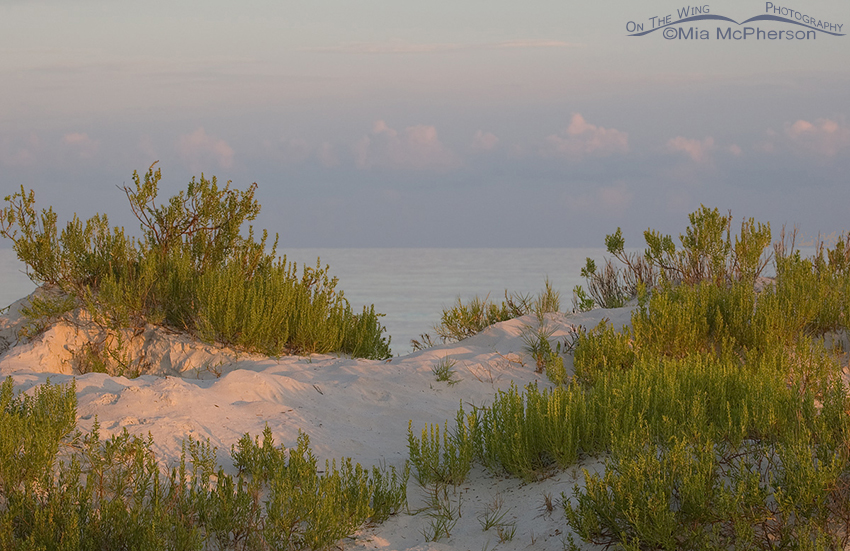
Sand Dune at Fort De Soto in early morning light

Sand Dune at Fort De Soto in early morning light – Nikon D70, handheld, f6.3, 1/160, ISO 200, Nikkor 70-300mm VR at 70mm

I created the image above while walking Fort De Soto’s north beach early in the morning of July 20, 2007, the sun had crested the horizon and had just begun to light up the dunes. Although Fort De Soto has many dunes covered with beautiful Sea Oats, in this image I liked how the Sea Purslane hugged the dune and how the tips of the plants seemed to glow with the early morning light. The sunlight had not yet lit up the surface of the Gulf of Mexico but had started to light up the tops of the storm clouds hanging in a bank off of the coast.

When I look at this image I can smell the salty air, the sand under my feet, the breeze ruffling my hair and the warmth of the sun’s rays warming my back.

Fort De Soto County Park is one of my favorite locations to photograph birds, scenery and clouds. More of my thoughts about Fort De Soto can be read here ”My Love Affair with Fort De Soto“.

Sand Dunes on Antelope Island State Park, Utah

Sand Dunes on Antelope Island State Park, Utah – Nikon D200, handheld, f11, 1/500, ISO 400, Nikkor 18-200mm VR at 18mm

I was camping on Antelope Island State Park when I photographed the image above the evening of March 30, 2011. I thought the sky was captivating with the swirly, layered clouds against the warm tones of the sand and the yet to green up Sagebrush and Rabbitbrush that grow on the oolitic sand dunes there. So very different from the dunes at Fort De Soto but they are equally appealing to me.

Antelope Island State Park is another of my favorite locations to go to photograph, it seems I always find something to catch my eye and tug at my heart there. I recently did a three-part series of articles I titled “Wild and Wonderful – Antelope Island State Park” on the scenery, the wildlife and the birds. I could not fit it all into one article.

Just two simple images from two different locations that whisper “home” to me.

Mia

Facebook Twitter

Friday Photos – Wilson’s Plover

Adult Wilson's Plover (Charadrius wilsonia) in dried Sea Purslane
Adult Wilson’s Plover (Charadrius wilsonia) in dried Sea Purslane
Fort De Soto County Park, Pinellas County, Florida
Nikon D200, handheld, f6.3, 1/640, ISO 250, +0.3 EV, Nikkor 80-400mm VR at 400mm, natural light

This Friday’s Photo is that of a Wilson’s Plover, a species I very much enjoyed photographing while I lived in Florida. Wilson’s Plovers are strictly coastal shorebirds so here in Utah I don’t get to see them. They are found from the mid-Atlantic states down to Florida, Cuba and all along the Gulf shorelines. A subspecies; Charadrius wilsonia beldingi, is found on the Mexican Pacific coast and the Gulf of California.
Wilson’s Plovers nest in simple scrapes that can be found on the sandy shorelines and in sand dunes. This adult did have several chicks at the time I photographed it and it had been running along trying to keep up with the young birds when it took a short break on this sand dune amongst some dried Sea Purslane. The chicks appeared to have a mind of their own and were running willy-nilly through the dunes. Must be exhausting for the adults to keep up with with their young. I couldn’t help but laugh at the actions of the seemingly strong-willed but very curious chicks.

Mia

* I’m stuck at home today waiting for the delivery of a replacement for my Jobu Black Widow Gimbal HD head. I had trouble with the older version when my locking pin broke off a few weeks ago. Jobu Design has been great about accepting the old Gimbal head back and replacing it with the newer version for a small upgrade fee. Although I rarely use a tripod, when I need it I really need it! My Nikkor 200-400mm VR f/4 gets a bit heavy to handhold for me so I can’t wait to get this new Gimbal set up.

More Wilson’s Plover images

Facebook Twitter

Nesting American Oystercatchers

American Oystercatchers Nesting

American Oystercatcher Nesting #1
Fort De Soto County Park, Pinellas County, Florida
The images on this page were taken with a Nikon D200, apertures of f6.3 & f7.1, ISO 200,
shutter speeds that varied between 1/500 and 1/800, Nikon 80-400mm  VR at 400mm.

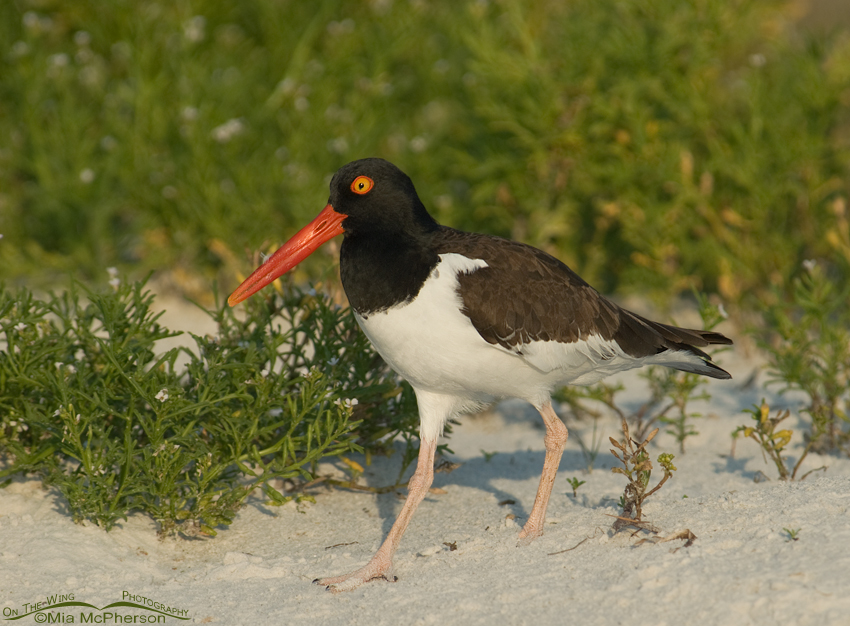
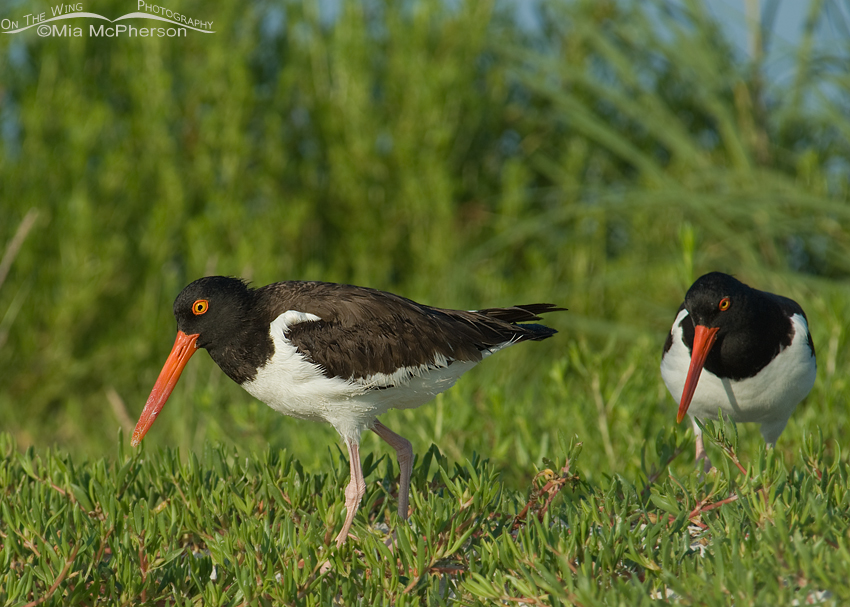
I watched this pair of American Oystercatchers (Haematopus palliatus)  for about half an hour and was able to observe and photograph them taking turns sitting on the nest in the Sea Purslane. American Oystercatchers are colorful, with an orange eye  ring, bright yellow eyes, thick pinkish legs and a long orange bill that they use to pry open bivalve mollusks. They have white underparts and are dark brown over the wings and tail while  the head is mostly black.

American Oystercatchers Nesting

American Oystercatcher Nesting #2

The nests of Oystercatchers are simple scrapes on coastal beaches, dunes and salt Marshes. They usually lay between 2-3 eggs around April to May. There are times when the first brood fails and they do re-nest. American Oystercatchers are exclusive to saltwater coastal habitats. This pair created their nest on a small purslane  and sea oat covered dune.

American Oystercatchers Nesting

American Oystercatcher Nesting #3

While one adult sits on the eggs the other goes off to feed. I noticed that the time interval between switching was between half an hour to forty-five minutes.

American Oystercatchers Nesting

American Oystercatcher Nesting #4

This pair of Oystercatchers first nest failed because a raccoon invaded  it and ate the eggs.  I have also witnessed Great Blue Herons attempting to steal the eggs.

American Oystercatchers Nesting

American Oystercatcher Nesting #5

Photographing American Oystercatchers can be challenging with the high contrast of whites, darks and oranges. Photographing them in early morning or late afternoon light helps or photographing on a day when the clouds diffuse the light.

Mia

Ethics on photographing nesting birds:

  • Do not approach too closely
  • If the birds show any sign of distress, back away
  • Don’t trim leaves, twigs or branches to get a clearer shot, you may inadvertently attract predators or cause the eggs/chicks to over heat
  • Follow local, state and federal guidelines concerning nesting birds
  • Don’t harrass the birds to get an action shot

More of my American Oystercatcher images

Facebook Twitter