Sanderling in nonbreeding plumage – Nikon D200, handheld, f6.3, 1/1250, ISO 200, Nikkor 70-300mm VR at 300mm, natural light
Sanderlings look very different in appearance during breeding season and winter and novice birders might even think they are two different species. I’ve heard people call nonbreeding Sanderlings “drab” and “plain” and while they might not be as colorful in nonbreeding plumage I personally wouldn’t call them drab or plain. I would, however; call them a challenge to expose properly and to get them in the frame because they are very active shorebirds when feeding.
The Sanderling above is in nonbreeding plumage and it was racing down the beach hunting for prey when I photographed it. At first I wasn’t happy with the motion blur of the bird’s right foot but the more I looked at this image the more I liked the motion blur because it indicates movement.
Sanderling in breeding plumage – Nikon D200, handheld, f6.3, 1/500, ISO 400, Nikkor 70-300mm at 300mm, natural light
This image taken about a month later than the first image shows a Sanderling in breeding plumage, it was created during May which is about the time that the Sanderlings head north to their breeding grounds. Although the belly is still white and the legs and bill are still black the head, neck and back of the bird is quite different. Rufous is the color I think of when seeing a Sanderling in breeding plumage because that color is evident in the head, neck and back of the bird.
A side note; I often hear people say you must have a long (read expensive) lens to photograph birds and in some cases you do actually need a long lens to get frame filling images of birds however in some situations you can get those even with a shorter focal length. Both of the images above were taken with an inexpensive Nikkor 70-300mm VR lens and what made them possible is that these birds were habituated to human presence on the beach so they weren’t as nervous around me and I used very slow belly crawls to get close to them. By being low I appeared less threatening to them and at times the birds would come in so close I could not focus on them. Down & dirty can and does pay off.
Not long after arriving at Antelope Island yesterday I heard the sound of Coyotes singing, it is a sound that always brings a smile to my lips and delights me.
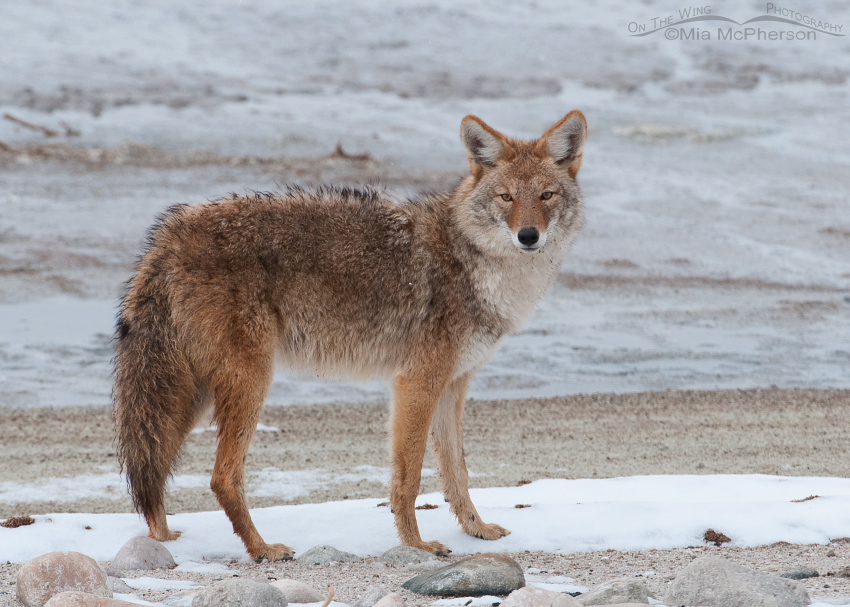
Coyote on the shore of the Great Salt Lake 1 – Nikon D300, f6.3, 1/2500, ISO 640, Nikkor 200-400mm VR with 1.4x TC at 242mm, natural light, not baited or called in
I couldn’t get any decent images of the pair of singing Coyotes on the island because there was too much dried vegetation in the way but it was fun to watch them even though they had stopped calling by then.
Later on; after leaving the island, I spotted another pair of Coyotes along the causeway and photographed them for a while. They were probably going to look for the leftover bits of ducks that the falcons leave on the shoreline of the Great Salt Lake.
Coyote on the shore of the Great Salt Lake 2 – Nikon D300, f7.1, 1/2500, ISO 640, Nikkor 200-400mm VR with 1.4x TC at 257mm, natural light, not baited or called in
I enjoy photographing the Coyotes along the causeway because the setting there is so different from the prairie grasses and sagebrush habitat on the island itself.
Coyote on the shore of the Great Salt Lake 3 – Nikon D300, f7.1, 1/2000, ISO 640, Nikkor 200-400mm VR with 1.4x TC at 257mm, natural light, not baited or called in
The Coyotes look beautiful in their fluffy winter coats and the warm morning sunlight. I can’t wait to hear the Song Dogs sing again, it is a sound that should never be silenced.
Prairie Falcon fly by after attacking the Northern Shoveler
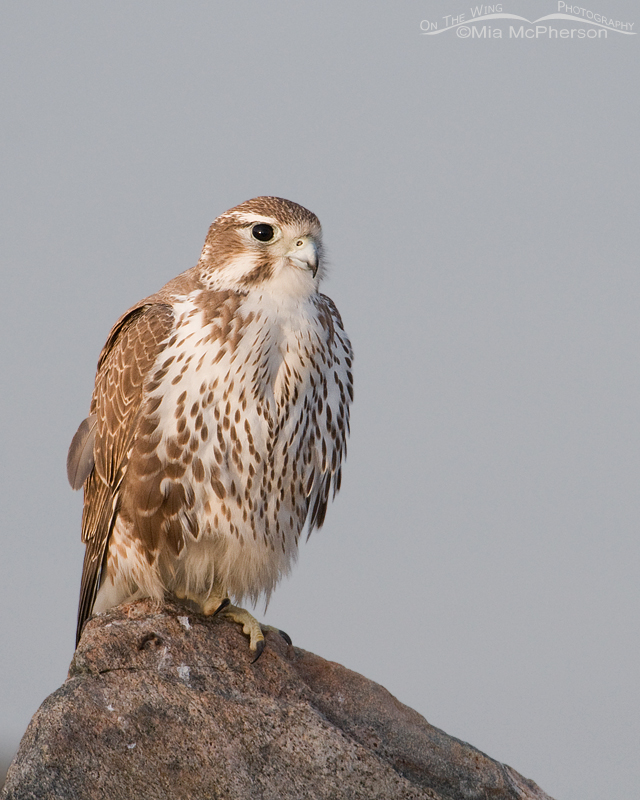
Earlier this morning I spotted a Prairie Falcon perched on a rock while on the Antelope Island Causeway, before we could get stopped and into position to photograph the falcon it took off over the water and attacked a Northern Shoveler. The duck was floundering in the water and the Prairie Falcon flew over and past it when I took this image.
Another flyby – Prairie Falcon
The Prairie Falcon made several passes up and down the shoreline, landing, then taking off again. The waves pushed the dying Northern Shoveler closer and closer to the shore.
Prairie Falcon with Northern Shoveler at the edge of the Great Salt Lake
When the duck reached the shoreline the falcon showed a bit of hesitation about going over to it and after a bit the bird flew over to the Shoveler which was still part way in the water.
Prairie Falcon tearing into the neck of the Northern Shoveler
The Prairie Falcon tore into the neck of the duck at this point even while the waves rocked the duck and the falcon gently back and forth.
Prairie Falcon moving the Northern Shoveler from the water 1
The the falcon gripped the duck with its talons, I wasn’t sure if it was going to fly away with its prey or just bring it on to the shore.
Prairie Falcon moving the Northern Shoveler from the water 2
The Prairie Falcon seemed to struggle a bit with the weight of the Shoveler which can weigh up to 1.3 pounds (375 grams).
Prairie Falcon moving the Northern Shoveler from the water 3
The falcon used its wings and its free foot to move the duck.
Prairie Falcon moving the Northern Shoveler from the water 4
It seemed determined to move it away from the water.
Prairie Falcon moving the Northern Shoveler from the water 5
I really liked this pose and the great eye contact the raptor was giving me.
Prairie Falcon moving the Northern Shoveler from the water 6
The falcon continued to drag the duck to drier ground.
Prairie Falcon with Northern Shoveler on the shore
It finally made it! The small waves were not reaching this section of the shoreline. I like how this shows the yellow feet, the dark tips of the talons and the yellow cere of this adult Prairie Falcon.
Prairie Falcon devouring the Northern Shoveler
The falcon wasted no time and tore into the breast of the Northern Shoveler and feathers were flying as it did. I wish that the bird had been closer but if it had been it might not have stuck around to eat its prey in front of us. The light began to fade as another cloud came in from the west, it was snowing (again) to the south and west.
Prairie Falcon with a pile of feathers from the Northern Shoveler
The falcon really chowed down on the Shoveler as we watched and photographed. When we left because the light was leaving us the handsome raptor was still there and still eating the duck.
I have to tell you it feels totally awesome to watch a falcon attack, bring in and eat the prey it caught naturally. These birds are simply amazing.
All of these images were taken with my Nikon D300 and Nikkor 200-400mm VR with 1.4x TC lens resting on my noodle. The Prairie Falcon wasn’t baited, it supplied its own food.
Mia
(I took a boat load of images of this falcon, these were just a few that I liked)
If you see a graphic here that says “STOP The Owner of this site STEALS Bandwidth and uses images Illegally without the COPYRIGHT Holder’s permission” it is because WallPaperFever.com hot linked my image and offered it for public use as wallaper WITHOUT my permission. People who do this should have their sites shutdown permanently because they are violating Copyright laws. For those who want to see the actual image go to the previous post then click the link back to this one.
Western Sandpiper on the go – Nikon D200, handheld, f6.3, 1/1000, ISO 200, Nikkor 70-300mm VR with 1.4x TC at 300mm, natural light
It dawned on me this morning that I haven not posted an image of a Western Sandpiper (Calidris mauri) here yet so I pulled this one out of my archives that I photographed at Fort De Soto, Florida as the small shorebird ran in front of me on the shoreline. Western Sandpipers winter along the Atlantic, Pacific and Gulf of Mexico coastlines as well as in the Caribbean and interior Mexico. The bird above was going into breeding plumage as indicated by the rusty cap and cheek patch, in full breeding plumage the wings would also show more rust color.
I was laying in the wet sand on the shoreline of the Gulf of Mexico when I created this image, I had been photographing nearly stationary birds when I saw this sandpiper about to run in front of me so I panned my lens to keep up with the running bird. I didn’t have time to change my ISO to gain shutter speed so the movement of the legs is not frozen. In this case though I like the motion blur of the legs because in my eye it shows movement.
Last week I posted some fun images of a Coyote with Falcon leftovers taken along the shoreline of the Great Salt Lake with piles of ice in the background. Six days later, on January 1st, I had more fun with a Coyote in almost the same location.
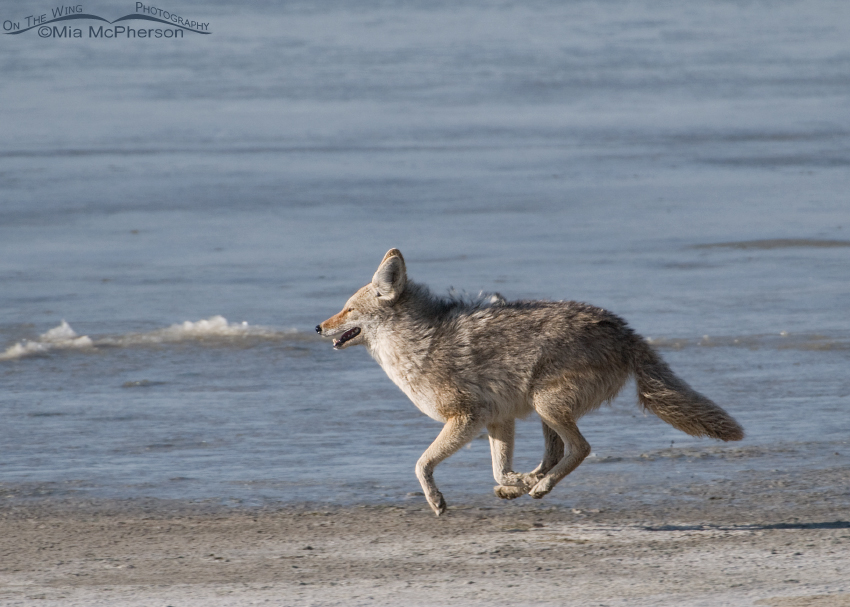
Coyote running on the shoreline of the Great Salt Lake ~ Davis County, Utah Nikon D300, f6.3, 1/2500, ISO 640, Nikkor 200-400mm VR with 1.4x TC 200mm, natural light, not baited or called in
The piles of ice from my earlier Coyote series of images are nearly gone due to some warm weather but the lake is still frozen in many areas. This Coyote was running; perhaps a better term would be galloping, along the shoreline and didn’t seem to be in the mood to hunt at all.
Coyote on the go Nikon D300, f6.3, 1/2500, ISO 640, Nikkor 200-400mm VR with 1.4x TC at 200mm, natural light, not baited or called in
This Coyote looks a bit messier than the other one that I posted last week but I think that just adds to the scruffy reputation that Coyotes seem to have. I had to pull my zoom all the way back to 200mm to try to keep the Coyote in the frame as it ran and I still had plenty of shots where I had clipped a part of it.
Three feet off of the ground Nikon D300, 1/2000, ISO 640, Nikkor 200-400mm VR with 1.4x TC at 200mm, natural light, not baited or called in
The Coyote was intent on its path and it was a challenge to try to get eye contact from it but several times it turned and looked my way. In the image above I was able to get three feet clearly off of the ground plus I had eye contact.
Coyote in the air Nikon D300, f6.3, 1/2500, ISO 640, Nikkor 200-400mm VR with 1.4x TC at 200mm, natural light, not baited or called in
Several times I was able to capture photos of the Coyote with all four feet off of the ground, I liked this frame because all of the feet were in the air, the eye is clearly visible, the mouth is open and the teeth are showing plus I really like the setting. The out of focus vegetation on the bottom of the image isn’t ideal but I believe the strengths of the photo outweigh the minor distractions there.
Coyote braking to turn around Nikon D300, f6.3, 1/2000, ISO 640, Nikkor 200-400mm VR with 1.4x TC at 200mm, natural light, not baited or called in
I wanted to keep my shutter speed high to capture all the movement so I set my ISO to 640 and my aperture at f6.3, the light was great so I didn’t need to adjust my exposure compensation at all. I used Aperture Priority and Auto White Balance and those settings worked very well.
When I took this last image the Coyote was slowing down to turn and go across to the other side of the road. I thanked the Coyote and went on down the road. (Yes, I thank my subjects)