

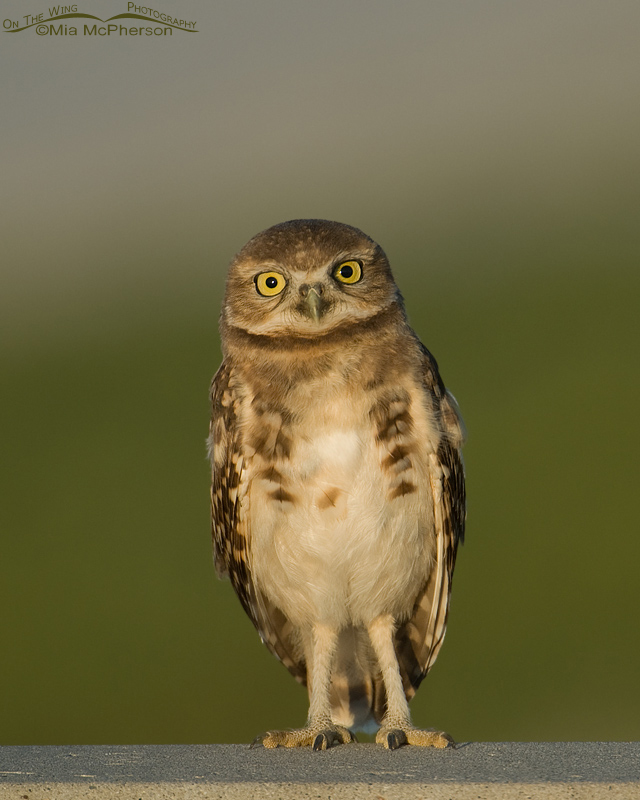
 Young Burrowing Owl – Nikon D200, f6.3, 1/320, ISO 200, Nikkor 200-400mm VR with 1.4x TC at 400mm, natural light, not baited
Earlier this year in March I wrote an article titled “Burrowing Owls – Loved to Death?” and this post is a sequel to it. If you didn’t read the first post about these amazing Owls you might want to click here (opens in a new window) before continuing to read this post so that you might understand why I am writing this sequel.
A brief excerpt below:
“When we came around the hill where the burrow is visible we saw three vehicles parked on both sides of the road but that wasn’t the shocker. There were three photographers, all with long lenses, out of their vehicles plus another person who didn’t have a camera in hand. What made me sick was that there were three of those people tromping around the owl’s burrow. I mean RIGHT up on it. They had no need to be that close but they were.
I felt like my stomach had been punched. You know, I can understand wanting to have a close look at the burrow but not at this time of the year, not when there are chicks, not when fledglings are still present and certainly not before or as the adult owls are in the process of deciding whether to use the same burrow again.”
I was concerned that day after seeing those people stomping around on top of the owl burrow, I wondered what I would see during the rest of the nesting season for those Burrowing Owls after those people disturbing the birds and the nesting site.
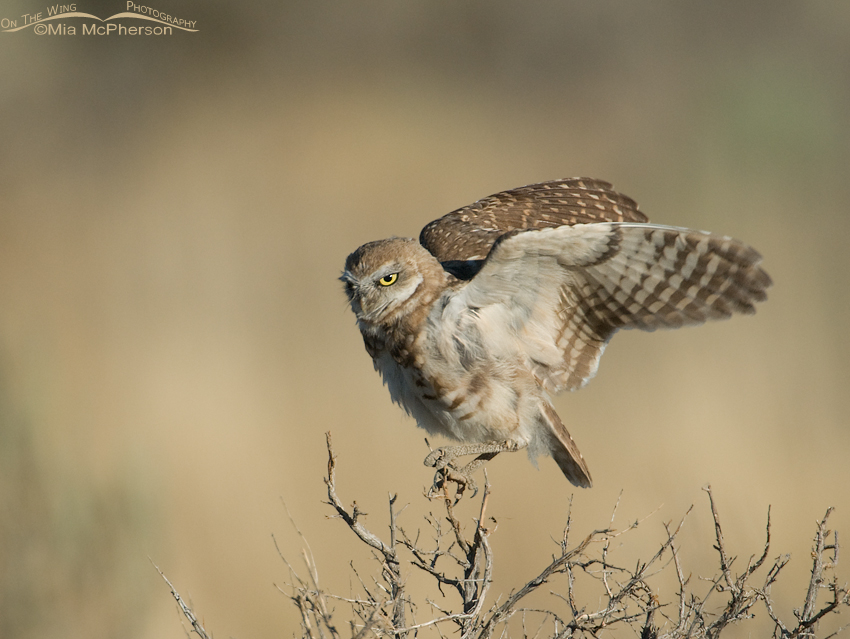
Juvenile Burrowing Owl flapping its wings – Nikon d200, f6.3, 1/1600, ISO 400, Nikkor 200-400mm VR with 1.4x TC at 400mm, natural light, not baited
After those photographers harassed the owls by approaching and standing on top of the burrow the behavior of one of the adult owls changed significantly.
The previous year I had found that by parking on the side of the road and using a vehicle as a mobile blind these owls were not disturbed by our presence and did not show any signs of distress. They went about their normal habits which made for great opportunities to photograph them.
But not any more. Even when slowly driving up to park the visible owl at this disturbed burrow would sound a series distress calls then fly far from the nesting site. It did that even weeks after the burrow disturbance. I kept hoping that things would go back to normal for the owls.
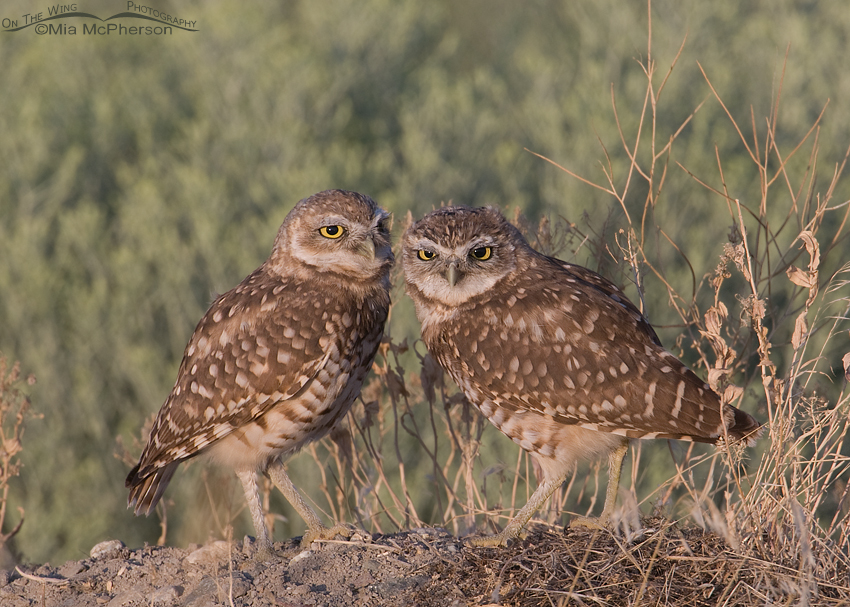
A pair of juvenile Burrowing Owls – Nikon D200, f10, 1/160, ISO 250, Nikkor 200-400mm with 1.4x TC at 400mm, natural light, not baited
Last year at this time the juveniles were out of that same burrow, perching on the sagebrush, hiding in the grass, learning to fly and interacting with the adults and siblings. They were enormous fun to observe and photograph and by using a mobile blind they were not harassed, distressed or disturbed. One day I counted 7 immature birds plus one adult. Quite often; first thing in the morning, both adults would be perched on top of nearby sagebrushes keeping an eye on their young.
It was amazing fun to watch the young birds last nesting season. The juveniles would preen each other, make silly faces, pose in the most comical positions and walk around peeking out from between the grasses or sagebrush leaves. They would stretch their wings, hop around, parallax and exlore the world beyond their burrow. I have hundreds of images from that burrow last year, all of them showing the birds just going about the business of being owls.

Burrowing Owl juvie in sagebrush – Nikon D200, f5.6, 1/1250, ISO 400, Nikkor 200-400mm VR with 1.4x TC at 400mm, natural light, not baited
About five to six weeks ago I thought I spotted a juvenile low on the sagebrush that grows over this particular burrow, it seemed to drop to the ground and hide well from sight. The grass under that sagebrush is much longer this year than last because we had such a wet spring. I think now that I just wanted to know that the March disturbance hadn’t affected the success of this burrow. Today I believe I wanted to see chicks at that burrow so much that my mind had only played a trick on me.
Right now I should be seeing the fledglings perched on this sagebrush or other bushes nearby. I should be seeing them testing their flight skills or basking in the light of the rising sun. I should be struggling not to laugh when the juveniles antics cause me involuntary giggles. I should be seeing them scanning the sky overhead for the predatory birds in their airspace or looking for fat grasshoppers to catch and eat.
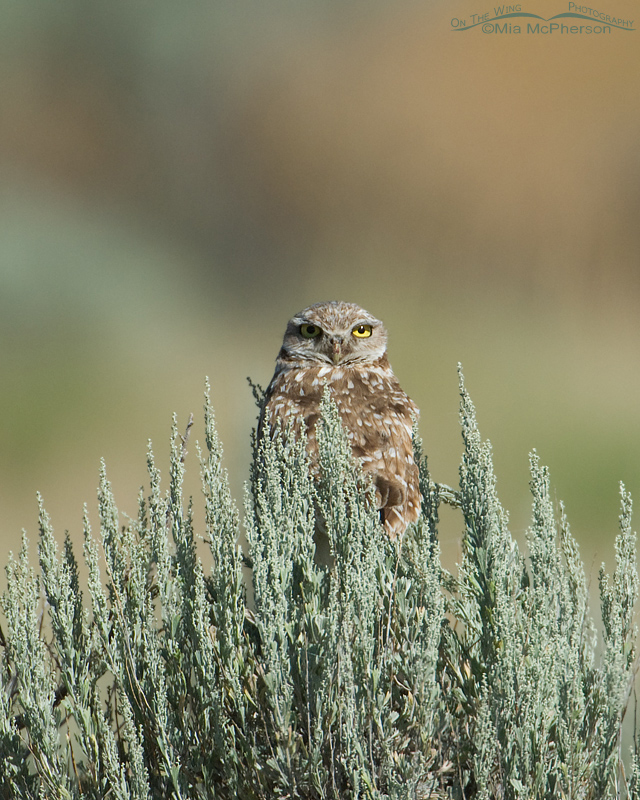
Lonely adult Burrowing Owl – Nikon D200, f5.6, 1/1250, ISO 400, Nikkor 200-400mm VR with 1.4x TC at 400mm, natural light, not baited
Instead this is what I am seeing, one lonely adult Burrowing Owl perched on the sagebrush that grows over the burrow. It is almost always hidden behind the leaves, it doesn’t sound a distress call anymore and it doesn’t fly away. No chicks.
Of course I can not prove that the disturbance those photographers caused at this burrow that day had anything to do with the overwhelmingly apparent signs that this nest failed this season.
It does, however, give me reason to believe it might have played a part in it.
Mia
To read about good field ethics: Principles of Birding Ethics published by the American Birding Association.
I’ve been searching for burrowing owls all year. I’ve seen pictures,and read stories of their behavior. As a biologist and conservationist, I’ve been wanting to at least see one if not get a picture of them. Today I went to Antelope Island for the third time this year, except I had the extremely sharp eyes of my wife with me.I spotted what I thought was a meadowlark, I asked what that bird was, she said it was an owl. Shocked I’m like NAH it’s TINY! I’m talking screech owl size tiny. And to my dismay, it was terrified of my vehicle. The only picture I got was when I left and came back a different way, it was perched on a sign. I drove up and took a picture just before it took off at the sound of my shutter going off. Disappointing cuz it was the ONLY one in the entire area. Reading this story of yours angers me and makes me cry inside. I cannot believe the Rangers would let that happen. Unfortunately they say in one area it is ok to get out and walk into the field. I am also worried that these owls will no longer breed in areas where non-state employees can have access to. Thus true, honest wildlife biologist/photographers will no longer be able to photograph them without a ton of red-tape.
I’m at a loss with these animals.
Hi Matt, thanks for visiting my site. I think I know which Burrowing Owl you saw, oddly enough it can be easy to approach sometimes, but not others. These Burrowing Owls are small, about the same size as an American Robin so I understand why at first you thought “NAH”! Ron probably wouldn’t have so many great shots of birds without me riding shotgun although he always wants to take credit for “spotting” them. 😉 Seriously, I am glad he keeps his eyes on the road more than I do.
The bird may not have taken off because of the sound of your shutter, they actively hunt during the day. I’m guessing that bird didn’t find a mate this year because I’ve only seen one in that location.
We’ve had “so so” luck wth Burrowing Owls since the one burrow got trampled but they seem to have created a burrow near the old one. I still wonder if the trampling incident didn’t trap some of the owls inside the burrow, the one adult that remained there was always in such distress. I know that young birds are adorable but I firmly belive we need to keep our distance from them so that they remain safe and undisturbed. I have very strict personal ethics when it comes to nesting birds and when they have young.
Thanks so much for your comment, I hope you see more Burrowing Owls soon.
Great article Mia (I know its an old post) it popped up as posts I might like etc. Sorrow and Joy would be my title for this event. First, I sense so much of the joy of birding through your descriptions, and how they mirror my own birding experiences albeit on a small local scale for me.
And then the sorrow, that there are others in our midst, who do not understand the need to allow these delicate beings to thrive.
So I thank you as always for a fantastic set of images and great descriptions of the events being highlighted
Thanks Stu, Burrowing Owls are great birds but they are on the decline in the west partly due to habitat destruction and the fact that humans are poisoning their prey. We sure can mess things up as a “race”.
It is agonizing to read these posts Mia. Like you, I feel a strong affinity for our Burrowing Owls and considering the rapid decline in their numbers in California, stories of disregard for their peaceful existence and habitat bring me to the point of tears and frustration.
I have reiterated your feelings in a post linking to this one in the hope of spreading the word of birding ethics and the consequences of ignoring those ethics. I would also like to make your readers aware of the Burrowing Owl Conservation Network of which I am a staff member.
We need to make sure birders and photographers alike are aware of the proper way to approach and photograph wildlife to leave the least possible affect on them. I have discovered as a photographer that digiscoping has been a huge advantage for me in this regard, allowing me to observe and photograph wildlife, many times without them being aware of my presence.
On another note, I love your website and your photography is truly exceptional! I found you through Robert’s “Birding is Fun” blog and I’m so glad I did. I have added you to my blogroll and look forward to more of your wonderful posts!
Hi Larry, “agonizing” was a great choice of words to describe what I witnessed at this owl burrow. I really felt very ill to see the photographers trampling around over that burrow, especially since they could have easily photographed them from inside their vehicles. I feel that way about all nesting birds and allow them as much space as needed so as to not disturb them. I’ve read of photographers clipping leaves and branches away so that they can get clear shots of nesting birds and that too makes me ill.
Thanks for providing the link to the Burrowing Owl Conservation Network, I think educating the public is a great idea to help conserve all of nature. For me my long lens helps so that I can photograph the birds and still keep my distance.
Thanks so much for your kind words about my website and photography, I think my passion for birds & nature and the great subjects we have shines through. I am creating a blogroll page and will certainly be adding your site, thebirdersreport.com . Thanks again for stopping by!.
I’m sorry to hear that the owls may have been adversely affected by the stupidity of those photographers. I guess having enough money to buy long lenses doesn’t mean that they have any common sense.
Thanks for your recent comments on my blog, Mia!
Another story of idiot people destroying nature! I feel for the owls, and for you Mia, I know how much you love these guys!
I know you didn’t bother to say anything to those guys last year(might have been to late anyway) but now that you look back would you have done anything differently?
Garen, I’m not sure I would have done things differently. There have been a few times I have spoken with the offending person(s) where they have gotten nasty towards me. Once a guy took a dog onto an area that has signs stating “No Dogs” that had nesting shorebirds and he got quite rude to me. Fortunately in that case the park supervisor was a friend of mine and I just rang him up, explained the situation, he was addressing the “offender” within mere minutes about getting the dog off of the beach. That took the pressure off of me. There are no signs in the area of this burrow so calling anyone at the park would not have done any good, the people were within their “rights” of walking freely in that area. But again, I don’t think that made them “right”.
Such a sad story. It’s unfortunate that some don’t see a great photo op when given one, without taking it too far. It’s obvious from your excellent photos that there was no need for those 3 to get any closer… There’s a spot near where I work that had some burrowing owls, but I haven’t seen them in 3 weeks. I’m hoping it’s just been too hot for them to be above ground. Hopefully they’re still around.
Thanks Jeremy, it is a sad story, for the owls and for those of us who love seeing them. I hope that it has just been too hot for your burrowing owls during the day and that you see them again soon.
Good news- I’ve seen a single owl the past 2 days at “my” location. There were 2 adults and 2 juveniles in June. I’ll keep looking.
That is great Jeremy. Hope you get the see the juvies too!
I only saw the one lonely owl today, it stayed hdden behind the sagebrush again.