

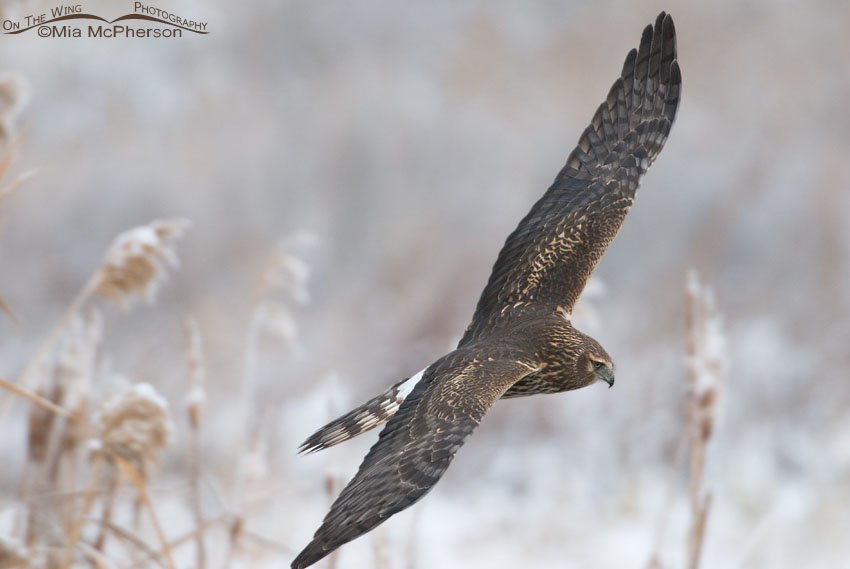
 Clipped wingtip young male Northern Harrier – D200, f6.3, 1/640, ISO 400, 200-400mm VR with 1.4x TC at 400mm, natural light, not baited
I usually do very little post processing of my images, cropping, rotation or white balance adjustments then selectively masking and sharpening the subject is about all I do.
But there are times when I think an image might be worth a little extra work and this young male Northern Harrier image seemed worth the effort.
I was photographing some ducks in a small pond that has marshy areas on the shoreline and was focused on the birds on the water when out of the corner of my eye I spotted this young male harrier coming in my direction.
I quickly focused on where I thought the harrier might fly by but I had not zoomed back and the harrier flew closer than I anticipated, thus the clipped wingtip.
The image above is full frame, straight out of the camera and resized to 850 pixels on the long side.
I knew when I clicked the shutter that I should have zoomed back to 350mm but it all happened so fast.
 Young male Northern Harrier with wingtip repaired – D200, f6.3, 1/640, ISO 400, 200-400mm VR with 1.4x TC at 400mm, natural light, not baited
I brought the image into ACR, made my adjustments and cropped the photo there then opened the file in Photoshop.
I had to add canvas on the bottom and that took me longer than repairing the wingtip so that it looked very natural.
The final image is a bit tighter on the top and bottom than I normally like but I loved the spread of the wings, the view of the plumage patterns and the look of concentration on the harrier’s face.
I could not post this to a critique forum without disclosing the repair work I did to the picture because of my personal ethics.
Also I don’t want to mislead any new photographers into believing that this image is “natural”.
In addition, I wouldn’t enter it into a contest because the rules often stipulate that only minimal processing should be done and cloning is not a minimal “processing”.
I learned from this experience though and next time a situation like this occurs I will back the zoom up a bit.
Even my photographic mistakes teach me something of value. On that note, I should say, this image didn’t make it into my photo galleries.
Life is good.
Mia
Click here to view more of my Northern Harrier photos plus facts and information about this species.
A very nice image Mia and an excellent repair. I greatly admire your ethics and your honesty! I hope October is good to you.
As far as I’m concerned there isn’t too much wrong with the first photo at all. But then I’m not a photographer. But was glad for the enlargement a bit as you really caught the expression in that harrier’s eye… Your photos are all stunning as far as I can see.
Thank you for your very kind comment Merrill
Great shot Mia, even if it is a bit tight in the canvas. As you stated, the look of complete concentration is the focal point here. Your plastic surgery on the wing looks very natural, and well worth the time spent. The only issue I have with this photo is you took it instead of me. With a lot of practice, maybe someday I’ll be able to capture an image this nice.
Thanks so much for your comment on this post Ster. I am certain your skills will shine with that new lens!
It’s a beautiful image Mia; worth the processing time you invested!
Thank you Mike! I wish I would have had time to pull back my zoom to get this image without repairing the frame, but I liked it enough to do more than my “normal” amount of post processing.