

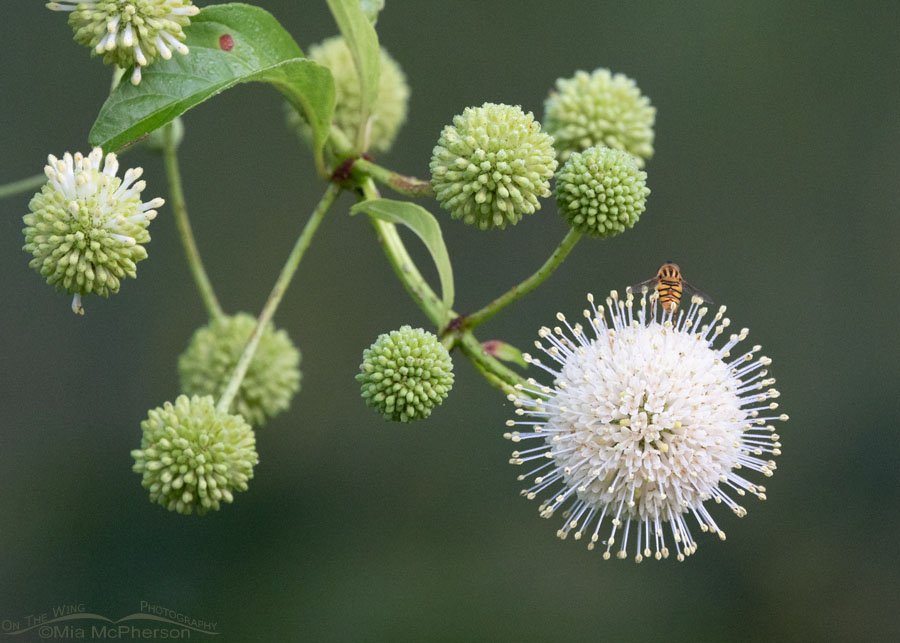
 Blooming Buttonbush with a hover fly at Sequoyah National Wildlife Refuge – Canon R7, beanbag, f7.1, 1/80, ISO 2500, Canon RF 100-500mm at 472mm, natural light
It has been a real treat for me to see blooming Buttonbush again this summer. I had gone more than a decade without seeing these beautiful, spherical white wildflowers.
When I saw them in 2023, I was surprised by how much I had missed seeing this native shrub in bloom. Since then, I’ve looked forward to its first blooms of the year.
Early in the season is the best time to photograph Buttonbush, in my opinion, because the flower buds are just opening and the blooms are fresh. I took this Buttonbush photo in early July at Sequoyah National Wildlife Refuge, where these shrubs grow close to the road.
The hover fly? I tried to identify it, but with only a back view plus more than 200 native hover fly species in Oklahoma and over 80 of them in the River Valley, I finally gave up and decided to share the blooming Buttonbush photo today.
If you know the ID of the hover fly, please let me know!
Buttonbush provides an important food source for a wide variety of wildlife. Its seeds are eaten by waterfowl and many other bird species, while wood ducks often nest among its dense branches for cover and protection.
White-tailed deer browse the leaves, although the foliage is toxic to livestock like cattle and horses. Thankfully the refuge has neither.
The spherical flower heads produce abundant nectar that attracts hummingbirds and a wide variety of insects, including bees, which use the nectar to make honey.
Buttonbush also serves as a host plant for the caterpillars of several moth species, including the hydrangea sphinx, royal walnut moth, and titan sphinx.
Life is good.
Mia
Click here to see more of my wildflower, shrub and tree photos.
Extraordinary! What a beautiful shot. Thanks Mia.
I have not seen one, beautiful plant and photo.
iNaturalist is a great way to find an ID, and the images are often useful to researchers.
You probably know about https://www.bugguide.net
You probably know about https://www.bugguide.net