

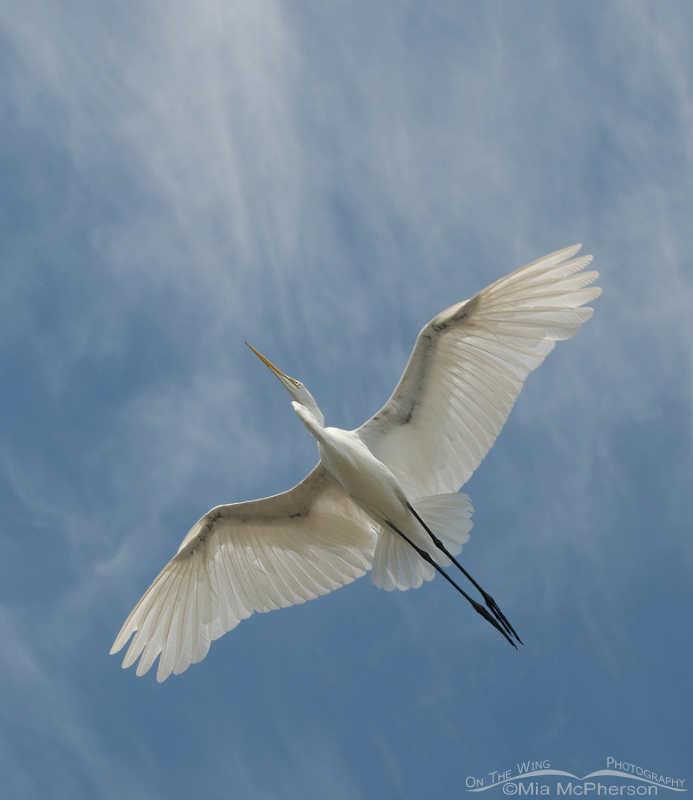
 American Egret in flight – Light on White – D200, handheld, f6.3, 1/500, ISO 200, 70-300mm VR at 82mm, natural light
I do not normally take many images of birds in flight that are almost directly over my head but I made an exception in the case of this American Egret because of how the light affected the whites of the bird and the thin cirrus clouds in the sky overhead.
Exposure of white birds can be very challenging, if the exposure is too bright some of the whites will be blown and will show very little detail.
If the exposure is too dark the whites can look gray or muddy and spots of noise may show up straight from the camera or in post processing.
I used no exposure compensation when I photographed this American Egret. I think the thin clouds helped to diffuse the light.
This image was taken at 8:20 am in the month of May, so the sun had been up for a bit over two hours. For exposing a white bird it was probably getting late.
I had been kneeling in the shallow waters of a lagoon when I saw this egret heading my way so I stood up and got ready for the bird to circle overhead as it made an approach to land.
I wanted to stand so I had a complete 360 degree range of motion. I’m glad I did that or I may have missed this shot.
I was using my 70-300mm VR lens because the lens I normally used for photographing in Florida was being repaired.
I’ve heard people say you need at least a 400mm lens to photograph birds. I sure didn’t need that reach for this image.
American Egrets are found in North, Central, and South America and can live as long as 25 years. In Florida they were more used to human presence and allowed closer approaches than they do here in Utah where they are a bit more skittish.
I love the beautiful details present in the white of this egret, how the wings appear translucent plus the spread of the wings and tail. The thin cirrus clouds against the blue sky are very appealing to me too.
Life is good.
Mia
Click here to see more of my American Egret photos plus facts and information about this species.
Update: Great Egrets were renamed American Egrets in October 2026, the scientific name was changed to Ardea egretta. This post has been updated to reflect those changes.
What an exquisite shot of this bird… every feather… and even the angle of the neck down to the way the toes come together… even with the glint of light in the eyes…. Now THAT’S amazing!
Thank you for this comment Merrill, the light that day was simply amazing.