

Earlier this week I videoed an adult Barred Owl who was perched in an old willow at Miner’s Cove at Sequoyah National Wildlife Refuge in Oklahoma.
Watch on YouTube
There had been two Barred Owl adults very early in the morning when the light was low. Both of the owls were hunting crawdads for their breakfast and possibly catching food for their chicks too.
This pair of owls hatched and fledged at least two chicks this year in the area. The chicks are hiding out deep in the trees around Miner’s Cove somewhere.
I hope that I’ll be lucky enough to photograph the young owls soon.
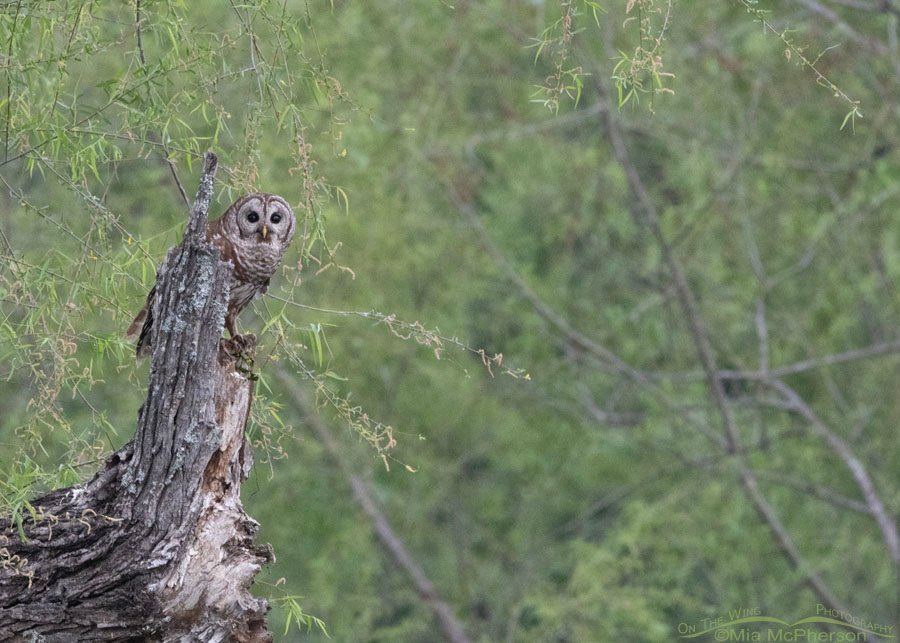 Adult Barred Owl at Miner’s Cove – Canon R7, beanbag, f8, 1/250, ISO 4000, Canon RF 100-500mm at 500mm, natural light
This photo was taken just a bit later in the morning of one of the adult Barred Owls across the water of the slough. The owls like to munch on crayfish on this dead branch. I wish it were just a bit closer to the road where we use our vehicles as mobile blinds.
Barred Owls prefer mature, fairly quiet forests with a mix of trees and water nearby. Across their range, they’re most often found in bottomland hardwood forests, swamps and wetlands, mature deciduous or mixed forests, and riparian zones.
These owls are pretty adaptable and over time and human habitation, they’ve moved into suburban woodlots, parks with large trees, and wooded neighborhoods.
If you’re trying to find them, think “follow the water, then look up into big trees.” And listen, because they’ll usually give themselves away long before you ever spot them. I even hear them at home.
I’m delighted to be able to see, hear, and photograph Barred Owls again. I had truly missed them while I lived out west. Their ebony eyes sure draw me in.
Life is good.
Mia
Click here to see more of my Barred Owl photos plus facts and information about this species.
The video was taken with my Canon R7 and Canon RF 100-500mm lens resting on my beanbag.
Terrific video and a wonderful still to go along with your narrative. Thanks Mia.
The Barred Owls’ eyes draw me too. They’re intelligent looking I guess. Love your photos.
Great catch1
Love your Barred Owl shots!
Really nice to hear the morning sounds as owl hunts!
Nice.