

Earlier this week I caught a flash of gray, white, and salmon-pink next to a dirt road at Sequoyah National Wildlife Refuge. It was a Scissor-tailed Flycatcher.
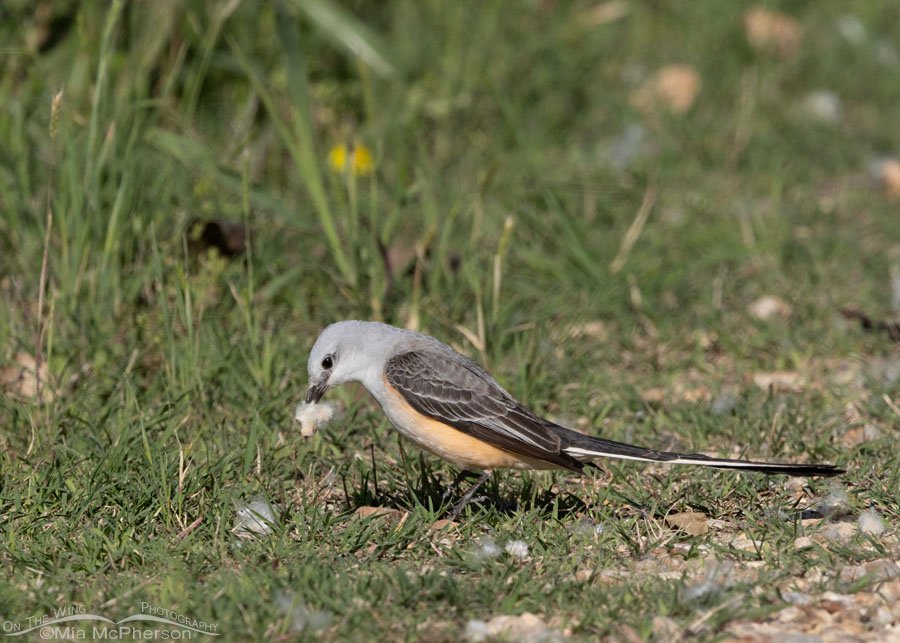 Adult Scissor-tailed Flycatcher with nesting material at Sequoyah National Wildlife Refuge – Canon R7, beanbag, f8, 1/2000, ISO 400, -0.3 EV, Canon 100-500mm at 500mm, natural light
I stopped my Jeep, slowly opened my door, stepped outside, and used my beanbag on my open window for support as I focused on the flycatcher.
At first I thought the Scissor-tailed Flycatcher was after bugs in the recently cut grass. That wasn’t what the beautiful flycatcher was after, though.
The bird was busy picking up cottonwood fluff that had fallen in the grasses. Personally, cottonwood fluff annoys my eyes and makes me sneeze.
But this flycatcher species? They use it for nesting material along with grasses, rootlets, weeds, bark strips, hair, feathers, and other soft materials.
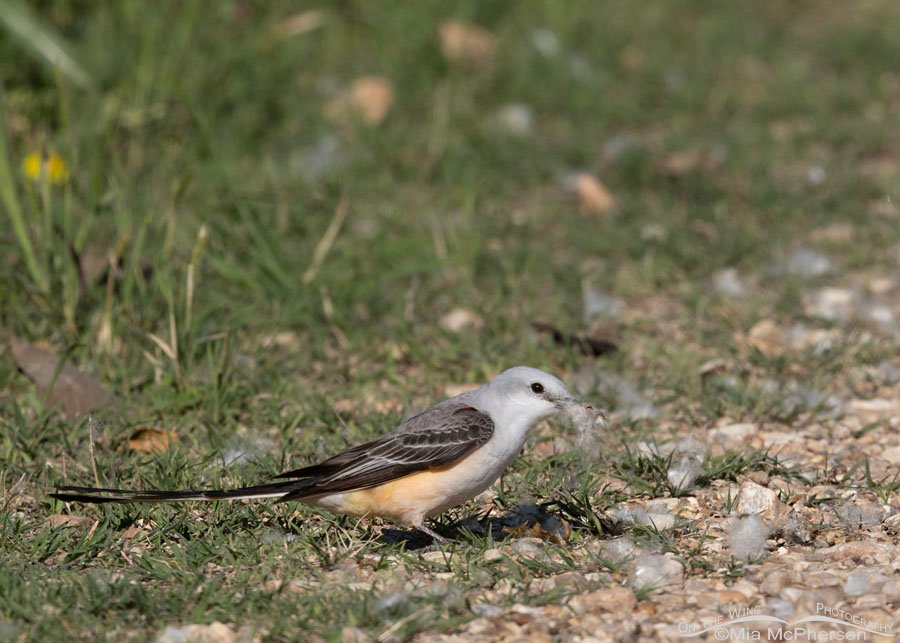 Roadside Scissor-tailed Flycatcher picking up nesting material – Canon R7, beanbag, f8, 1/2000, ISO 400, -0.3 EV, Canon 100-500mm at 500mm, natural light
The fluffy cotton from cottonwood seeds can make a soft lining for the nest cup, especially in spring when that fluff is floating everywhere like nature exploded a pillow factory.
Scissor-tailed Flycatchers also commonly nest in cottonwood trees, particularly along rivers, wetlands, shelterbelts, ranches, roadsides, and open country with scattered trees.
Cottonwoods are favored because they’re tall, open branched trees that give the flycatchers good visibility for hawking insects and enough horizontal limbs to place a nest.
Sequoyah National Wildlife Refuge has plenty of cottonwood trees. Right now, there are piles of cottonwood fluff there. It almost looks like snow or frost on the grasses next to the road.
I do at times complain about how my eyes feel itchy when that cottonwood fluff is flying, but now that I know Scissor-tailed Flycatchers use the fluff in their nests, I’ll try to complain less.
Also, I picked these photos to share this morning because it is World Migratory Bird Day and Scissor-tailed Flycatchers are migratory and the state bird of Oklahoma.
World Migratory Bird Day is celebrated in May and October because bird migration occurs at different times for the Northern and Southern Hemispheres.
Happy World Migratory Bird Day!
Life is good.
Mia
Click here to see more of my Scissor-tailed Flycatcher photos plus facts and information about this species.
Wonderful shots to go along with your very interesting narrative. Thanks Mia.
Lovely bird and images, I’d love to see one sometime!
Good action shot!
Great picture and discussion!-Jeri