

Update: In October 2026, the American Ornithological Society split Willets into two species. Eastern Willets are now Saltmarsh Willets (Tringa semipalmata), and Western Willets are now Prairie Willets (Tringa inornata). This post has been updated to reflect those changes.
 Saltmarsh Willet in flight – Fort De Soto County Park, Florida, June 6, 2009 – Nikon D200, handheld, f8, 1/750, ISO 250, Nikkor 80-400mm VR at 330mm, natural light
I have been able to photograph Prairie Willets here in Utah, Idaho and Montana and in Florida I photographed both the Saltmarsh and Prairie species, eastern during their breeding season and western during their nonbreeding season.
 Prairie Willet lifting off near White Rock Bay – Antelope Island State Park, Utah, April 26, 2013 – Nikon D300, f6.3, 1/1250, ISO 500, Nikkor 200-400mm VR with 1.4x TC at 400mm, natural light
Yesterday when I wrote about a possible name change for Ring-necked Ducks to Ring-billed Ducks I mentioned that in the blog post I read at the American Birding Association (ABA) that there are proposals for potential splits at the American Ornithological Society (AOS), one of those is the proposal to split the two Willet subspecies into two distinct species, Eastern Willet (Tringa semipalmata) and Western Willet (Tringa inornata). I may have written about a possible split in Willets before, this proposal comes up quite often.
There are differences in the appearance of the two subspecies as well as differences in their DNA, breeding locations, and calls.
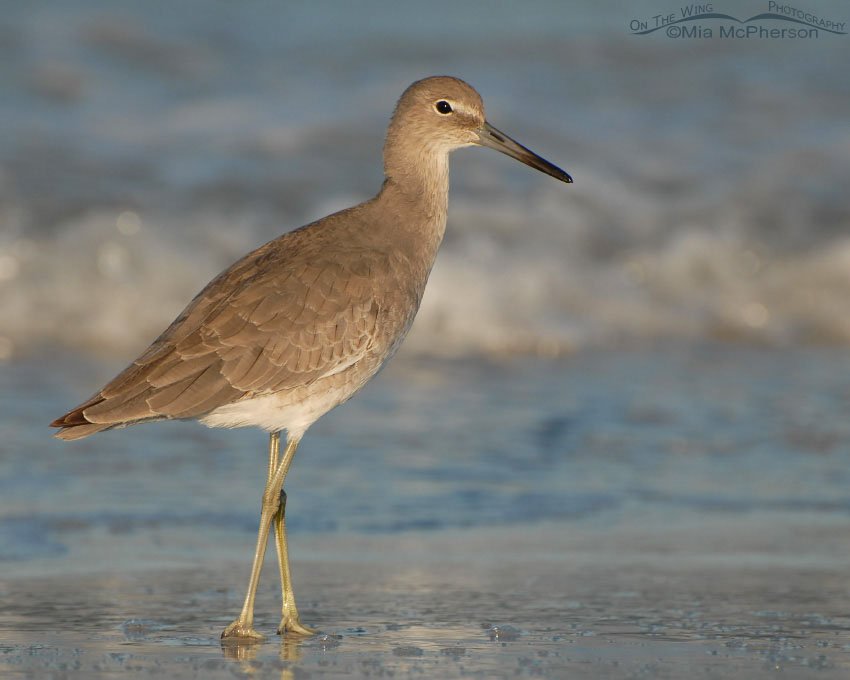 Prairie Willet on the shoreline of the Gulf – Fort De Soto County Park, Florida, November 2, 2007 – Nikon D200, handheld, f6.3, 1/800, ISO 200, Nikkor 70-300mm VR at 300mm, natural light
If this split happens birders who keep lists will add to their lists without even having to leave home if they have checked off both current subspecies.
For me, as a bird photographer with photo galleries on my site, it will mean I will need to set up separate galleries for Eastern and Western Willets then go through my Willet images and put them in the galleries where they would belong.
That is not hard to do for the Willets I have photographed in the western U.S. because we do not have the eastern subspecies here but I will have to go through the images of Willets I photographed in Florida carefully to separate them into eastern and western.
The question regarding this proposal is… Willet happen?
Life is good.
Mia
Click here to see more of my Prairie Willet photos plus facts and information about this species. Click here to see more of my Saltmarsh Willet photos plus facts and information about this species.
Wonderful images Mia, and I liked your pun. All this snow is giving me and my wife a good workout.
I love the background in the second imagd…beautiful photo !!!
That second image is a marvel!
“Willet happen?” BAD!!!
Like them all, but the flight shots are wonderful. “Oh! Wow! ” was my automatic reaction to the first!!! Perfect!!! Thank you…
Love the flight captures.