Shades of Blue – Wildflowers, Birds, Sky and Sea

Blue-eyed GrassBlue-eyed Grass – Nikon D200, handheld, f6.3, 1/400, ISO 200, Nikkor 80-400mm VR at 400mm, natural light

Last week I was Thinking Pink so this week I thought I would focus on the shades of blues found in wildflowers, birds, the sky and seas. Blue-eyed Grass (Sisyrinchium angustifolium) is one of my favorite blue wildflowers from the eastern United States. Blue-eyed Grass isn’t actually a grass at all, it is from the Iris family and may have gotten the “Grass” part of its name because the leaves are very thin and grass-like. I found and photographed this beauty under the pines of the Osprey Trail at Honeymoon Island State Park in Florida.
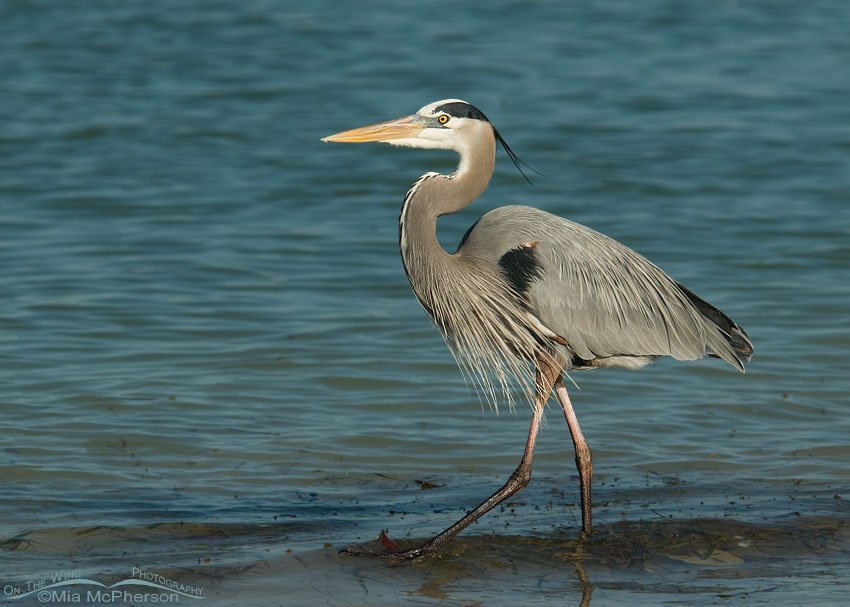
Great Blue Heron in the Gulf of MexicoGreat Blue Heron in the Gulf of Mexico – Nikon D200, handheld, f6.3, 1/1000, ISO 200, Nikkor 80-400mm VR at 230mm, natural light

It seems to me that Great Blue Herons (Ardea herodias) are misnamed because they are more gray than they are blue, in fact when I see a Great Blue Heron posted on line that is very blue I scratch my head because they really aren’t that blue. I photographed this Great Blue Heron as it walked along the shoreline of the Gulf of Mexico at Fort De Soto’s north beach in Florida.

Little Blue Heron stalking prey in a tidal lagoonLittle Blue Heron stalking prey in a tidal lagoon – Nikon D200, handheld, f7.1, 1/640, ISO 200, Nikkor 80-400mm VR at 360mm, natural light

Little Blue Heron (Egretta caerulea) adults are more blue than Great Blue Herons, at least from the base of the neck to their tails, their necks have a reddish cast to them. I was sitting in the lagoon with the Little Blue Heron approached me while it was stalking and hunting prey at Fort De Soto County Park in Florida.

Male Lazuli BuntingMale Lazuli Bunting – Nikon D200, f8, 1/500, ISO 250, Nikkor 200-400mm VR with 1.4x TC at 400mm, natural light

Male Lazuli Buntings (Passerina amoena) have a gorgeous azure blue head as well as some blue on other parts of their bodies. The word “lazuli” come from the semi-precious gemstone Lapis Lazuli which comes in various shades of blue with gold colored specks. I photographed this Lazuli Bunting in the San Rafael area of Utah and the background is the color of sandstone found in that area.

Mountain BluebirdMountain Bluebird - Nikon D200, f6.3, 1/2500, ISO 500, -0.3 EV, Nikkor 200-400mm VR with 1.4 TC at 400mm, natural light

Mountain Bluebirds (Sialia currucoides) are one of the bluest bird species I have photographed, especially the males. I didn’t add any color saturation to this image at all, this is how blue the bird looked in the light conditions I had at the time I took this image at Red Rock lakes National Wildlife Refuge in Montana. The males during the breeding season are a rich, vibrant blue.

Blue skies at Red Rock Lakes National Wildlife Refuge, MontanaBlue skies at Red Rock Lakes National Wildlife Refuge, Montana – Nikon D200, handheld, f20, 1/160, ISO 400, +0.3 EV, Nikkor 18-200mm VR at 18mm, natural light

Some of the bluest skies I have ever seen have been at Red Rock Lakes National Wildlife Refuge in southwestern Montana where on a clear (or not so clear) day you can see for miles & miles. I loved how this wave of clouds fanned out in this frame and added a nice contrast to the blue tones in the sky.

Amazing blues of Magens Bay, Saint Thomas, USVIAmazing blues of Magens Bay, Saint Thomas, USVI – No techs, this is a panorama made from several images that were joined together

The colors of the seas and oceans have always drawn me to water because they can vary from the palest aquamarine to deep royal blues and everything in between. Magens Bay in Saint Thomas and the Atlantic Ocean beyond it give this image wonderful shades of blue that I find very soothing and it brings back nice memories of my stay on the island.

Shades of blue…

Mia

Facebook Twitter

Lazuli Buntings near the San Rafael River

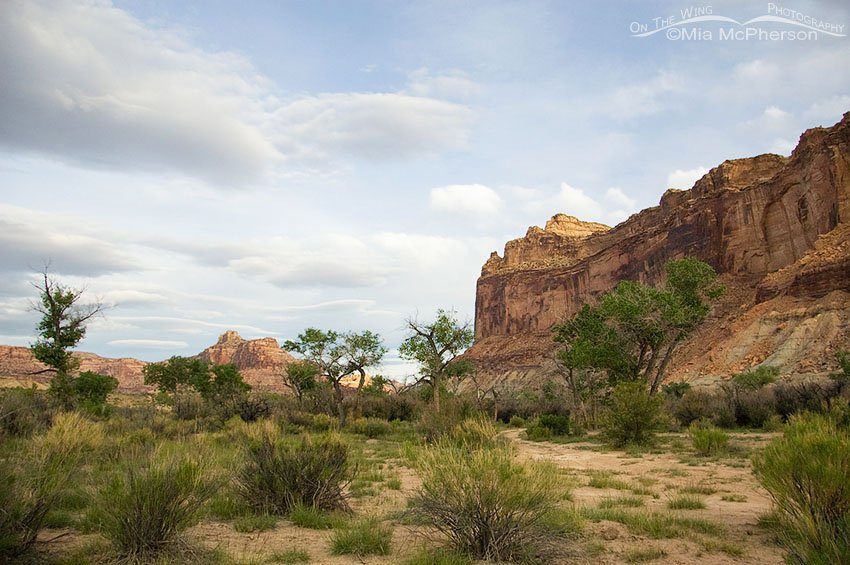
Morning at the San Rafael River campground

Morning at the San Rafael River campground – Emery County, Utah

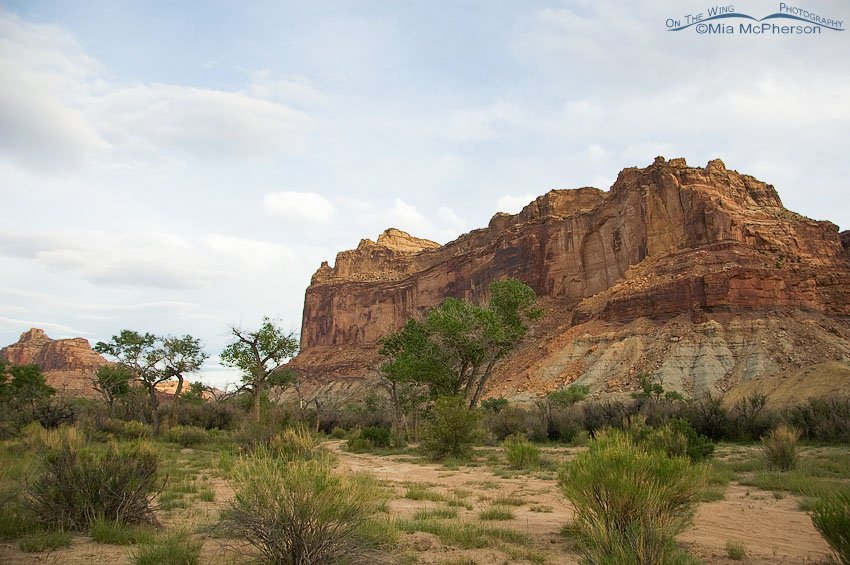
Utah has so many stunning places to visit, awesome views to see and has an abundance of birds and wildlife to observe and photograph.  The San Rafael Swell Recreation Area in central Utah is a gorgeous location that is far from towns and civilization. Locals call this area “Castle Country” and it doesn’t take much imagination to see the amazing rock formations as castles.

The San Rafael Swell is 2,000 square miles of public land and everywhere you look you can see stunning formations of Entrada and Navajo Sandstone. Some of the canyon walls are embellished with “Desert Varnish”, the varnish is the dark wash on the canyon wall on the right hand side of the image above.

Lazuli Bunting male with a sky background

Lazuli Bunting male with a sky background – Nikon D200, f8, 1/1000, ISO 250, Nikkor 200-400mm VR with 1.4x TC at 400mm, natural light, not set up or called in

I have enjoyed photographing Lazuli Buntings (Passerina amoena) near the San Rafael River at the San Rafael Swell Recreation Area. These images were taken in the spring when the males were high on perches singing to attract females. The males sport a sky blue head, a mantle tinged with brown, a dull orange breast and a white belly. They are the colorful relative of the Indigo Bunting of the east. The name comes from the semi precious gemstone Lapis Lazuli, one of my favorites for making jewelry.
I like the sky as the background in the image above but feel the blue sky competes with the blues of the bird. I still won’t pass up a shot of this bunting even with a plain blue sky in the background though.

Male Lazuli Bunting with Navajo Sandstone in the background

Male Lazuli Bunting with Navajo Sandstone in the background – Nikon D200, f7.1, 1/640, ISO 400, +0.3 EV, Nikkor 200-400mm VR with 1.4x TC at 400mm, natural light, not set up or called in

In this frame the Lazuli Bunting is perched on a Greasewood (Sarcobatus vermiculatus) shrub and has the Navajo Sandstone of the canyon wall as a background. To my eye the bird’s colors stands out better in this image.

That is just my own personal taste though.

Mia

More Lazuli Bunting images

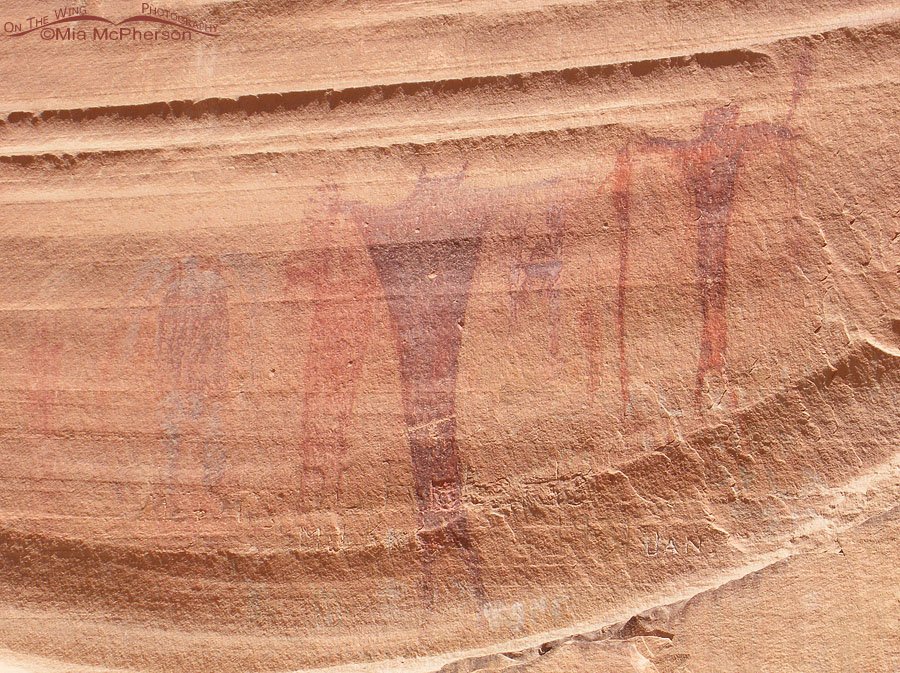
More scenic images of the San Rafael Swell area (The petroglyhs and pictographs are great!)

Facebook Twitter

Juvenile Common Raven

There weren’t many birds present at the San Rafael Swell Recreation Site in central Utah this past week, the San Rafael River seemed lower than I have seen it and there was evidence of drought conditions, mainly in the vegetation there. The greasewoods looked yellow instead of the vibrant green I remember from the past two years, plants that are normally flowering weren’t and many of those plants appeared stunted.

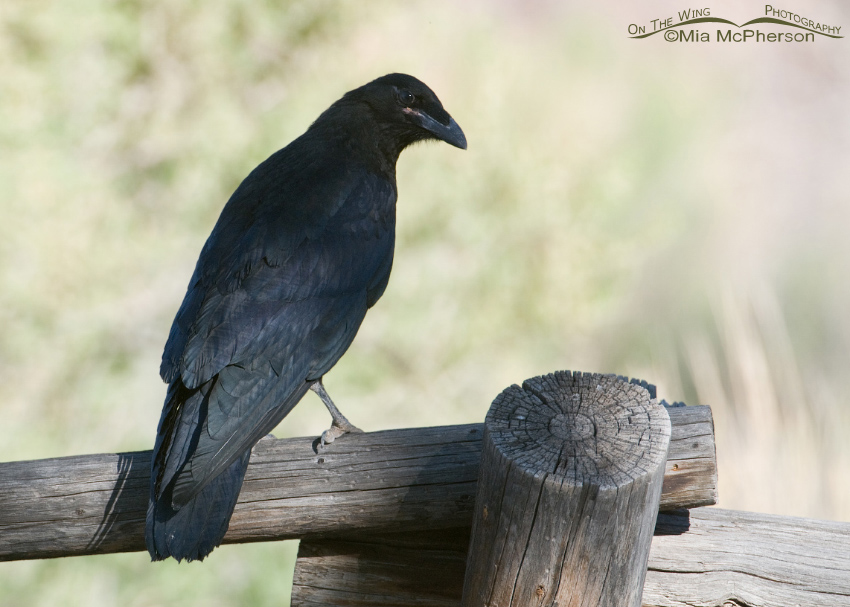
Juvenile Common Raven back view

Juvenile Common Raven back view – Nikon D300, f6.3, 1/500, ISO 400, +0.3 EV, Nikkor 200-400mm VR with 1.4x TC at 322mm, natural light, not baited

It wasn’t a complete wash though because I did come back with some juvenile Common Raven (Corvus corax) images that I like.  There was a family of ravens making a racket in and near the campsite which was right next to the two bridges over the San Rafael River, at one point I counted at least six birds, there may have been more.

The Swinging Bridge is no longer used for vehicle traffic but it is safe for foot traffic. It was built in 1938 and was the only bridge at the site until the early 1990′s.

Calling juvenile Common Raven

Calling juvenile Common Raven – Nikon D300, f6.3, 1/800, ISO 400, Nikkor 200-400mm VR with 1.4x TC at 314mm, natural light, not baited

One of the juvenile Ravens perched on a fence near the Swinging Bridge, the light was challenging because it was filtered through the leaves of old Cottonwood trees creating dappled light on the fence and bird while the background of greasewood and Navajo sandstone was in full sun. Surprisingly I did not need to use any exposure compensation with this image or the following one to get nice detail in the dark plumage without blowing out the background.

Common Raven juvenile by the San Rafael River

Common Raven juvenile by the San Rafael River – Nikon D300, f6.3, 1/800, ISO 400, Nikkor 200-400mm VR with 1.4x TC at 314mm, natural light, not baited

This bird is easily identifiable as a juvenile Common Raven because of the short tail, the pink on the gape and the violet-blue eyes. I have images of  Black-billed Magpie juveniles; also Corvids, with similarly colored eyes here. I’m not sure if other Corvid juveniles exhibit the same trait.
Mia

Facebook Twitter

Close Encounter of the Snake Kind!

Rattlesnake full body

Midget Faded Rattlesnake full body
The Wedge Overlook, Emery County, Utah
Nikon D200, handheld, f8, 1/1000, ISO 320, Nikkor 70-300mm VR at 122mm, natural light

Yesterday I returned home from a camping and bird photography trip to the San Rafael Swell area located in Emery County in central Utah and even though there weren’t many birds to speak of in the area I still had an awesome time. Normally we camp near the San Rafael Recreation area near the swinging bridge but when we scoped that area out we didn’t see or hear any birds so we headed to The Wedge Overlook hoping there might be some birds in that area, maybe migrants moving through or raptors soaring on the thermals.

We were checking out the campsites at the top of  The Wedge to see if we could manouver the camping trailer into the the one closest to the edge of the overlook and because getting in to a campsite is sometimes easier than getting out so we got out of the pickup to walk around the site.  At one point I could not resist the urge to walk over to the peer down into the Little Grand Canyon and the San Rafael River 1200 feet below. The views are incredible.

Rattlesnake headshot

Midget Faded Rattlesnake headshot
The Wedge Overlook, Emery County, Utah
Nikon D200, handheld, f10, 1/500, ISO 320, Nikkor 70-300mm VR at 300mm, natural light

I was totally focused on the scenery in front of me as I walked between two gnarly old Junipers that might have been spaced about 12 feet apart and wasn’t watching my foot placement as closely as I should have been when I heard a very distinctive buzzing sound, it probably only took me 1/100th of a second to realize that I had walked too close to an extremely well camoflauged Rattlesnake. I estimate that I was within a mere 15 inches or so of stepping on it.

Talk about an easy way to get the adrenalin flowing, and it did!

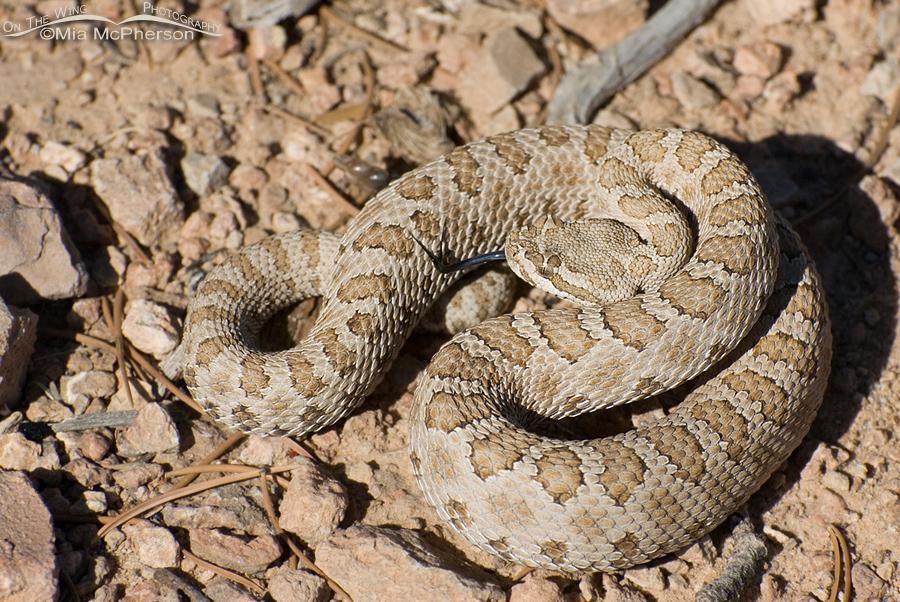
Now Ron will tell you that I “squealed like a girl”, I’m not sure about that but I do know I made a sound as I jumped back away from the Rattlesnake, I hadn’t even seen it clearly at that point because it blended into the habitat so well. It took me a few seconds to even form the words “It’s a rattlesnake”. The snake was only about 14 to 15 inches in length but even at that small size it had startled me quite sufficiently.

Rattlesnake close up

Midget Faded Rattlesnake close up
The Wedge Overlook, Emery County, Utah
Nikon D200, handheld, f10, 1/64, ISO 320, Nikkor 70-300mm VR at 165mm, natural light

I scurried over to the pickup to grab my backup D200 with the 70-300mm VR lens attached and Ron’s “little camera” because our longer lenses would have been overkill while Ron kept an eye on my “find”. I took 46 images of the Rattlesnake, probably half of them were sharp, the others were not so sharp thanks to taking them handheld with too much adrenalin coursing through my body which caused my hands to shake!

I’m not certain about the identification of the snake, it may be a young Great Basin Rattlesnake - Crotalus oreganus lutosus or a Midget Faded Rattlesnake – Crotalus oreganus concolor. It might be another croatline subspecies too. If anyone reading this can identify the snake, I would certainly like to know.

Edit: I’ve been informed by Jamison Hensley; who  knows far more about rattlesnakes than I, that this is a Midget Faded Rattlesnake – Crotalus oreganus concolor. Check his blog out here.

I spent the rest of the trip in the San Rafael Swell area very carefully watching where I put my feet because I didn’t want another Close Encounter of the Snake Kind!

Mia

PS. Maybe I did “squeal like a girl”, I was rather “rattled“.

Facebook Twitter

Lazuli Bunting males

Lazuli Bunting male perched on greasewood

Lazuli Bunting male perched on Greasewood
San Rafael Swell, Utah
D200, f7.1, 1/500, ISO 400, +0.3 EV, 200-400mm VR with 1.4x TC at 400mm, natural light

In June of 2010 my friend Ron and I went camping in the San Rafael Swell area of Utah, we were fortunate to find quite a few Lazuli Buntings  (Passerina amoena) in the areas near the campgrounds. The females did not seem to be present but their more subtle coloring does camouflage them well and we may have missed spotting them. The males; however, were present and singing atop shrubs and bushes.

The male Lazuli Bunting above was perched on a Greasewood (Sacrobatus vermiculatus) shrub near the campgrounds by the river. The name of this species comes from Lapis Lazuli, a blue semiprecious blue gemstone. Lapis Lazuli is one of my favorite gemstones to work with when fashioning jewelry and it goes great with blue jeans.

Lazuli Bunting with sky in the background

Lazuli Bunting with sky in the background
San Rafael Swell, Utah
D200, f8, 1/1000, ISO 250,  200-400mm VR with 1.4x TC at 400mm, natural light

Male Lazuli Buntings resemble bluebirds but they are smaller and the blues are a different hue than the Mountain, Eastern and Western Bluebirds. Lazuli Buntings occur in open, disturbed habitats, thickets and along waterways. They winter from southern Arizona down to southwestern Mexico.
Lazuli Bunting male with Navajo and Entrada sandstone in the background

Lazuli Bunting male with Navajo and Entrada sandstone in the background
San Rafael Swell, Utah
D200, f8, 1/1000, ISO 250,  200-400mm VR with 1.4x TC at 400mm, natural light

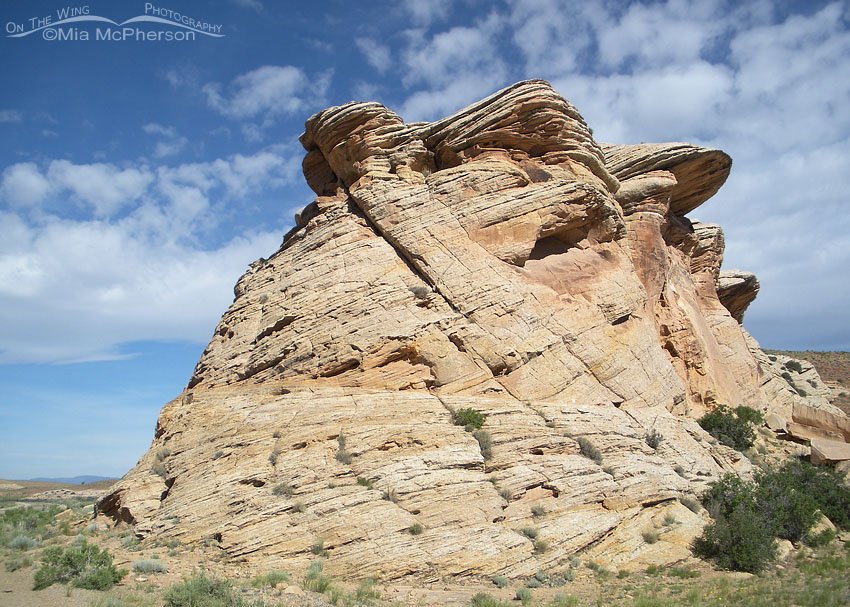
The San Rafael Swell area has abundant formations of Navajo and Entrada sandstone which provides beautiful backgrounds that compliment the Lazuli Buntings coloration. They also have a habit of perching high on top of bushes which helps to give clear views of this species when photographing.

Male Lazuli Bunting singing with canyon walls in the background

Male Lazuli Bunting singing with canyon walls in the background
San Rafael Swell, Utah
D200, f8, 1/1000, ISO 250,  200-400mm VR with 1.4x TC at 400mm, -0.3 EV, natural light

It seemed that the buntings were the most active early in the morning and late afternoon, this image was taken in late afternoon light while the male Lazuli Bunting was singing, the sweet calls bouncing off of the canyon walls. I hope that next year I’ll have many more opportunities with this colorful species.

Mia

Facebook Twitter