Peregrine Falcon with prey ~ Low light

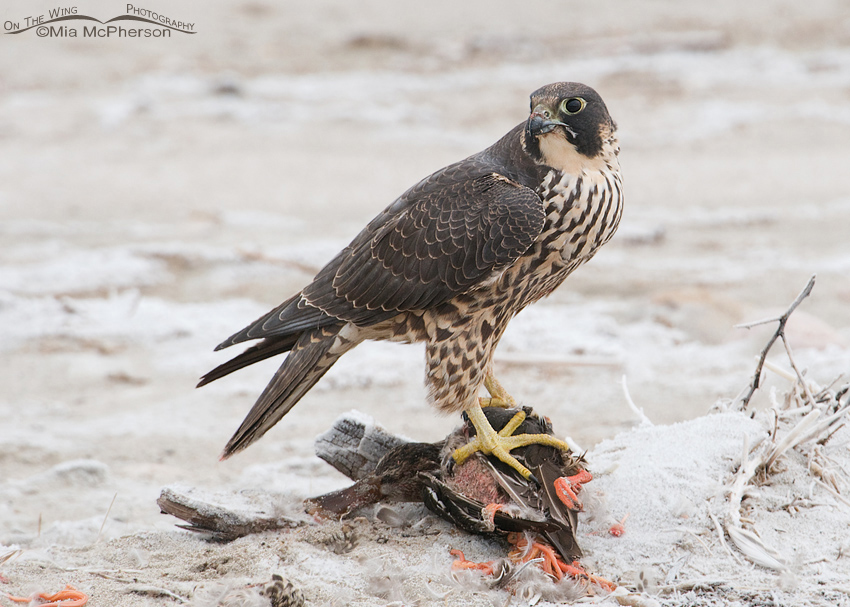
Where is the light when you want it? Yesterday it was hiding behind the clouds and lake fog when I spotted this Peregrine Falcon at a close distance, on prey and sticky. The frustrations of being a bird photographer were glaringly apparent to me yesterday morning. Curses!
Peregrine Falcon on top of prey
Peregrine Falcon (Falco peregrinus) on top of prey ~ Davis County, Utah
Nikon D300, f7.1, 1/160, ISO 640, -0.3 EV, Nikkor 200-400mm VR with 1.4x TC at 357mm, natural light, not baited or set up

I was the closest I have ever been to a wild Peregrine Falcon yesterday but I felt my heart sink knowing that the light was not going to be in my favor. There were no visible openings in the clouds. And it there it was on prey too!

Since moving to Utah and being faced with more low light situations than I ever had in Florida, I have had plenty of practice learning the techniques required for when the light just will not cooperate. So I just attempted to do my best with the light that I had.

I had 27 minutes with this Peregrine Falcon so I played with many different settings, changed my ISO for faster shutter speeds, adjusted my exposure compensation and my aperture trying to get sharp, interesting images of this young falcon.  

I watched and photographed the falcon tearing into the Northern Shoveler beneath it, there were feathers flying everywhere and unfortunately there just wasn’t enough light to capture that action even at ISO 1600, all I got were blurry feathers floating softly towards the ground.

I also observed the falcon’s crop growing larger and larger as it ate.

Peregrine Falcon removing intestines of its prey
Peregrine Falcon removing intestines of its prey ~Davis County, Utah
Nikon D300, f6.3, 1/320, ISO 640, -0.3 EV, Nikkor 200-400mm VR with 1.4x TC at 400mm, natural light, not baited or set up

I could barely detect a catchlight in the falcon’s eyes because the rays of the cold looking barely touched the eyes but despite the low light of the barely visible sun I kept right on shooting and hoping I’d get a few images of this beautiful bird worth saving.

I did get those images but; oh, what I would have given for the sweet light just after dawn. Perhaps another time.

Mia

Facebook Twitter Stumbleupon Digg Delicious Reddit Posterous Pinterest Email

Share

Turd Birds; errr… I mean Sage Thrashers

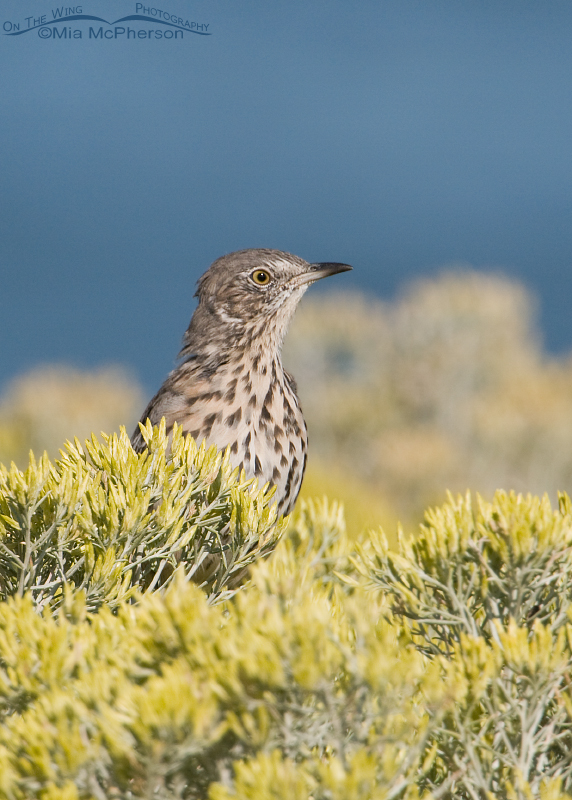
Sage Thrasher nearly hidden in the brush
Sage Thrasher (Oreoscoptes montanus) nearly hidden in the brush
Davis County, Utah
Nikon D300, f6.3, 1/2000, ISO 500, -0.3 EV, Nikkor 200-400mm VR with 1.4x TC at 305mm, natural light, not baited or set up

Yes, I call Sage Thrashers “Turd Birds“, that is what I call any birds that are difficult to get close to or birds that seem to have the ability to read a bird photographers mind and when they hear ”I’ll get just a little closer before I start taking pictures” at which point the bird takes off.

Sage Thrashers quite often perch on top of sagebrush and rabbitbush and you would think they might be easy to photograph. Hah! They see you coming and dive down towards the bases of the bushes to hide. Or they let you see them but with a really messy background, like in the image above. Just about any bird photographer I know loves to have a clean, pleasing background that doesn’t compete with the bird itself.

I guess those Sage Thrashers didn’t get that memo.

Sage Thrasher tucked behind the flowers
Sage Thrasher (Oreoscoptes montanus) tucked behind the flowers
Davis County, Utah
Nikon D300, f8, 1/1250, ISO 500, Nikkor 200-400mm VR with 1.4x TC at 400mm, natural light, not baited or set up

Sage Thrashers know how to test a bird photographer’s patience, I see them partially hidden behind flowers and stop to get my exposure and aperture set all the while the thrasher just sits there looking at me over the flower heads. I get into position in case the Sage Thrasher moves towards the top of the shrub to showing me its feathered body in glorious light. Checking the depth of field again, if it does come up I want to have enough depth of field to get the whole body sharp.

And I wait, never taking my eye off of the bird through the viewfinder. And I wait some more.

Sage Thrasher in flight
Sage Thrasher (Oreoscoptes montanus) in flight
Davis County, Utah
Nikon D300, f8, 1/1600, ISO 500, Nikkor 200-400mm VR with 1.4x TC at 305mm, natural light, not baited or set up

About the time I give up on the thrasher getting on top of the shrub I start to think about changing my settings in case the thrasher lifts off. I want less depth of field, more shutter speed so I can freeze the action.

Those thought are the Sage Thrashers cue to lift off before I’m able to get those settings changed. Not enough shutter speed to freeze the action, argh!! Even worse, it doesn’t even give me a great angle when it flies.

Turd Bird.

Sage Thrasher on the ground

Sage Thrasher (Oreoscoptes montanus) on the ground
Davis County, Utah
Nikon D300, f6.3, 1/2000, ISO 500, -0.3EV, Nikkor 200-400mm VR with 1.4x TC at 260mm, natural light, not baited or set up

Some times though a flock of Sage Thrashers will show up. When do they do that; you might ask? Oh, when the sun has gotten high enough that the light is really contrasty and harsh, never when the light is sweet. Another time they will show up in flocks is when you can’t get out of your mobile blind (vehicle) out of fear of scaring them away. Then all I can get is a bad angle. You know, like I am taking it looking down from the top of the vehicle?

I almost forgot, those flocks will also show up and I think I am getting some really nice photos until I get home and pull the images up on my screen and see some twig stuck to the birds feathers somewhere.

I guess the Sage Thrashers didn’t get the memo about looking their best either.

Sage Thrasher, way too close

Sage Thrasher (Oreoscoptes montanus), way too close
Davis County, Utah
Nikon D300, f6.3, 1/2000, ISO 500, -0.3EV, Nikkor 200-400mm VR with 1.4x TC at 400mm, natural light, not baited or set up

Then there are the Lunatic Sage Thrashers. I pull up and stop because I’m seeing Sage Thrashers, keeping one eye on the birds to get my exposure set, adjust my aperture all the while paying attention to the bird with my other eye. I finally get it all together when out of the blue the Sage Thrasher runs over to get as close to me as it can, even going so far as to dash under the vehicle fearlessly! There goes my depth of field.

I can’t acquire focus on the Lunatic Sage Thrashers because they don’t ever stay still long enough, they race around willy-nilly until dizziness forces me to stop watching them. Think Ricochet Rabbit.
I honestly think that the Lunatic Sage Thrashers believe they are Roadrunners! Meep, meep!

Ahhh!

 Ahhh! Gotcha
Davis County, Utah
Nikon D200, f7.1, ISO 320, +0.3 EV, Nikkor 200-4000mm VR with 1.4x TC at 400mm, natural light, not baited or set up

Then there are the “Grab Shots“, those unexplainable images where a bird shows up out of no where, posed in lovely light, no time to change any settings, just lock on focus and shoot and the photos come out looking beautiful. No Planning. Go Figure! The trick is to get those grab shots before the thrasher even realizes you are there.

There sure are a lot of frustrations being a bird photographer but I wouldn’t change that for anything. The Lunatic Sage Trashers will soon be gone for the winter and I won’t see them again until next year. I’ll have all winter long to think about how to out smart these cunning Sage Thrashers next year.

Yeah, right, like that is going to happen! They already have my number and already know how to yank my chain!

Mia

More Sage Thrasher images

Facebook Twitter Stumbleupon Digg Delicious Reddit Posterous Pinterest Email

Share

Friday Photos – A split second does matter

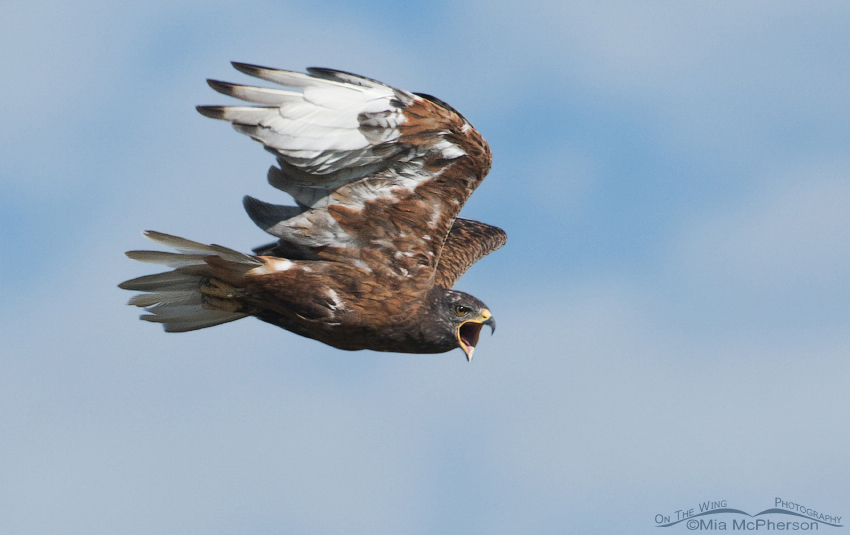
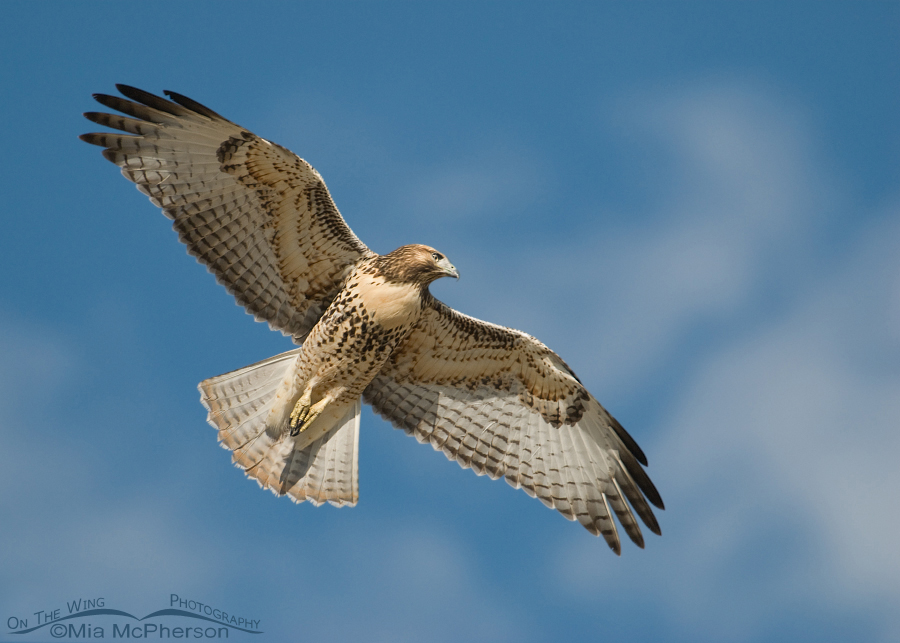
Red-tailed Hawk (Buteo jamaicensis) in flight
Clipped Red-tailed Hawk (Buteo jamaicensis) in flight
Tooele County, Utah
Nikon D200, handheld, f6.3, 1/800, ISO 400, +1.3 EV, Nikkor 200-400mm VR with 1.4x TC at 400mm, natural light, not baited

For the past two days I have been having an amazing time photographing a family of Red-tailed Hawks; including at least 4 juveniles, in Tooele County, Utah which is west of Salt Lake City. Amazing; yes, but also extremely frustrating. The photos are being taken from a road that goes up a canyon, at times the canyon walls are very steep and that can be a problem when the birds are high above you. The hawks were constantly on the move, soaring quickly by or hanging on the currents of air that were warming as the sun rose.

Yesterday a Prairie Falcon joined the family of hawks in aerial manouvers and I truly wish they had been closer because the action was fast, fantastic and utterly mesmerizing. None of the hawk’s seemed aggressive towards the falcon and the falcon wasn’t showing any aggression either.

Because the hawks were very difficult to track when you have a limited range of motion from inside a mobile blind (vehicle) these photos were taken outside the vehicle and they were handheld because there was no time to set up a tripod. None.

Exposure control was also a challenge as the hawks soared in a blue sky with ever increasing clouds or dipped down into the Juniper and grass covered slopes. For shots where the hawks were in the sky some positive exposure compensation was needed and then  a split second later I’d have to try and get the exposure back down to avoid blowing out the lights with the trees and grasses in the background.

Trying to track the fast flying birds while handholding my 200-400mm VR lens with a teleconverter while constantly trying to adjust exposure and keep the hawks in focus was hard. Ok, maybe it was more exasperating than hard. Just know that I am kicking my own rearend tonight for the shots I missed today for one reason or another.

Take the image above, nice clean look at the eye, light under the wings plus on the body and head, wonderful wing position, fanned tail and the exposure worked well. But I clipped the tips of both of the wings! I didn’t crop it that way.

Red-tailed Hawk (Buteo jamaicensis) in flight

Red-tailed Hawk (Buteo jamaicensis) in flight
Tooele County, Utah
Nikon D200, handheld, f6.3, 1/800, ISO 400, +1.3 EV, Nikkor 200-400mm VR with 1.4x TC at 400mm, natural light, not baited

The frame above was the very next frame taken just mere tenths (hundreds) of a second after the image where I clipped the wings of the bird. No clipped wings and this is 94% of the original frame! I could tell I hadn’t clipped anything when I took the shot. Yay!

Again I had light under the wings plus on the body and head, wonderful wing position, fanned tail and the exposure worked well. But… the hawk had already started to turn it’s head and the look at the eye isn’t optimal. Very disappointing.

I wish I had a time machine to go back to this morning and get things exactly right. The exposures, the framing, the tracking and more.

Right now though I think I’ll go find a nice pillow to sit on and give my rearend a break from all the kicking I have been giving it. It deserves a rest.

Mia

I will try working with this Red-tailed Hawk family again soon!

More Red-tailed Hawk images

Facebook Twitter Stumbleupon Digg Delicious Reddit Posterous Pinterest Email

Share

It has only been 4 days? Really?

Clark's Grebe adult

Clark’s Grebe (Aechmorphus clarkii) adult
Salt Lake County, Utah
Nikon D200, f6.3, 1/2000, ISO 400, -0.7 EV, Nikkor 200-400mm VR with 1.4x TC at 400, natural light

I’ve written before about my addiction to bird photography and today I am beginning to have serious withdrawls. For days it has been raining (sometimes hailing), cloudy and a miserable gray here in the Salt Lake Valley though it seems like two weeks to this bird photographer. It has only been four days since I was out to photograph birds.

Oh sure, there have been sucker holes where the blue sky and fluffy white clouds can be seen. For about 10 minutes. When the sucker holes happen I’m tempted to hop into my Jeep and head anywhere there are birds even if it means I only get to shoot 5 minutes before the rain starts again. That probably sounds very odd to a non-bird photographer.  But it is what it is.

Northern Rough-winged Swallow adult in defensive posture

Northern Rough-winged Swallow (Stelgidopteryx serripennis) adult in defensive posture
Jordan River Trail, Salt Lake County, Utah
Nikon D200, f6.3, 1/640, ISO 400, Nikkor 200-400mm VR with 1.4x TC at 400mm, natural light

The withdrawl symptoms are setting in, my shutter button finger is twitching, when I see a bird outside the window my pulse races, I keep looking longingly at my camera mounted on the tripod in the corner of the living room wondering how long it will be before a fine coating of dust settles on it for lack of use.

I’ve been working my tail feathers off trying to keep my mind occupied. It isn’t helping. I’ve also been reading a book but the author keeps mentioning birds in the story and I can’t seem to focus (sorry for the pun). Sure, the rotten weather is giving me time at my desk to edit and cull the images I have already taken though that just seems make this withdrawl affect me more.

Adult Double-crested Cormorant in flight

Adult Double-crested Cormorant (Phalacrocorax auritus) in flight
Salt Lake County, Utah
Nikon D200, f6.3, 1/1000, ISO 400, +0.3 EV, 200-400mm VR with 1.4x TC at 400mm, natural light

I looked at the 10 day weather forecast earlier and saw that this gloomy weather may last until Thursday of next week. That is awful! 

Yes, I am addicted to bird photography.

Mia

Facebook Twitter Stumbleupon Digg Delicious Reddit Posterous Pinterest Email

Share

Argh.. don’t turn!!

Male American Kestrel in flight with a vole

Male American Kestrel in flight with a vole
Davis County, Utah
Nikon D200, f6.3, 1/1600, ISO 400, Nikkor 200-400mm VR with 1.4x TC at 400mm, natural light, not baited, not a set up

In February I wrote a tongue in cheek and slightly serious article titled “So ya think ya want to be a bird photographer?” that explained some of the joys and pitfalls of being a bird photographer and since I wrote that I find myself coming up with new things I would/should add to that article. Maybe sometime in the future I will simply rewrite it to add all my additonal thoughts on the subject.

Yesterday I came across another thing I should add to that post.

Imagine that you come across a male American Kestrel perched on a post with a vole and that you would love to get some images of the little falcon eating the prey. So you drive slowly up to the bird, lens out the window after checking your settings to make sure you have the right depth of field, exposure and shutter speed. You are ready so you creep the vehicle up just a tiny bit closer while holding your breath that the bird doesn’t fly away.

You look through the viewfinder, compose your shot and lock in focus as your finger presses the shutter button halfway down.

You release your breath, relax and start to take images when out of your peripheral vision you see another vehicle at the T intersection of the road, in your mind and quietly outload you mutter “don’t turn, don’t turn, please don’t turn!” because you know the chances are that the vehicle will head your way and startle the bird.

There are times this happens after you have been on the bird for a long time waiting for wonderful action, the best light or for a lift off photo, you’ve had time to check your techs and are sitting there watching the minutes quietly ticking away or; as it happened yesterday, just long enough to get ready to take your shots.

I was fairly certain that the oncoming vehicle would cause the bird to lift off and he did. I mentally prepared myself; in mere tenths of a second, to try for the lift off shots to come.

As the vehicle passed by the kestrel did indeed take flight with his breakfast in his talons. I was able to get three shots off with the bird in the frame and one when the bird had nearly left it, two of those images had the bird’s wings clipped (delete bin), one was a blur (delete bin) and the image above where I had the whole bird, the prey and light in the eye. I got one shot I am happy with.

Yes, the frustrations of being a bird photographer… but I still love being one.

Mia

More American Kestrel images

Facebook Twitter Stumbleupon Digg Delicious Reddit Posterous Pinterest Email

Share