The answer to the Gull and Tern Quiz is…

There were 30 people that voted on this quiz, these were the votes:

Juvenile Western Gull, 1st winter Franklin’s Gull, Elegant Tern: 1 vote (3%)

Juvenile Herring Gull, 1st winter Laughing Gull and Royal Tern: 25 votes (83%)

Juvenile Western Gull, 1st winter Franklin’s Gull, Royal Tern: 3 votes (10%)

Other answer: Clueless LOL = 1 Vote (3%)

The majority of you voted for the correct answer: Juvenile Herring Gull, 1st winter Laughing Gull and Royal Tern

Juvenile Herring GullJuvenile Herring Gull

 The range of Herring Gulls includes Florida as a wintering location. The range of Western Gulls does not extend into to Florida, it is primarily found on the Pacific Coast and it would be a very rare visitor to Florida.

1st winter Laughing Gull1st winter Laughing Gull

Laughing Gulls are found along the Atlantic and Gulf coast year round, Franklin’s Gulls are vagrants to the same area. A 1st Winter Franklin’s Gull would show less brown on the back and upper wings than the bird in the quiz image did and the bill would be smaller.

Royal Tern in breeding plumageRoyal Tern in breeding plumage

Both Royal Terns and Elegant Terns are large crested Terns. The range of the Royal Tern includes Florida as year round residents while Elegant Terns shows them only as vagrants to the East Coast but does not show them in Florida.

You all did great!

Thanks for playing, it was a fun quiz!

Mia

Facebook Twitter

Gull and Tern Quiz

Mystery Gulls and Tern

I came across this image this morning while working up my post Bird images from warmer days and all at 300mm or less and thought it might make a great image for a Bird ID Quiz.
There are three different species of birds in this image, the image was created at Fort De Soto County Park’s north beach in Florida on April 24, 2009. I have supplied three answers to the quiz and only one of them is correct. Get out your bird guide books, check out the images/drawings and geographic ranges and see if you can figure out which answer is correct!

[yop_poll id="1"]

Juvenile Western Gull, 1st winter Franklin’s Gull, Elegant Tern: 1 vote (3%)

Juvenile Herring Gull, 1st winter Laughing Gull and Royal Tern: 25 votes (83%)

Juvenile Western Gull, 1st winter Franklin’s Gull, Royal Tern: 3 votes (10%)

Other answer: Clueless LOL = 1 Vote (3%)

I’ll post the answer on Monday morning! (See the correct answer here)

Mia

Facebook Twitter

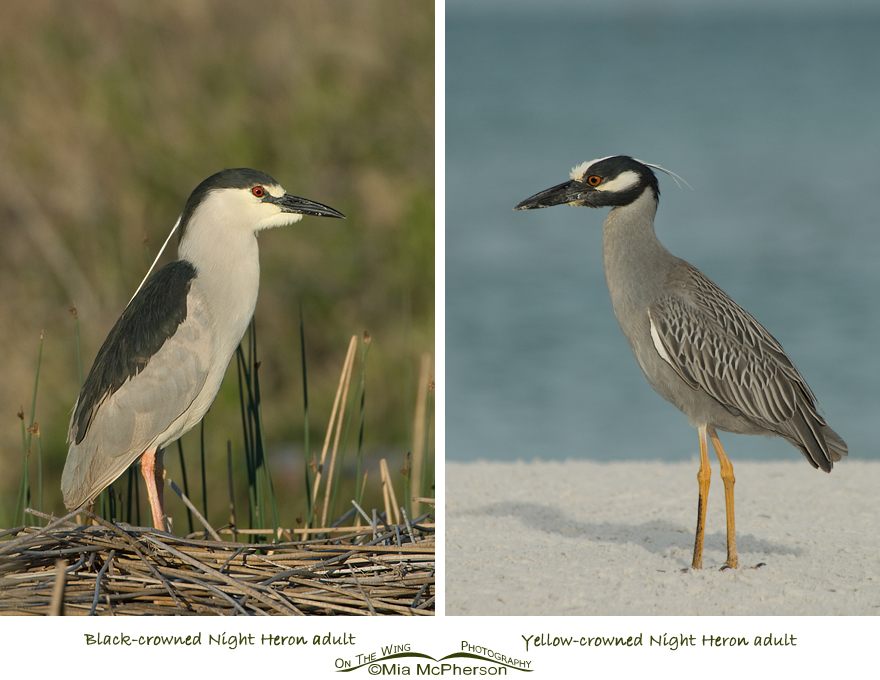
Comparing Black-crowned and Yellow-crowned Night Herons

Black-crowned and Yellow-crowned Night Heron adults

The adult Black-crowned and Yellow-crowned Night Herons aren’t terribly difficult to tell apart though the juveniles can be more of a challenge.

Black-crowned Night Herons have red eyes, a black crown and white plume, a short white to pale gray neck, a very pale gray belly, a solid black back and pale yellow legs that a red during breeding season. Black-crowned Night Herons have a black bill that is shorter and more slender than a Yellow-crowned Night Heron. They appear chunky and squat compared to a Yellow-crowned Night Heron. Yellow-crowned Night Herons have orange-red eyes,  a white crown with a slight yellow tint & white plume, they have a black head with a white cheek patch, a long slender gray neck and belly, a gray back with a pattern and yellow legs. Yellow-crowned Night Herons have a thick black long bill. They appear slender compared to a Black-crowned Night Heron.

Black-crowned and Yellow-crowned Night Heron juveniles

The juveniles are slight more difficult to ID but some features make them easier to identify.

Juvenile Black-crowned Night Herons are chunky and squat like the adults and have short necks. The bill of a juvenile is dark on top and green to yellowish on the bottom, the lores are sometimes a greenish color and the wings have large white spots on a brown back. Juvenile Yellow-crowned Night Herons are slender in appearance and have long slender necks. The bill of a juvenile is mostly black and the back and wings have fine spots and the overall color is darker than a juvenile Black-crowned Night Heron.

Additionally, geographic location should be taken into account when making an identification in that Black-crowned Night Herons have a much larger range that covers most of the United States into southern Canada, Mexico and the Caribbean. Yellow-crowned Night Herons are found mainly on the east coast of the United States, Mexico and the Caribbean.

Mia

Facebook Twitter

The ID of the female duck is…

Two days ago I posted an image of a female duck taken at Farmington Bay Wildlife Management Area in Davis County, Utah and a quiz about her ID here.

Female duck ID

The answer to the ID quiz is a female Green-winged Teal!

Out of 49 people taking the quiz there were 6 votes for Mallard, 8 votes for Blue-winged Teal, 9 votes for Gadwall and 26 votes for Green-winged Teal.

Why I would rule out a female Blue-winged Teal:

A female Blue-winged Teal would have a dark eye line with white arcs, a longer, dark bill and yellowish legs, the female Green-winged will not have the white eye arcs, would have a smaller thinner bill and grayish legs.

Why I would rule out a female Mallard:

A female Mallard would have an orange bill with a dark center and yellowish orange legs, the female I posted has a black bill and grayish legs.

Why I would rule out a female Gadwall:

A female Gadwall has yellow legs, a thin bill that is dark on the top and shows orange on the sides (males have a solid dark bill) and the face of a female Gadwall is lighter in color plus they lack having an eye line. The female I showed has grayish legs, a solidly dark bill and does have an eye line.

My friend Larry said this in a comment on the quiz page:

I love bird quizzes Mia and this is a tough one. I wouldn’t want to give it away in a comment but when I first started birding and asked a more experienced birder how he could tell the female ducks apart he said, “It’s easy! Just look at who she is hanging out with!”

The only male ducks my female was hanging out with were Green-winged Teal drakes, so looking at who she was hanging out with was a great help  when I ID’d her too!

Green-winged Teal drake

Green-winged Teal drake – Nikon D300, f6.3, 1/1600, ISO 640, Nikkor 200-4000mm VR with 1.4x TC at 400mm, natural light

The photo above shows a drake Green-winged Teal in breeding plumage taken on the same day just a few feet away from where the female was photographed.

My thanks to everyone who participated and left your thoughts about the ID of the female duck in your comments. I had fun with this.

Mia

Facebook Twitter

Black Skimmers – Down and dirty

Calling adult Black Skimmer (Rynchops niger)
Calling adult Black Skimmer (Rynchops niger) in breeding plumage
Fort De Soto County Park, Pinellas County, Florida
Nikon D200, handheld, f8, 1/640, Nikkor 80-400mm VR at 400mm, natural light

Anyone who has photographed birds during the month August in Florida knows it is hot and humid even in the early hours of the morning. And it just gets hotter throughout the day. From mid March until November I was always prepared to sweat. And sweat some more.

Part of being addicted to bird photography I suspect. Dedicated bird photographers will endure heat, hunger, extreme cold, blistered feet, numb fingers and much more to get their shots. I’m sure to outsiders we look crazy.

The day I took the images in this post I arrived before sunrise to a light sea fog which burned off rather quickly and after that the heat was on. I wandered around for a bit taking images of shorebirds, egrets and pink fluffy clouds before  I noticed a large mixed flock of gulls, terns and skimmers. As I walked towards them I could see hundreds of birds, some on their way out to go get food and some resting on the sand.

According to my EXIF information It was 7:15 am when I first started photographing where the flock of birds were that morning.

Many yards away from the birds I dropped down to my knees then laid on my belly and slowly sand-crawled within range.  Sand-crawling is not just a way to get closer to your subject it is also low cost dermabrasion for your elbows, tummy feet and any other exposed part of your skin. It probably took me over 10 minutes of wiggling my way forward in the sand to get into a slight depression where I was close enough to the birds and low enough to get the low angle I wanted for my images.

Juvenile Black Skimmer (Rynchops niger) spying on me

Juvenile Black Skimmer (Rynchops niger) spying on me
Fort De Soto County Park, Pinellas County, Florida
Nikon D200, handheld, f7.1, 1/640, ISO 160, Nikkor 80-400mm VR at 340mm, natural light.

I had seen from a distance that there were juveniles in with the adult birds, my plan was to wiggle into that depression and stay put so that I wouldn’t disrupt the young birds or the adults who were flying in to feed them. The safety and well-being of the birds is always uppermost in my mind.

About the only movements I made were to lift my head to the viewfinder, click the shutter button, reach around to my backpack for my bottle of water to sip and to use my bandana to wipe the sweat from my brow.  Long before that day I had learned that if I didn’t move much the birds were likely to come closer to me and they did that day. Dressed in light tans and khaki colors I probably began to look like I was part of the beach. Clearly my sweaty skin had enough sand stuck to it to make me look like something the tide had washed up.

I photographed Forster’s, Sandwich and Royal Terns along with Laughing and Ring-billed Gulls that morning but my main focus was on the Black Skimmers in the large mixed flock. The juvenile skimmers were either laying down on the sand resting or begging  for food when they could see or hear the adults nearby. The image above shows a juvenile moving towards one of its parents to get some food.  This pose and image reminds me of an old magazine cartoon, I think it was called “Spy VS Spy”.  Mad magazine perhaps? Anyway, the pose makes me laugh.

Resting adult Black Skimmer (Rynchops niger)

Resting adult Black Skimmer (Rynchops niger) going out of breeding plumage
Fort De Soto County Park, Pinellas County, Florida
Nikon D200, handheld, f8, 1/500, ISO 160, Nikkor 80-400mm VR at 310mm, natural light

Because I was laying in a slight depression which was below the birds I was able to get very low angle shots. My friends say when my images have such a low angle that I must have been “Down ‘n dirty”.  Well I know for sure I was dirty, I had sand everywhere! And I was laying down.

Black Skimmers are very long birds from the tip of the bill to the end of the tail and it can be quite a challenge to have enough depth of field to get all of the birds in focus, to compose the frame well and then there is the difficulty of properly exposing a black and white bird with orange legs and bill. But they are well worth the troubles to get some nice shots.

Juvenile (L) and adult (R) Black Skimmers (Rynchops niger)

 Juvenile (L) and adult (R) Black Skimmers (Rynchops niger)
Fort De Soto County Park, Pinellas County, Florida
Nikon D200, handheld, f7.1, 1/640, ISO 160, Nikkor 80-400mm VR at 230mm, natural light

Because I had been so still I was rewarded a few times by the birds moving closer to me than I would have approached them like the juvenile and adult bird above. It felt like an honor. My patience and laying still for so long paid off.  I know I took hundreds of Black Skimmer images that morning, some I still have yet to process.

My EXIF information shows that I took my last skimmer image at 9:33 am which means I laid there in the sand and heat for two hours and eighteen minutes photographing those birds and in my mind it was worth every second, all the sand on my skin and the perspiration that at times had burned my eyes.

Maybe I am crazy to be so addicted to bird photography! A good crazy I hope.

Mia

More Black Skimmer images

Facebook Twitter