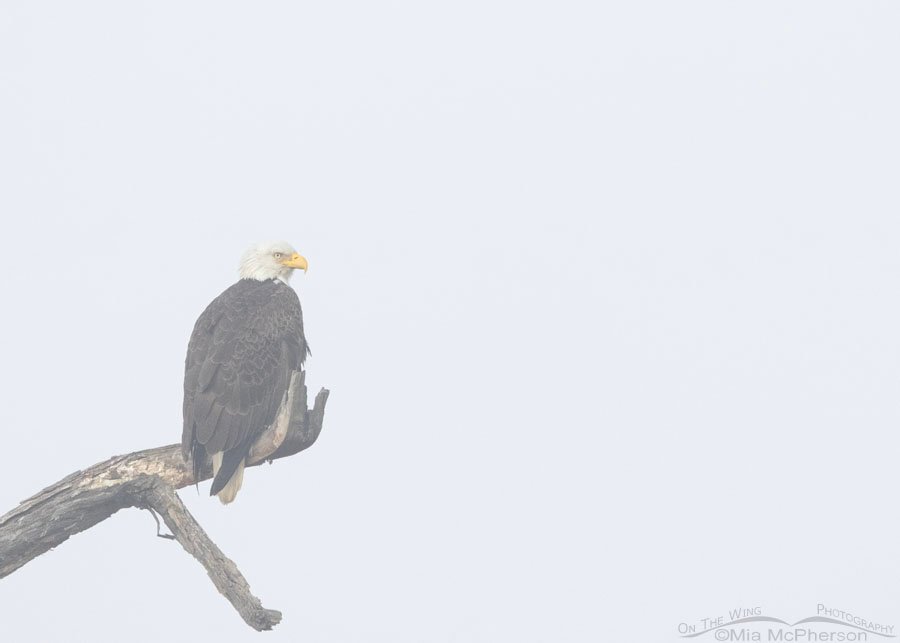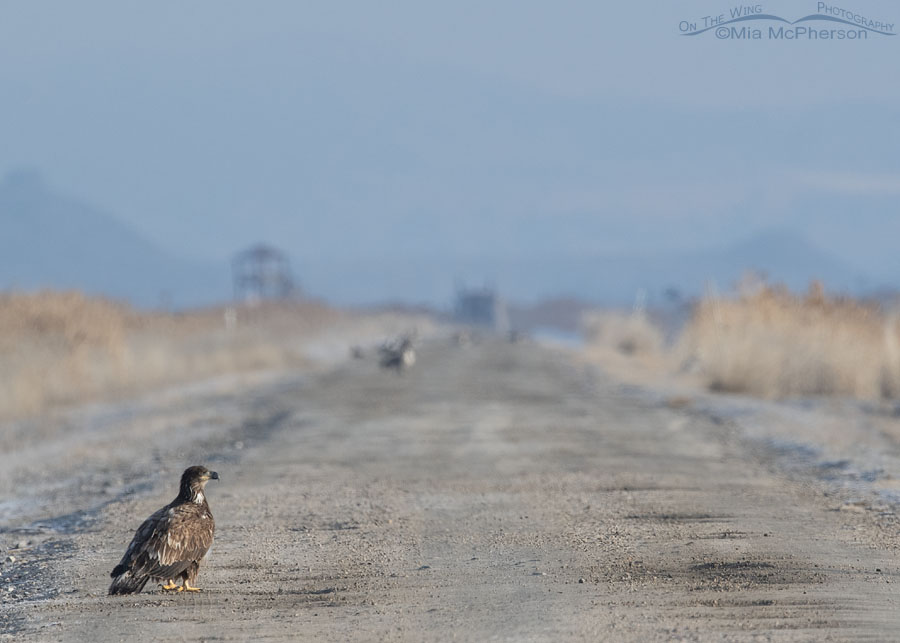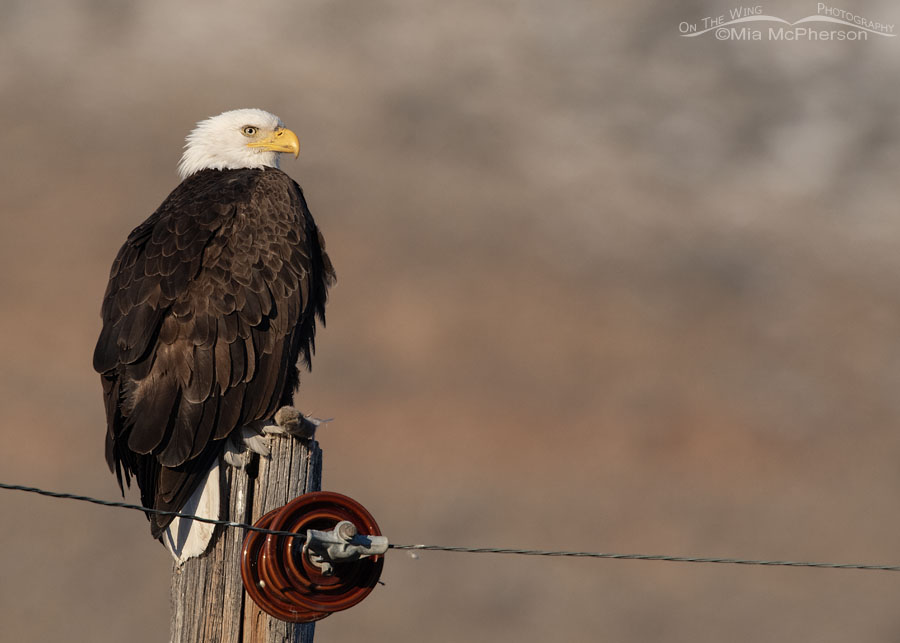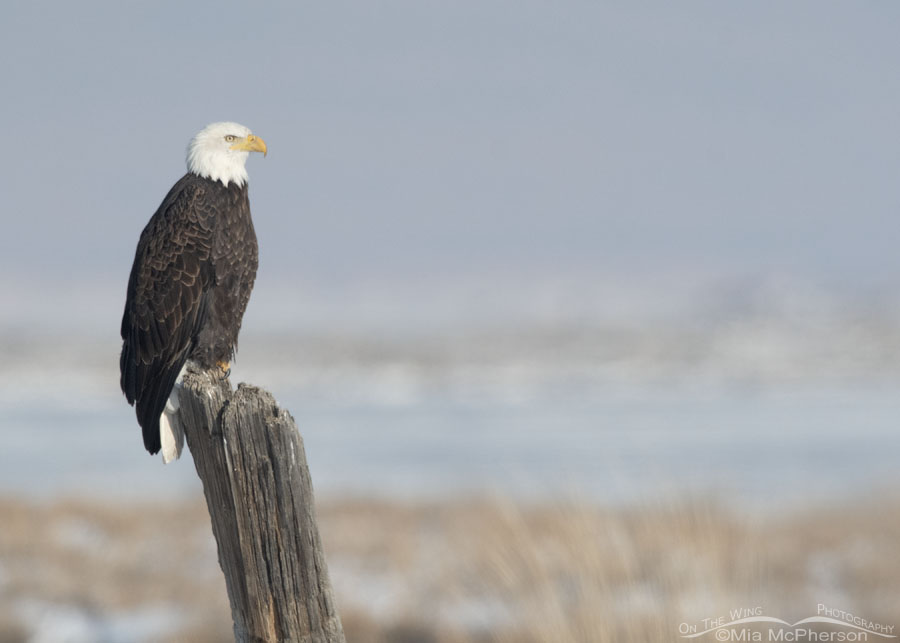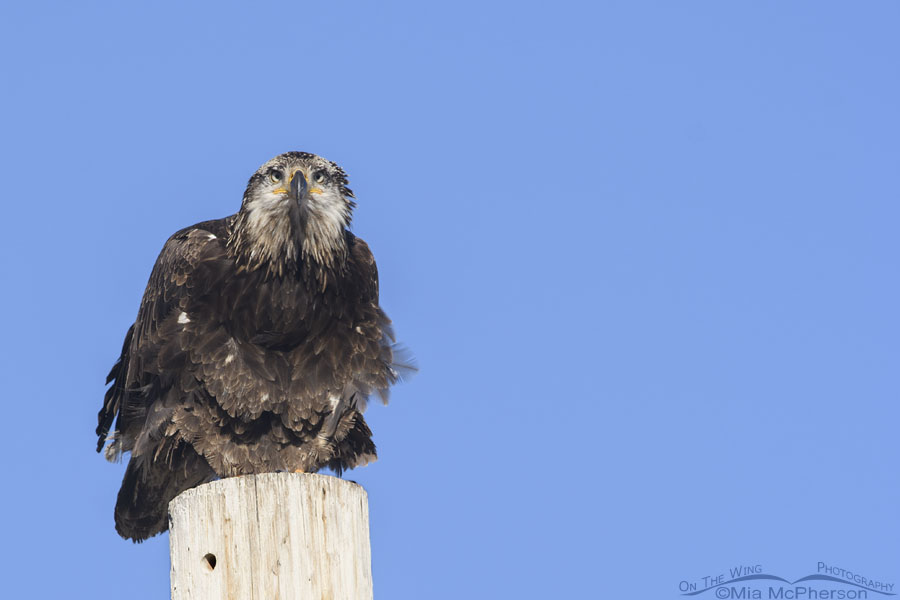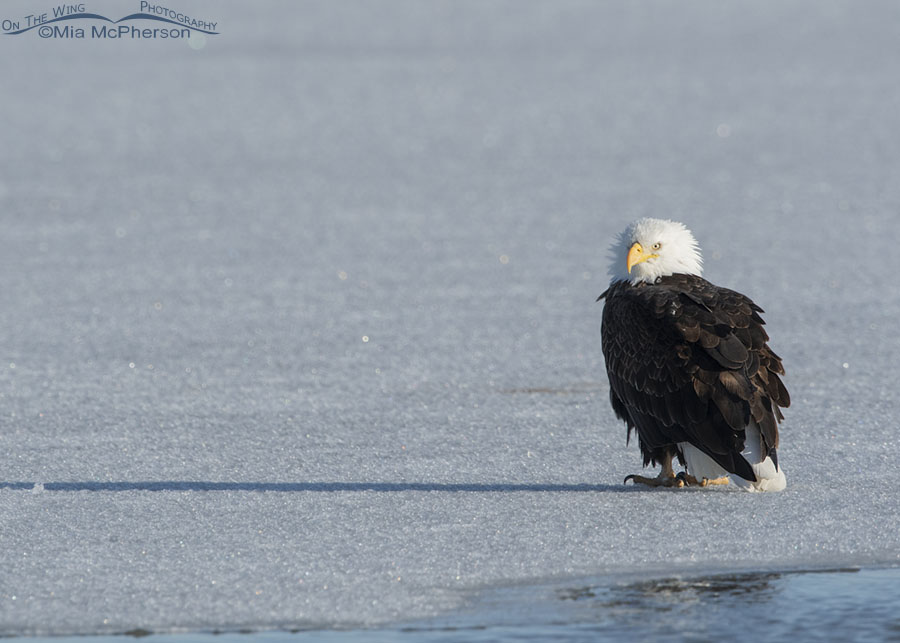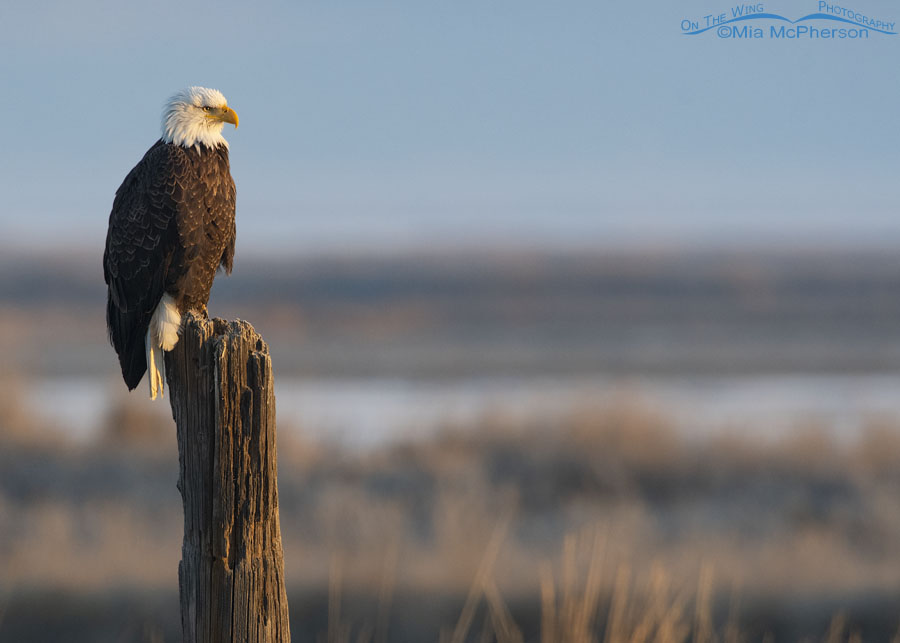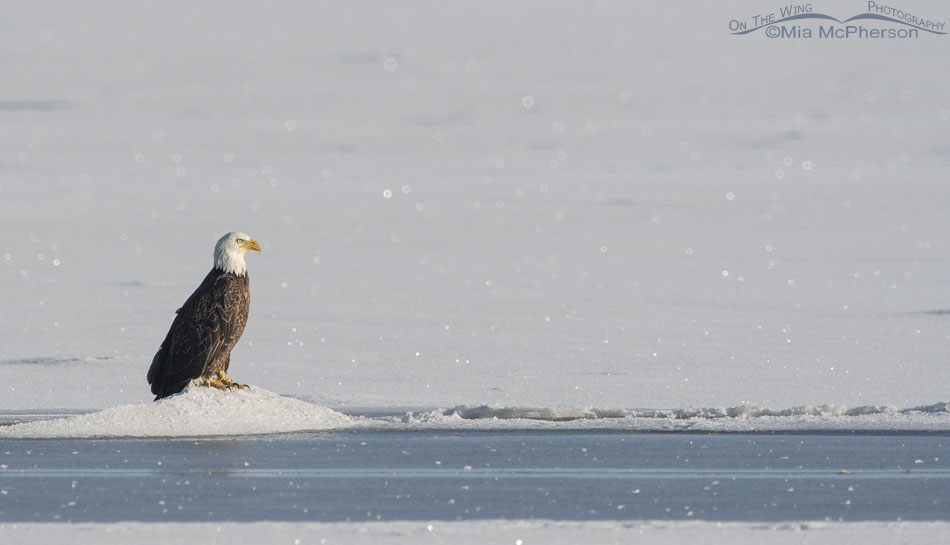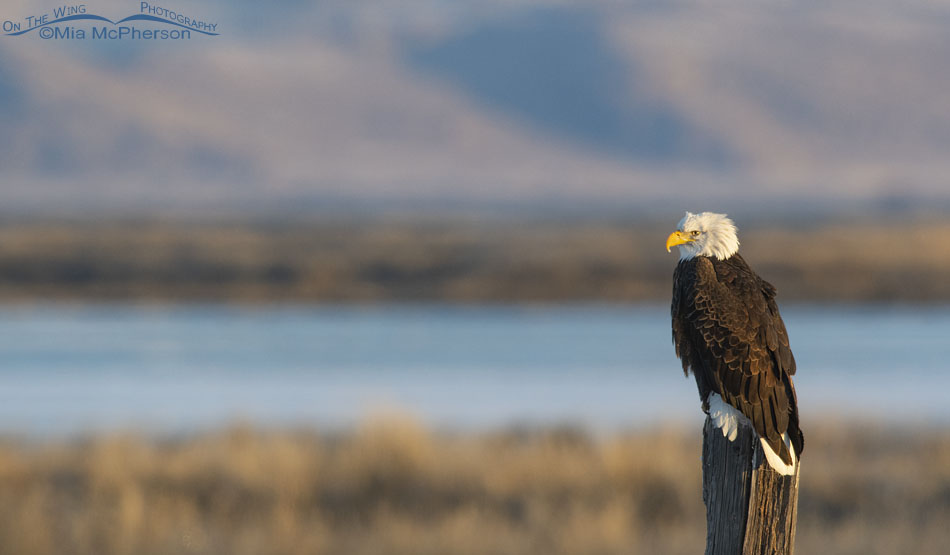

Bald Eagle eating a fish – Nikon D200, f9, 1/320, ISO 250, Nikkor 200-400mm VR with 1.4x TC at 400mm, natural light, bird caught its own prey, not baited
It was the day after Christmas in 2009 when I watched this four year old Bald Eagle lift off from this pole to catch this fish in the water impoundment nearby and to my surprise it flew right back to the same pole to devour it. The Eagle was too far away when it grabbed the fish out of the water to get decent images but it gave us quite a show as it ate the small carp.
It takes about 5 years for a Bald Eagle to obtain its adult plumage and the summer after this was taken the Bald Eagle pictured above would have molted into it.
After this image was taken someone stuck a very ugly, reddish colored bat box on this pole and while I support the action of providing bats with shelter I do wish they had placed it about a foot down from the top of the pole because the bat box is not at all photogenic and the larger raptors like this Bald Eagle don’t use the pole as a perch as frequently as they once did.
Stormy sky over Red Rock Lakes National Wildlife Refuge, Montana
I am a bird, nature and wildlife photographer. I am a nature lover, a citizen scientist, and a lover of the great outdoors. I am fascinated by insects, vertebrates, invertebrates, plants, topography, geology and the unique environments I see and travel to. I am a star watcher. I am a hunter of knowledge about our natural world and a conservationist. I am an advocate who wants to protect the wildlife habitats that the National Wildlife Refuge system contains.
Welcome to Red Rock Lakes National Wildlife Refuge, Montana
I am also a non-consumptive user of the National Wildlife Refuge system who supports the creation of a Wildlife Conservation Stamp which could provide a revenue stream for the National Wildlife Refuges to preserve and protect the existing 560 wildlife refuges and promote the creation of more.
Short-eared Owl at Red Rock Lakes National Wildlife Refuge
A 2011 survey by the U.S. Fish and Wildlife Service counted 71.1 million wildlife watchers in the U.S., and 13.7 million hunters, wildlife watchers and non-consumptive users are increasing whereas the number of hunters are decreasing. The Duck Stamp program can only do so much to provide revenue for the National Wildlife Refuge system and the creation of a Wildlife Refuge Stamp could provide a parallel revenue stream that is needed during this time of budget cuts and austerity.
Pronghorn buck at Red Rock Lakes National Wildlife Refuge
If only a quarter of the 71.1 million wildlife watchers in the U.S. spent $20.00 on a Wildlife Conservation Stamp that could provide a revenue of $568 million dollars. $55 billion dollars each year is spent by wildlife watchers in pursuit of wildlife activities and that is a great benefit to local economies.
Elephant’s Head at Red Rock Lakes National Wildlife Refuge
I am a supporter of the Wildlife Conservation Stamp which could create a community of wildlife watchers, birders, nature photographers, artists and the nature loving general population who share a commitment and passion for wildlife and who want to be proactive in protecting, preserving and maintaining the National Wildlife Refuge System today and for the future for everyone.
Juvenile Swainson’s Hawk at Red Rock Lakes National Wildlife Refuge
Many refuges today do not have adequate funds for operational costs that involve maintenance and administration or educational programs. Without adequate funding programs that reduce invasive species suffer, habitats are not restored or maintained, illegal activities such as poaching rise with less staff to go out into the field and wildlife suffers.
Fish Springs National Wildlife Refuge, Utah
I do not know why it has taken so long for a Wildlife Conservation Stamp to be created. Isn’t it time? Right now when funding cuts are hitting the refuges hard?
Fish Springs National Wildlife Refuge, Utah
The future of our Wildlife Refuges depend on all of us whether we are hunters, anglers, wildlife watchers, birders, nature photographers or nature lovers. A Wildlife Conservation Stamp and the additional revenues could help to save them.
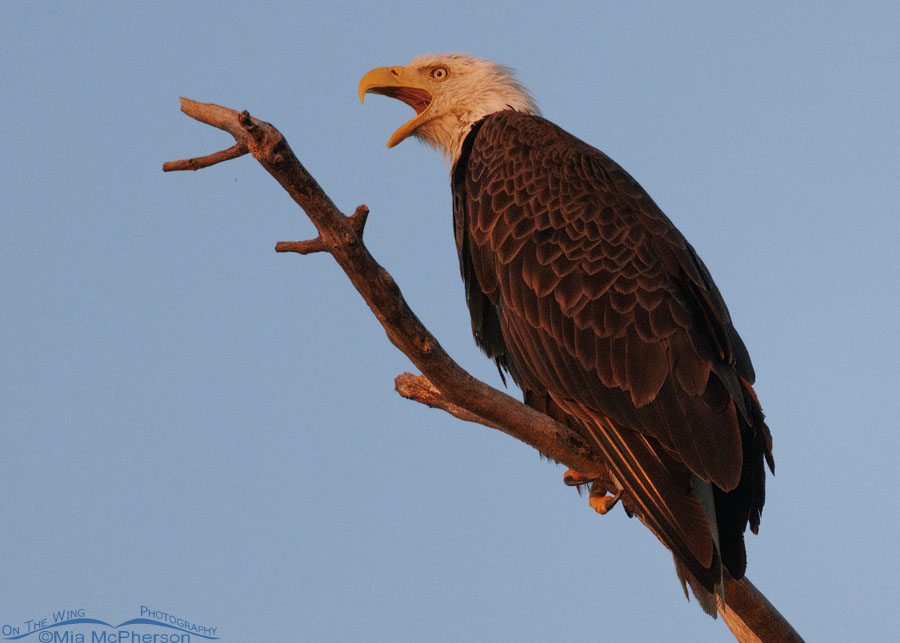
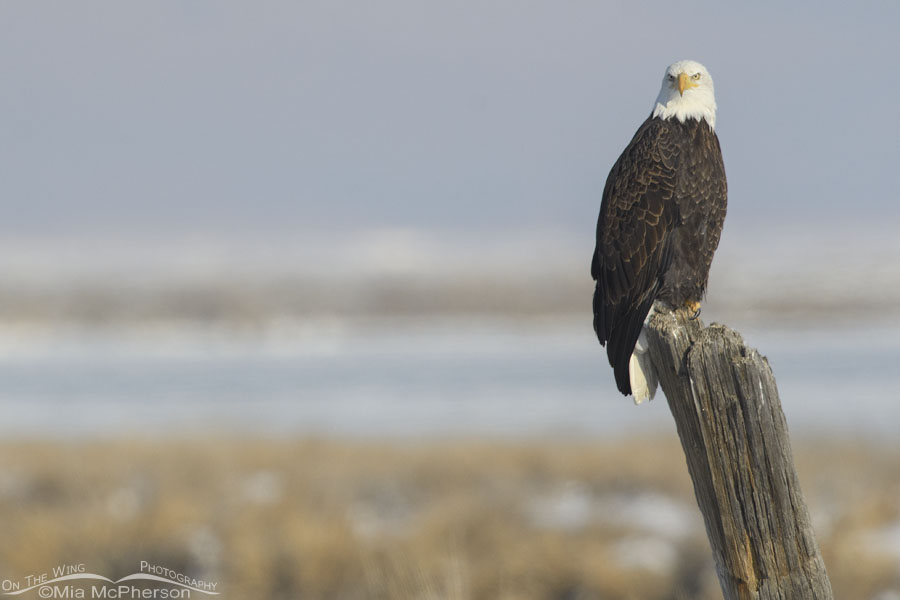
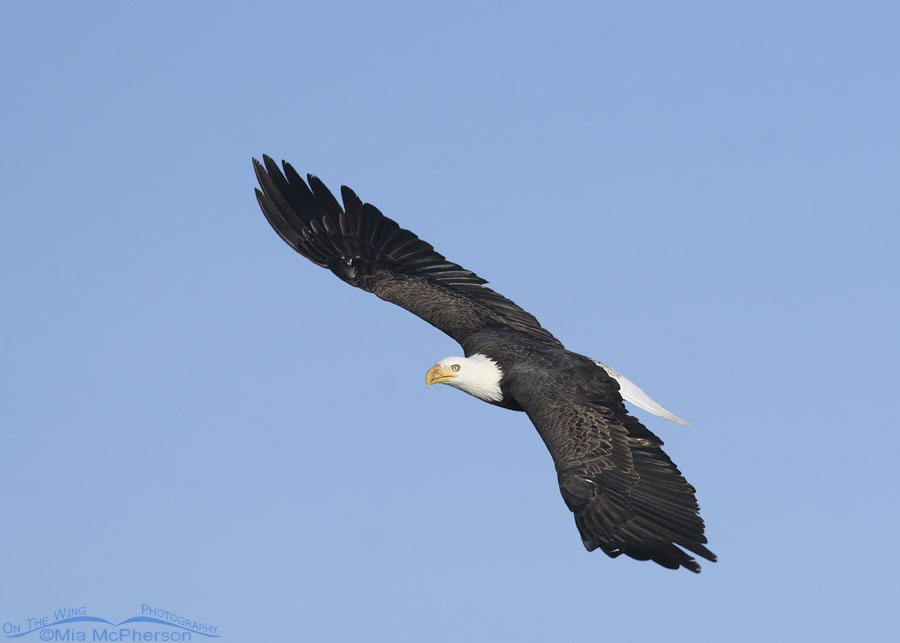
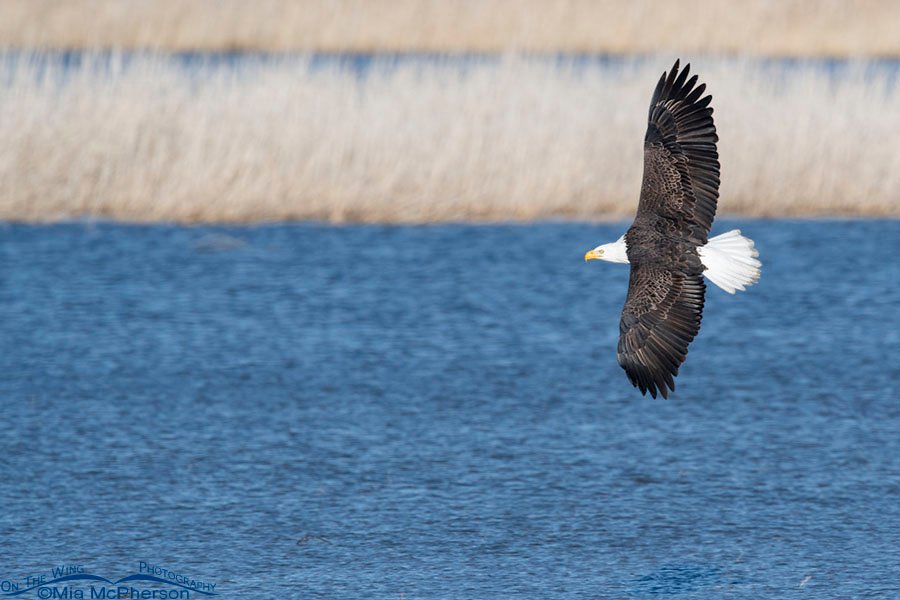
Adult Bald Eagle at Bear River National Wildlife Refuge
Ask birders, photographers, wildlife photographers and wildlife watchers if they think spending $20.00 on a Wildlife Conservation Stamp is too much to help our National Wildlife Refuges and I’m certain that the majority would open their wallets so they can be counted and so their voices can be heard.
Please visit the website for the creation of the Federal Wildlife Conservation Stamp at http://wildlifeconservationstamp.org/the-proposal for more information. If you support the Wildlife Conservation Stamp please leave a comment or send in your bio to the email address on the “About Us” page.
This is a win/win proposal for the National Wildlife Refuge System and for everyone who visits them. For every person who is concerned about the future of out National Wildlife Refuges and for every organization who supports conservation of our public lands and the nation’s wildlife.
Mia
* Think about it, the cost of a Wildlife Conservation Stamp is usually less than the cost of a fast food lunch for a family of four.
Bald Eagle – Small in the frame – Golden Spike National Historic Site, Utah
Yesterday Ron, Brian Gatlin and I went to Bear River National Wildlife Refuge and the Golden Spike National Historic Site area in bad light, falling snow and lake fog looking for birds to photograph and we came up pretty much empty-handed but we did find this adult Bald Eagle perched on some snow-covered rocks going towards the Golden Spike National Historic Site Visitor Center as the snow fell. The eagle was quite a distance away but I loved the rugged habitat so I decided to have the raptor small in the frame rather than over-crop and reduce the image quality. For me the habitat in this frame is as important as the Bald Eagle.
It was about 5 degrees Fahrenheit which was cold for us even photographing from inside a warm vehicle so I imagine the Bald Eagle was cold too.
We didn’t come away with the images that we hoped for but the company was terrific and we all had a great time while surrounded by the beauty of nature.
North section of the Bear River NWR auto tour route – Nikon D200, handheld, f7.1, 1/1500, ISO 400, +1.0 EV, Nikkor 18-200mm VR at 18 mm, natural light
Christmas Day of 2012 turned out to be as beautiful as I hoped at Bear River National Wildlife Refuge (also known as Bear River Migratory Bird Refuge) because of bright skies, snow on the ground and virtually having the place to ourselves. The Promontory Mountains to the west were gorgeous covered in a blanket of fresh snow. Bear River had some open water but there was also ice along the shore and some of the smaller ponds were frozen over. The lowest temp I saw was 6 degrees Fahrenheit but it didn’t feel that cold because of the warmth of the sun.
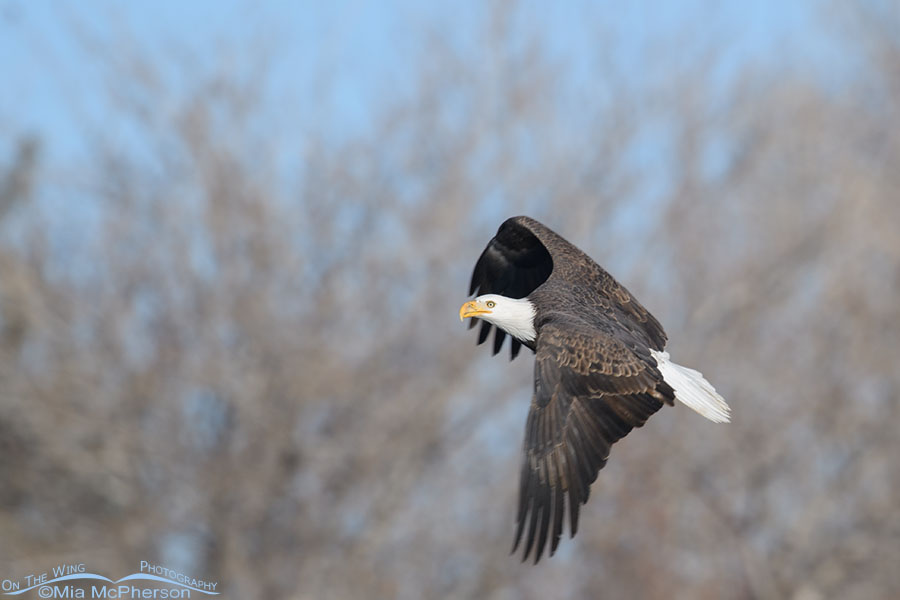
Bald Eagle Landing on the Bear River – Nikon D300, f5.6, 1/3200, ISO 640, +0.3 EV, Nikkor 200-400mm VR with 1.4x TC at 400mm, natural light, not baited
Just before the maintenance buildings at the start of the auto tour route I spotted this Bald Eagle standing on the frozen surface of the Bear River, it looked beautiful in the soft morning light. The eagle was looking at the ice covering the river when it lifted off and flew a few feet towards something that I couldn’t see. This photo was taken as the eagle started to land on the ice once again. Two American White Pelicans lifted off from the river right after the bridge by the maintenance building, they have hung around rather late in the season. Maybe they just didn’t want to be called “snow birds” by the people down south.
Before seeing the Bald Eagle I spotted a Barn Owl flying but the owl would not let us get close enough for images. During the morning at Bear River NWR and north in the Golden Spike Area we saw Bald and Golden Eagles, Rough-legged Hawks, Red-tailed Hawks, Northern Harriers, a Prairie Falcon and quite a few American Kestrels. In addition I spotted two Short-eared Owls flying over a marshy area. Most of these great raptor were just too far away for photos.
Marshes and the distant Promontory Mountains – Nikon D200, handheld, f14, 1/640, ISO 400, +1.0 EV, Nikkor 18-200mm VR at 75mm, natural light
The air was crisp, and the only sounds I could hear when the truck wasn’t moving were the sounds of nature. Rustling Phragmites and Cattails, small birds flitting around and some times further away, the cries of gulls. It was peaceful, relaxing and invigorating all at the same time. What a wonderful Christmas gift.
Young Great Blue Heron on Christmas Day – Nikon D300, f6.3, 1/2000, ISO 640, Nikkor 200-400mm VR with 1.4x TC at 400mm, natural light
On the north section of the very muddy auto route we saw a scattering of around 100 Great Blue Herons, I have never seen so many in an area that size at the refuge. It was pretty amazing to see. right after we headed south I spotted this immature Great Blue Heron standing in a section of open water surrounded by ice, it wasn’t long before the bird flew onto a pile of snow topped vegetation which is where it was when I captured this image.
You might wonder how I know that this is a young bird, the crown is dark and there isn’t any white on top of the head or behind the eye as would be seen on an adult. The rusty colored shoulder patches that adults have aren’t evident and the mottled stripes on the chest of this bird wouldn’t be seen on an adult.
Looking towards Promontory Point – Nikon D200, handheld, f14, 1/320, ISO 400, +1.0 EV, Nikkor 18-200mm VR at 22mm, natural light
After leaving the auto tour route was finally saw another car parked on the shoulder of the hard-topped road and that is where I spotted the first Short-eared owl flying over the marshy area. The driver of the car was out taking photographs so we pulled in a distance behind him to see if the owl would fly in close. The young man came up and introduced himself after a bit. David is from Washington State and it was his first visit to Bear River NWR so we told him what we had seen on the auto tour route and I hope he saw some of the birds we mentioned. It was very nice to have met him.
Bear River NWR and the Golden Spike area are always wonderful but yesterday both seemed even more fantastic.
The port of Burnie, Tasmania – Christmas Eve day 2007
Yesterday I took a stroll down memory lane, actually I looked for images I have taken either on Christmas Eve or Christmas Day in my files but in a way that is taking a stroll down memory lane.
In 2007 I was onboard a cruise ship crossing Bass Straight from Melbourne Australia to dock in Burnie, Tasmania. Even though it is summer during Christmas in the Southern Hemisphere Tasmania is far enough south for it to be cool. The water was such a deep royal blue that I wanted to jump ship just to feel it on my skin. I went inland from Burnie on Christmas Eve to visit a rehab facility for animals and birds, many of them were native but a few exotics stuck out, like Water Buffalo, Camels and different types of deer.
I loved seeing Tasmanian Devils, Quolls, Black Swans, Wallaby, Wombat, Kangaroos and Emus. Ok, maybe not the Emus so much but that was because when I was taking a photo of a Wallaby an Emu snuck up and pecked the UV filter on my lens and scared the snot out of me. Imagine all of a sudden seeing a huge beak and two big eyes through your viewfinder as the beak crashes into the glass! I am just glad I had the UV filter attached otherwise it would have been expensive glass that got beaked.
After getting back on board ship we headed out to make the crossing to the South Island of New Zealand across the Tasman Sea and spent Christmas Day on the open water.
A foggy Christmas Day 2008 – Roseate Spoonbill
Christmas Day of 2007 started off very foggy at Fort De Soto County Park’s north beach. Fort De Soto is open on Christmas day which I adored because quite often I would have the north beach to myself. It was a time to soak in the beauty, to relax and reflect on the year that was coming to a close. The friends I had made. The sights I had seen. And the birds of Florida that enchanted me.
The light wasn’t the best when I photographed this Roseate Spoonbill foraging in the tidal lagoon north of the foot bridge but I kept the file any way as a reminder of Christmas all by myself sitting in the waters of the lagoon surrounded by Wood Storks and Roseates.
Snow (sand) Man – Florida Style 2008
Floridians don’t let the lack of snow stop them from creating the Florida Snowman out of the white sugary sand found at Fort De Soto. This one is decorated with a Sea Urchin on its head, a Mangrove seed pod as a staff and a Leopard Crab as pet. Ingenuity, yes, that is what it is.
Six months after Christmas I made my mind up to leave Florida and move back out west, the west had called to me softly for years while I lived in Florida. The mountains, the big sky, four seasons, snow, fall colors and wide open spaces. After Christmas the western U.S. wasn’t calling to me softly, it was talking long and loud.
A Regal Bald Eagle – Christmas Day 2009
Christmas of 2009 found me in the state of Utah. I had mountains, 4 seasons, plenty of birds, big skies, deserts, plains, gorges, marshes, lakes, rivers, valleys and plenty of Red Rocks. AND I had the Great Salt Lake close by!
I made new friends and felt a wonderful peace wash over me. I was back where I belong. In the west. Because of my photography I have met the most fascinating people in real life and those who have become friends over the internet that share my interests in nature, birds and photography.
Christmas Day 2009 started foggy at Farmington Bay Waterfowl Management Area in Davis County, Utah. The sun wouldn’t give up though and it broke through the fog to allow me to get close up images of a majestic 4-year-old Bald Eagle perched on an old post.
Spending time with a best friend in nature is the best Christmas present to me.
Common Merganser – Christmas day 2010
Christmas Day of 2010 came and it was spent again at Farmington Bay Waterfowl Management Area photographing Pied-billed Grebes, Ruddy Ducks and this Common Merganser. The water looked golden because the dried stalks of Phragmites were reflected on it. We pretty much had the place to ourselves for the first few hours. Yes, that is Peace on Earth to me.
Male Northern Harrier in flight – Christmas Eve day 2011
Christmas Eve day of 2011 was spent on Antelope Island State Park and while the island wasn’t all that birdy or critter the causeway had some Northern Harrier action going on as we went to leave. The “Gray Ghost” was hunting near the shoreline of the Great Salt Lake with the snow-covered Wasatch Mountain Range in the background.
What will Christmas Day 2012 bring? I don’t know for sure but it is going to be a white one and I’ll be spending time in nature enjoying the companionship of a best friend. I can’t ask for a better gift. So while other people are just starting their day and opening their presents I’ll already be enjoying mine.